| บ้านของเรา |
| เกี่ยวกับเรา |
| โปรแกรมท่องเที่ยว |
| ติดต่อเรา |
| ขั้นตอนการจองทัวร์ |
| ประวัติอุ้มผาง |
| แผนที่และการเดินทาง |
| เพื่อนบ้าน |
| ข้อควรปฎิบัติเมื่อเข้าพื้นที่ |
| สมุดเยี่ยม |
 |
| บริการรถท้องถิ่นนำเที่ยวอุ้มผาง |
The Karen Hilltribe people
Karen women are skilled in sewing and dyeing, and dress in white blouse-sarong combinations with colorful patterns or beads for trim. They wear their long hair tied back in a bun and covered with white scarves. The Karen are gentle, peaceful, and cooperative people, who, like all the Hill tribes, reserve their highest veneration for their ancestors and living elders. The Karen
There is
soulfulness in the eyes of many Karen, rooted perhaps in their legend
that their culture was once great, but is now (temporarily) in decline.
They believe they once had a written language which somehow disappeared,
however, through neglect on their part. Some small groups of Karen also
believe in a Messiah figure that will one day lead them back to
greatness. The Karen, (called
Kaliang, or Yang in Thai) are found along most of the length of the
Thai-Burmese border. Their population is at least 300,000 in Thailand,
making them much the most populous hilltribe here. They have also lived
in this area for far longer then the other hilltribes. Over 200 years is
probable, and perhaps much longer than that. There are over
four million Karen in Burma, where a group of them have been fighting
for their independence for 50 years. They inhabit many areas of western
Thailand, and can be divided into several sub-groups, including the
Padaung, the famous 'long-neck' people whose women traditionally wear
many tight brass rings around their necks. The most numerous groups in
Thailand are the Sgaw Karen, followed by the Pwo.
Sources:
Tribal Museum, Ratchamankala Park, Chiang Mai, 2000, research by Chiang
Mai University The
steady process of development Development is a process, not a goal. The
traditional Pwo Karen hilltribe farmers in the mountainous Sop Moei area
along Thailand’s northwestern border with Burma are an example of the
way the world’s remote societies are shrinking. The last 20 years of
development activities in this area is an inspiring example of the
process of true development, starting from the traditional way of life,
facing new problems in a changing world and meeting the needs.
The
traditional form of agriculture for these hill people was rotational
‘slash and burn’ (or swidden agriculture), which meant a village
would farm rice on a hillside for just one or two seasons before moving
to another area. This allowed for a long fallow period (10-15 years),
when the land would regain its nutrients before being used again.
Over
the last 30-40 years this natural balance in Sop Moei has changed.
Population growth remained at 2-3%, but all available land became
occupied, which meant increased pressure on the land as fallow periods
became shorter. Insufficient fallow periods meant that the soil was not
able to regain its fertility, and more and more forest was being
‘slashed and burnt’, resulting in increased environmental
degradation and human malnutrition.
To alleviate an emerging health crisis, not to mention environmental degradation, Kent set about making a permanent use terraced rice farm, like the ones used in the low lands, which could be used every year and with higher rice yields. Local farmers watched Kent's terraced farm for eight years before one farmer asked him how to develop one for himself. Subsistence farmers around the world are very cautious about new methods, as they live on the edge of existence from year to year. Any changes could mean disaster for the family, so new methods are approached with caution. Once the first farmer adopted the method, others could see that rice was grown year after year on the same hillside, and soon started to follow. The farmers were assisted with a small loan, in order to hire the initial help needed to make the terraces, which the farmer would then pay back over 3 years. The next step was to increase soil fertility of the terraced padi farms which weren't producing as much yield as the padi farms in the lowlands. Chemical fertilizers could increase fertility but they were expensive, unsustainable and transportation was a problem. In addition, due to steep slopes or lack of water for canal irrigation not all families could make terrace farms. So what could these families do to increase their food security? Brendon Irvine, with an agricultural background, arrived in the early 90s with his family to concentrate on finding answers to these problems. Through research and experimentation, Brendon found that a nitrogen fixing water fern called Azolla was best suited to the situation, as it was easy to use, and fast growing. Azolla was actually used on rice padi farms hundreds of years ago in China, but has since been lost in Southeast Asia. Soon all the terrace farmers were reporting increased yields, some up to 46% from using this Azolla 'green manure' water fern. The next step in the development process was to meet the needs of other diet deficiencies such as protein. Brendon established example plots to experiment with a variety of legumes and other crops that could be grown during the dry season. The best legume was a small red cowpea that grew so fast it out-competed weeds, was easy to harvest, could be dried and stored and had a nice flavor. Garlic, which is widely used in the local diet and can be readily sold, was also grown. Over the years Brendon continued to experiment with the local farmers who took an active part in the experiments and recommendations, as they could see the potential benefits and commitment of Kent and Brendon's families to their needs. The non-threatening example plot method meant farmers could watch and wait to see the success and adopt whatever method best suited their needs. Karen Hilltribe friend Group funded this sustainable agriculture project.
The Karen LanguageKaren language along with their origins, has long puzzled linguists and other social scientists. Unlike most of the other ethnic groups which migrated to Thailand during the last century, their language and culture shows no obvious Chinese influence. Karen language is generally classified in the Karennic sub-group of the Tibeto-Burman language family. It is a smooth, rolling language sometimes referred to as the French of Asia.
|
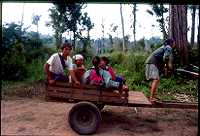 The
Karen (Kariang, Yang) like to settle in foothills, and live in bamboo
houses raised on stilts, beneath which live their domestic animals: pigs,
chickens, and buffaloes. They, like all the tribes, are skilled farmers
who practice crop rotation, and they also hunt for game, with spears and
crossbows, and use tame elephants to help them clear land.
The
Karen (Kariang, Yang) like to settle in foothills, and live in bamboo
houses raised on stilts, beneath which live their domestic animals: pigs,
chickens, and buffaloes. They, like all the tribes, are skilled farmers
who practice crop rotation, and they also hunt for game, with spears and
crossbows, and use tame elephants to help them clear land.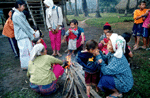 ‘We
are the ‘blank’ people’, said a Karen man, interviewed about his
culture. The Karen are a gentle, reserved, warm and elegant people.
Their culture is rich in legend and tradition, their customs complex,
deep and strictly adhered to. They have a strong belief in sexual
morality, and severe punishments for those who break their laws. They
are the only ethnic group in northern Thailand who have a tradition of
growing paddy rice in the valleys, and are the most productive farmers.
‘We
are the ‘blank’ people’, said a Karen man, interviewed about his
culture. The Karen are a gentle, reserved, warm and elegant people.
Their culture is rich in legend and tradition, their customs complex,
deep and strictly adhered to. They have a strong belief in sexual
morality, and severe punishments for those who break their laws. They
are the only ethnic group in northern Thailand who have a tradition of
growing paddy rice in the valleys, and are the most productive farmers. 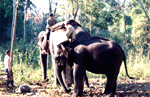 The
Karen costume for women is very attractive and distinctive. Unmarried
girls wear loose white V-necked blouses, decorated with Jobs tear seeds
at the seams. Married women wear blouses and skirts in bold colours,
predominantly red or blue. Men wear blue baggy trousers with red or blue
shirts, a simplified version of the women’s blouses. Black Karen men
wear black shirts with a red cummerbund or head scarf.
The
Karen costume for women is very attractive and distinctive. Unmarried
girls wear loose white V-necked blouses, decorated with Jobs tear seeds
at the seams. Married women wear blouses and skirts in bold colours,
predominantly red or blue. Men wear blue baggy trousers with red or blue
shirts, a simplified version of the women’s blouses. Black Karen men
wear black shirts with a red cummerbund or head scarf. 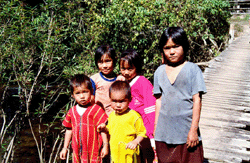 Pwo
Karen cultural laws regarding the correct way to live with nature are
exemplified by the expression (translated) “Live with the water, care
for the river… Live with the trees, care for the forest.” This
saying is of central importance in directing the relationship between
humans and nature. The traditional relationship between the community
and nature is demonstrated in traditional folk tales and the
conservation of a community forest near every village. This old-growth
community forest is for village utilization and protection. It provides
cool shade for people and animals, it is where children learn to hunt
and play, and is used for village ceremonies. Low population density
(2-10 people/square km) meant that apart from the farmed land, half of
the land belonging to the village could be left as old forest, important
for wild animals (protein), building materials (bamboo, and leaf for
roofing), and collecting wild vegetables and fruits.
Pwo
Karen cultural laws regarding the correct way to live with nature are
exemplified by the expression (translated) “Live with the water, care
for the river… Live with the trees, care for the forest.” This
saying is of central importance in directing the relationship between
humans and nature. The traditional relationship between the community
and nature is demonstrated in traditional folk tales and the
conservation of a community forest near every village. This old-growth
community forest is for village utilization and protection. It provides
cool shade for people and animals, it is where children learn to hunt
and play, and is used for village ceremonies. Low population density
(2-10 people/square km) meant that apart from the farmed land, half of
the land belonging to the village could be left as old forest, important
for wild animals (protein), building materials (bamboo, and leaf for
roofing), and collecting wild vegetables and fruits.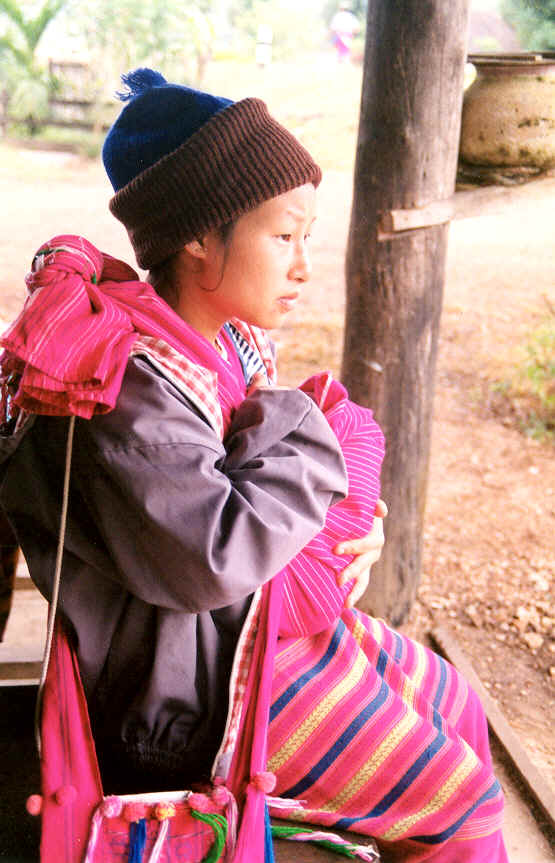 In
1978 a young couple (Kent Gregory and family) from Loma Linda University
arrived in Sop Moei to conduct a public health project. In those days
access was on foot or by elephant, and even today many villages are
still inaccessible by 4WD. They soon began to realize that many of the
health problems facing the Pwo Karen (not Karen refugees from Burma)
were malnutrition related, especially in children. Infant mortality
began to increase due to decreasing rice yields and protein deficiency
from forest loss.
In
1978 a young couple (Kent Gregory and family) from Loma Linda University
arrived in Sop Moei to conduct a public health project. In those days
access was on foot or by elephant, and even today many villages are
still inaccessible by 4WD. They soon began to realize that many of the
health problems facing the Pwo Karen (not Karen refugees from Burma)
were malnutrition related, especially in children. Infant mortality
began to increase due to decreasing rice yields and protein deficiency
from forest loss.  As
the farmers were starting to grow enough crops to sustain their dietary
needs, Kent began a project aimed at women’s income generation. The
cash economy was starting to make inroads into the area and as with many
other places, women have proved that they handle money better to the
benefit of the children and family. Utilizing the traditional weaving
skills of the Pwo Karen women, and to a lesser extent the basketry
skills of the men, Kent established a self supporting business of
international high quality silk textiles and fine basketry which brings
income into the Sop Moei communities. Fabrics are often transported out
by elephant, and the income to these remote communities is having a
significant impact as the cash economy becomes more important.
As
the farmers were starting to grow enough crops to sustain their dietary
needs, Kent began a project aimed at women’s income generation. The
cash economy was starting to make inroads into the area and as with many
other places, women have proved that they handle money better to the
benefit of the children and family. Utilizing the traditional weaving
skills of the Pwo Karen women, and to a lesser extent the basketry
skills of the men, Kent established a self supporting business of
international high quality silk textiles and fine basketry which brings
income into the Sop Moei communities. Fabrics are often transported out
by elephant, and the income to these remote communities is having a
significant impact as the cash economy becomes more important.