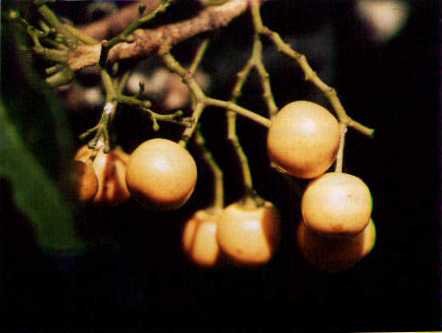
Funnily enough, though there is a whole range of flower colours from light to dark red/pink, there are only two fruit colours, white or red.
On this page you can find pictures of the white variant.
| Puriri fruit is usually bright red, but occasionally you'll find a tree with white fruit on it. This white fruit only occurs on trees with white flowers. Funnily enough, though there is a whole range of flower colours from light to dark red/pink, there are only two fruit colours, white or red. On this page you can find pictures of the white variant. |
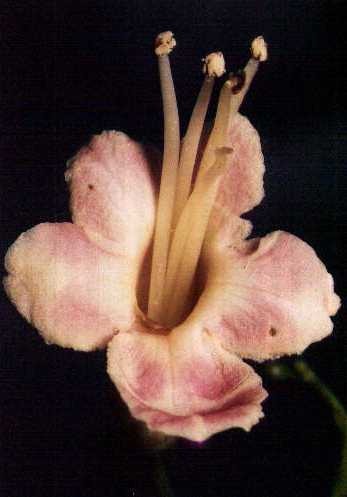 A white puriri flower in close-up. | 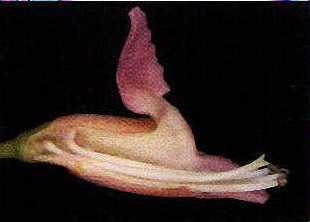 This cross-section of a more traditional pink flower shows some of the important features. The stigma (female part that receives pollen) sits on top of the ovary (that eventually grow into the seed) at the base of the flower. Around the ovary are nectar producing glands that can produce so much nectar that the liquid fills the entire flower and drips out the end. This really only occurs in parts of New Zealand where there aren't enough honey eating birds to keep sampling all the flowers. Unfortunately, large parts of New Zealand have very few native birds left. The nectar is protected by a fine net of hairs, not sure if you can see them in the base of the flower. The hairs keep insects away from the nectar, but are not strong enough to keep a birds beak and brush-tipped tongue out. |
As the bird probes the flower for nectar the anthers (pollen sacks) at the tips of the stamen touch the bird on it's head leaving some pollen behind on it's feathers. This pollen is carried to different flowers, hopefully on different trees, and picked up by mature stigma (female part). So, the birds are the pollinating agents for puriri, they carry the pollen from flower to flower.