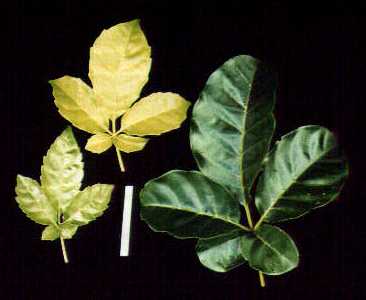
This is what is meant by palmate leaves. The leaves look just like the fingers on a hand. All the leaflets originate from a central point.
Leaves of different aged trees have quite different leaf forms.
From left to right;
- the flat thin tender leaf of a seedling. The edges are also quite serrated (like a breadknife).
- In the middle is a leaf of an older seedling, the serrations are less and the leaf undulates more.
- The leaf on the right is from a mature tree, it is very thick and leathery, has no
serrations and is very wavy.
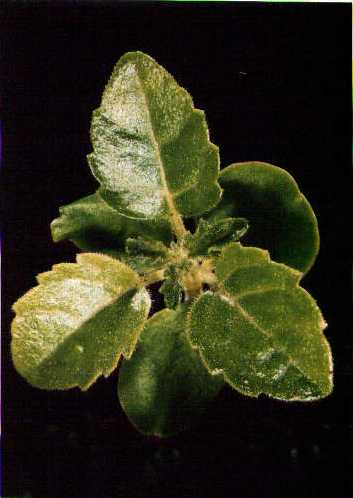
Usually puriri throws out pairs of leaves, but this seedling produced triplets of leaves until it reached about 60 cm in height. Producing triplets was more common than I expected. About 1% of the seedlings had triplet leaves.