Battle of Britain Day
"For Red Tobin, of 609, 'it was the toughest day we had...a terrific battle over London.' Red shot at a Me. 109, 'One of the yellow-nose boys'; then, after sending a Dornier down south of the city, he saw 'a Spitfire...spinning down on fire. I sure hope it wasn't Jeff (Gaunt, one of his best friends), and if it was - well - from now on he'll be flying in clearer sky.' In this, as in all battles, the tragic and the comic went hand in hand: while Jeff (for it was he) was crashing to his death, part of a shattered Dornier, noted 609's diarist, 'reached the ground just outside a Pimlico public house, to the great confort anf joy of the patrons."
September 15, 1940, dawned a bright, slightly misty, early autumn morning. But by noon that day about 100 German bombers were flying in a 10-mile front over north Kent, heading for London. Flying to intercept them, were nine RAF Squadrons.
Reg Hewitt, who was just 14 and lived with his family in Castle Farm Cottages in Redmans Lane near Lullingstone Castle, Eynsford, remembers the day vividly.
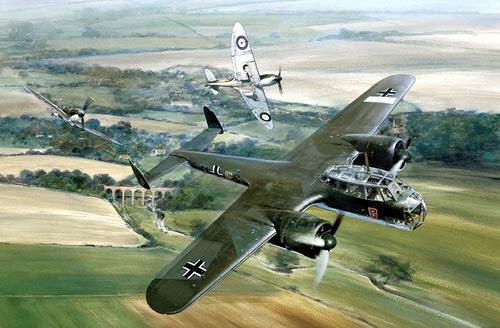
As individual dogfights developed between German and British planes, one Dornier was attacked and hit by two Spitfires flown by Flying Officer John Dundas and Pilot Officer Eugene �Red� Tobin from 609 Squadron (both killed later on in the war) and the German crew prepared for a crash landing.
�My mother and I were in the back garden near the shed when a man, who had walked along the footpath from Shoreham, came down the road by the cottage and shouted �Look out madam, there�s a plane coming down�,� Mr Hewitt said.
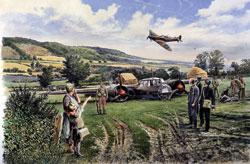
They ran indoors and heard a plane fly past the cottage very low. �As soon as it had gone, I ran outside and, with the man and a neighbour, ran up the bank opposite intending to run across the field and up the hill to where we could see the plane had crashed.� By the time Mr Hewitt got to the scene lots of others had also arrived, including members of the local Home Guard.