
SOLIDARITY NETWORK
By Lauren Anzaldo
First, though, we wanted to express our outrage to the United States Consulate General for Palestine. We were furious that our tax money was funding the atrocities we'd witnessed, and, as Dr. Nabil reminded us, this would be our opportunity to speak directly to someone influential in that decision and its consequences. As U.S. citizens, we were supposedly represented by the Consulate General, and we'd been told all of our lives that the U.S. is a democracy of, by and for the people.
The ridiculousness of this idea became clear shortly into our meeting with Jeff Beals, a staff member of the U.S. Consulate General's office in West Jerusalem. Our first clue that we weren't being taken seriously was that the Consulate General himself didn't talk with us. Ironically, Gabe had joked that, if Arafat could find the time to see us, it would be a shame if our own Consulate couldn't. Another clue: Used to Palestinian generosity and hospitality, we were flabbergasted when Beals told us that we would be served no refreshments but that we were free to help ourselves to water from the fountain in the hallway. We also noticed that, although he said he would write a report on the meeting, Beals took virtually no notes of what we said to him over a two-hour period.
Beals began the meeting by explaining to us the role of the Consulate's office. The consulate functions like a foreign embassy, but, because embassies are relegated only to states, the Palestinian Authority has a consulate. It is charged with conveying U.S. policy to the Palestinian leadership and, in turn, conveying Palestinian realities to U.S. rulers. The office reports to the U.S. the progress of Palestinian leaders in enacting changes required under the roadmap. It also publishes two important annual reports: the Human Rights Report and the International Religious Freedoms Report, both available on the State Department website. I said sarcastically that, based on what I'd seen in Palestine so far, the human rights report must be at least four inches thick. "The latest report was 65 pages, and that's quite a bit," Beals informed me. Joe later commented that he could write a 200-page report from his experiences over five days.
Beals then told us what is required of Palestine and Israel under the roadmap. The Palestinian Authority is expected to reform its economic and security systems, to consolidate its security services and to fix alleged corruption in the way it pays its police. Beals told us that there has been some success: police officers' paychecks are now deposited directly into bank accounts, instead of distributed in cash, which he said was sometimes stolen by police captains. It was later mentioned by us that Israeli soldiers also stole money from Palestinians: $9 million, in fact, was taken from two banks in Ramallah. Trust, then, might be an obstacle to Palestine cooperating more fully with Israel.
Under the roadmap, Israel is supposed to improve humanitarian conditions for Palestinians by dismantling settlements and removing certain checkpoints. Except in isolated instances, Israel has failed to do this. Beals conceded that, even when checkoints are removed, they are often just moved to a nearby location. In other words, Israel has not demonstrated that it is a real partner for peace, yet it is Arafat and not Sharon with whom the U.S. refuses to negotiate. Beals couldn't justify that rationale for us.
In fact, throughout our discussion, he had difficulty backing up with reason any of the U.S.'s policy on the Israel-Palestine Conflict. He certainly tried. He gave us the official version of things -- Israel's "right to defend itself," the Wall as a security measure, the U.S. as an "honest broker for peace" -- but none of it jibed with what we'd seen or our own basic sense of right and wrong. This just proved what I'd already learned: that the Israel-first argument collapses under the slightest scrutiny, yet people still cling to it.
About the Wall, Beals analogized, "If you and your family were inside your house and an armed mob was outside trying to break in, you'd certainly want to build a barrier to keep them out." To this, Joe replied, "But imagine if you were in your home, and it was demolished and your entire family killed." Still, Beals insisted that the U.S. opposes the Wall and has instructed Israel not spend the foreign aid it receives out of U.S. taxpayers' pockets to build the Wall or purchase the military equipment used for extrajudicial executions (aka assassinations). Of course, encouraging someone not to spend money on state terrorism and actually holding that person responsible for not spending the money on tools of terror are two entirely different things.
This was the crux of the argument we presented to Beals: We don't want our money -- money that could be used on education, social programs, health care -- strengthening the fourth-largest military in the world. That money should, at the very least, be tied to compliance with UN resolutions. Shamair confided to Beals that she was baffled by the logic of giving Israel -- a known human-rights violator that has been condemned by Amnesty International, B'tselem and other respected human-rights organizations -- free reign to use U.S. tax money however it likes.
Seeing how upset we were at the U.S.'s support of Israel, Beals cautioned us not to focus solely on the U.S.'s role in the conflict. "You must remember that this conflict did not begin with America," he said. "This is a conflict between Israel and the Palestinians. If America were to disappear tomorrow, this conflict would continue in the same manner that it has all along." To this, I responded, "You can't be so naive as to actually believe that. Even ignoring America's role in supporting the establishment of Israel in 1948 or in vetoing UN resolutions, we all know that Israel could not sustain its military operations without U.S. funding." Fadi, a Palestinian-American who had joined us for the meeting, also brought up Bush's letter assuring Sharon that he needn't worry about the right of return or a two-state border based on the 1967 armistice line, known as the Green Line. Bolstered by the U.S., Israel has no reason to ease up on Palestine, and this certainly works to perpetuate the conflict.
The U.S., of course, is very careful not to tread too heavily on Israel's toes because of its desire to keep Israel as a partner in the Middle East. Beals called this "the strategic alliance" between the U.S. and Israel, yet he tried to convince us that this alliance doesn't bias the U.S. toward Israel in the peace process. "The Palestinian Authority has always had the right to turn down any agreement presented to it. In fact, Arafat has done this in the past," Beals assured us. Yes, Arafat has done that and then has been lambasted for refusing "a very generous offer." "Issues such as the right of return and borders are up to the two parties to settle in final-status negotiations," Beals said. But getting a fair shake at that is easier said than done for the Palestinians, who have practically no power at the bargaining table and will probably be forced to cave to Israel's demands on these precious points. We weren't buying any of Beals' rhetoric.
To wrap up the session, Beals told us that, in taking his position with the State Department, he'd agreed to represent and support U.S. policy. No kidding? We hadn't noticed. So much for influencing this guy and trying to make changes in the system. Still, Dr. Nabil soothed us by telling us that Beals had told him afterward that ours was the best meeting he'd had. "You impressed him with your knowledge," Dr. Nabil said. "He expected some kids who don't know anything, and he was surprised by you."
I welcomed the encouraging words, but they didn't go very far to quell the nausea in my stomach as I pondered the powerful alliance between the U.S. and Israel. As we left Jerusalem for the village of Biddu, where residents are engaged in a nonviolent struggle for their lives and livelihoods being confiscated by the Wall, the U.S.-Israel alliance was illustrated for us in the form of an Israeli flag superimposed over an American flag flying on a car. Israel is perhaps the only place on the planet where people display more national flags than Americans.
Since our talk with Beals had taken two hours, we were running late to Biddu, and the visit was very rushed. We met Mansur, one of the local coordinators with the International Solidarity Movement (ISM), and Huwaida, a co-founder of ISM, at the municipal building. They told us about the situation in Biddu. Like many other villages where Israel is building the Apartheid Wall, Biddu is losing much of its farmland, which will lie on the opposite side of the Wall and will be virtually inaccessible to the villagers. The Wall will take almost 90% of Palestinian land in the region northwest of Jerusalem, where Biddu is located.
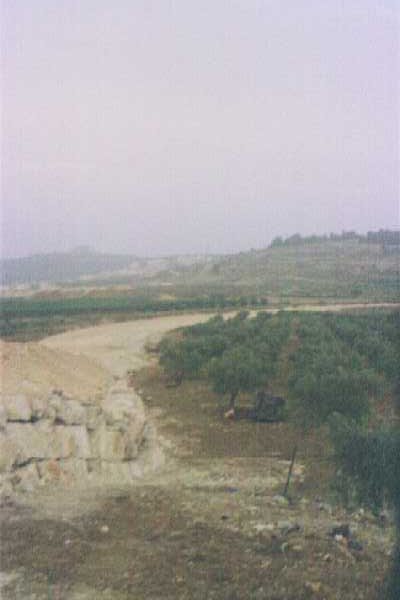
Safety in Biddu is fleeting. Since Wall construction began there in 2003, villagers, with sympathetic Israelis and international activists, have engaged in several forms of resistance. They have appealed to Israeli courts to stop construction and generated a petition. (Notably, the petition was signed by Israelis living at a nearby settlement who fear that the Wall will increase Palestinian frustration and militance.) Palestinians, Israelis and internationals also hold regular nonviolent protests at the Wall site. The Israeli Occupation
As we clearly saw, the fight against the Wall is a fight for survival, and Palestinians prefer to die fighting than to remain passive. Unfortunately, the struggle in Biddu -- and in all of Palestine -- goes unnoticed by most of the outside world. Israel tries its best to keep the Palestinians isolated from internationals and Israelis, and other countries do little to pressure Israel to stop slaughtering and assaulting Palestinians and to obey UN resolutions. While we were in Biddu, Mansur gave each of us a copy of a typed press release titled "An appeal to the international community" from the village's Popular Committee Against the Wall. The appeal concluded with words of appreciation "to all the people who have joined us in resisting this Wall, especially the International Solidarity Movement and Israeli peace groups, who are our true partners in establishing a just and lasting peace."
As much as I would've liked to have stayed to talk more with the villagers about their strategies for stopping the Wall, we had to hurry back to make it through the Qalandia checkpoint into Ramallah before the Israeli soldiers closed it at 9 p.m. We thanked our hosts and pledged our support.
Read more about the nonviolent resistance in Biddu