
SOLIDARITY NETWORK
By Joe Aldridge
Everyone began to exit the plane, and our group was split up due to the number of people disembarking from the plane and the spacing out of our seats. After exiting the plane, I stood outside for a moment to see if anyone else from our group was coming. The others that had come out of the plane on my side were the youth, and they had all gathered together as we waited for the next shuttle to bring us to the main terminal. I was approached by a male airport security guard who asked to see my passport. Upon inspection, he noticed a stamp from Saudi Arabia and began to question me about my reasons for being in Israel, the nature of my trip, my religious affiliation, and the reason for visiting Saudi. I answered his questions as he asked them, and we were soon joined by another airport security guard who took the passport and asked the same questions with minor variations. Again I answered them and, since I was holding up the shuttle to the main terminal, they told me I could go, and I thought that was the end of the questioning.
However, when I got to the main terminal and met with Matt, one of the members of our group, I was again pulled aside by the female security guard who had questioned me outside. Matt was pulled aside, as well, by a different pair. I was again questioned about my visit to Israel, but this time the questions took on a more personal tone. Upon hearing that I had converted to Islam and went to Saudi Arabia for Hajj, a pilgrimage incumbent upon all Muslims, the security guard began to question not only my religious affiliation but also the religion of my parents, my reasons for converting, the occupation of my parents, and a variety of other questions. They wanted to know why I had chosen to come to Israel at this time, where I was staying, the cost of the ticket, the nature of the trip, why I hadn't chosen Judaism instead of Islam, and a more intense questioning pertaining to my religious affiliation. When they were through with their questioning and satisfied with my answers and those that Matt gave, they allowed us both to get back into the customs line. Interestingly enough, the first individual to approach us as we waited in line was an Orthodox Jew who explained how he went to the United States on a regular basis and was questioned each time by airport security.
After our conversation with the Jewish gentlemen and as we waited for the line to proceed, I took a few moments to look around the airport terminal. Despite the questioning about the timing of my visit and comments about how tourism was not wise considering the current conflict between Israel and Palestine, there was an abundance of Jewish youth and visitors waiting in the lines next to us. Many of them were obviously of European descent while others could have passed for Middle Eastern. There were large groups of students who were most likely part of the Birthright Israel campaign in which Israel sponsors Jews from anywhere in the world to come to Israel. I also noticed the advertisements in Hebrew, the similarity of all the airport staff, and the time it took for individuals who did not appear to be Jewish to get through the passport stamping. When we got to the front of the line, Matt and I presented our passports to the agents behind the window and waited as they were checked. A member of the Israeli airport security approached the agents at the window and spoke in Hebrew. When the stamping was done, we were told to see the security personnel who were making the final checks before the luggage claim.
Matt and I were again pulled aside, this time with very little commentary, and told to wait as our passports were taken. We waited with our carry-on luggage for about ten minutes before we were approached and told we could claim our luggage and that we had to return. Considering that they had our passports, we had little choice but to comply, so we got our luggage and returned. We waited another 10 minutes and were ignored as people passed and the airport security talked amongst themselves. We were not told for what purpose we were pulled aside, what we were supposed to do, or when we would get our passports again. A few other individuals were also waiting, apparently in the same position. We were finally told to bring our luggage and to follow one of the airport security personnel to a room. We were told to stand outside a door with the other individuals who had been waiting as we were taken individually into a room where luggage was being searched and swabbed. They took our luggage and brought it into a back room, apparently for X-ray, and we waited with a bit of confusion since we had been told nothing except to hand over our luggage. I noticed several other people in a similar predicament, and I struck up a conversation with one of them. He was obviously of Middle Eastern descent, spoke Arabic and was waiting in the same area we were. His questions went unanswered whenever he inquired about his luggage. I asked him his nationality. He explained that he was a Palestinian and that each time he came to the airport, he underwent the same procedure. I glanced around and noticed that everyone else in the room also appeared to be of Arab descent.
As we talked, our luggage was brought out from the back room and rolled out the door to several tables. Two females in their early 20s then opened every piece of our luggage and passed a cloth over everything inside and outside. After swabbing an area, they would disappear back into the room for a minute, then reappear and continue the swabbing. I realized they were checking for traces of chemicals while also doing a visual inspection. The several attempts I made to start up a conversation didn't go well, but I tried to inject some humor into the situation. They continued to swab and check our luggage as we waited, standing idly by as the two females conversed in Hebrew. I noticed another individual standing nearby and, out of curiosity, asked if he was Palestinian. He said that he was and another man standing nearby said he wasn't Palestinian but he was Muslim. When it was time for us to leave, one of the men I was speaking to gave me his contact information and told me to contact him if I needed anything.
When Matt and I finally made it out of the airport, we met with our group members, who were relieved since the entire incident took roughly an hour. We got into a bus and began to head toward Ramallah. Our road trip took us through very mountainous area, some of which was populated, but mostly the land was barren. Nabil Abuznaid, who had organized the trip and would serve as our guide to Palestine, pointed out along the way various Palestinian villages, Israeli settlements, and explained the history of the conflict and some of what we would experience during our trip. Forty-five minutes later, we arrived at the road to Ramallah and were greeted by Israeli soldiers who barely seemed old enough to be out of high school manning a checkpoint, each carrying an M-16. One of them, a female soldier, had "100% Bitch"� written in marker on the back of her uniform.
Anyone entering of leaving Ramallah was subject to questioning by the soldiers. We noticed long lines of Palestinians waiting to cross the checkpoint and many taxis on both sides, waiting for passengers to be brought to their destinations. Those who had cars sat in a line that crept forward at a snail's pace as the soldiers checked each car or chatted idly as the cars waited. Our American passports allowed us to pass through the checkpoint relatively quickly, yet Palestinians who lived in the village were treated like criminals, even when they were doing nothing more than attempting to return to their own homes. It wouldn't be until later in the trip that we would realize the extent the checkpoints and soldiers impaired the ability of Palestinians to lead a normal life. As we drove past the checkpoint, we could see a portion of Israel's "security wall"� being built around the city that would further restrict movement and encompass the Palestinians in a concrete cage. Despite Israel's claim that the wall was for security, it dipped into Ramallah, and the Palestinians were separated from their land and subject to constant humiliation despite the fact that the city offered no access to Israel.
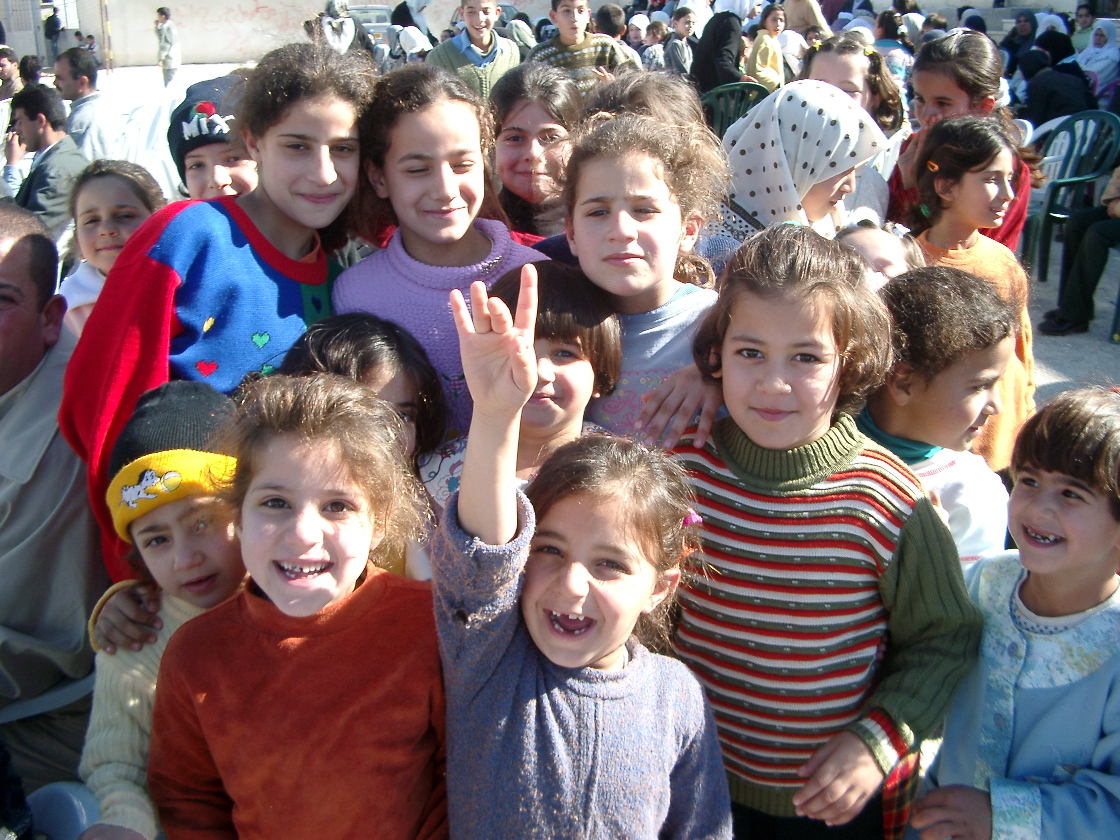
We drove down rickety roads that weren't paved and saw kids playing in alleys, in dirt areas and, in general, wherever they could. We could see the results of the incursions into the city by the Israeli military. Partially destroyed buildings, bullet holes, children playing in rubble, and military outposts were common sights. Yasser Arafat's compound was visible as we passed, and we could see the destruction inflicted upon it by the Israeli tanks and missiles during the siege that took place roughly a year ago. A sole Palestinian flag could be seen flying above the compound. Navigating through the streets, our driver finally pulled up to our hotel, and we were all relieved to get out and stretch.
We had a breathtaking view of the Palestinian countryside and the rolling hills that we would become so familiar with on our trip. As we waited for our rooms to be readied, I noticed two small boys in a field across from the hotel digging in the dirt. A few of our group walked over and attempted to communicate with them. Having studied Arabic, I tried to talk with them, but it was difficult to ask that questions that I wanted to since I had learned a formal style of Arabic and they were speaking a Palestinian-Syrian dialect. We managed to ask, through gestures and my horribly broken Arabic, what they were doing. They showed us Israeli bullets they had found while digging and presented them to us to see. Upon closer inspection, I realized many of them were unfired and the number they had found indicated that there were a great number of them in the area. As we introduced ourselves and took pictures, another group of young boys approached us. By this time, Fuad, a member of our group who spoke Arabic fluently, had joined us and was able to translate. We learned that they all lived close by, had seen the Israeli army inside the city on various occasions, and went to school. They knew about death, the army, the checkpoints and explained how they would throw stones at the tanks as they passed by before returning to their soccer games. We left them to go back to our hotel where we took showers and then went to dinner.
At dinner, we had fish and a mixture of other foods. We discussed a variety of issues and met several other Palestinians. After dinner, we decided to go out, so we took a cab downtown and walked around Ramallah. The city itself was busy, the Palestinians cordial and inviting, and the atmosphere welcoming. We were able to walk through the streets with no fear for our security and, despite not knowing our religious affiliation and it being obvious we weren't from the area, we were not given even a dirty look from anyone. We bought ice cream from a shop and sour cherries from a street vendor as we headed down the road. We decided to go to a nargeela restaurant where we all sat in conversation and smoked hookahs. We eventually returned to our hotel and began to settle in for the night. I reflected on the Palestinian situation and their reaction to Israeli aggression.
As a people, Palestinians try to live normal lives despite soldiers, checkpoints, and the systematic stealing of their land. They hang out, they laugh, they joke around with each other, they open and close stores, play soccer, flirt with girls, try to live normal lives. The only difference was that just a few miles away was the fourth-largest military in the world threatening to throw them off their land, destroy their homes and replace them with illegal settlers and settlements. However, the Palestinians continue to live their everyday lives and simply refuse to give up until they get what they rightfully deserve: freedom and a homeland. It becomes more apparent daily that the Palestinian issue is not simply a political one. It is the struggle of a people to attain basic rights we in the United States take for granted: life, liberty, and the pursuit of happiness.