
SOLIDARITY NETWORK
By Gabe Pendas
After quietly stumbling into the van, we were on our way to Qalqilya. I wasn�t sure what to expect. We had already been informed of Qalqilya being one of the towns in the West Bank that has been completely surrounded by Israel�s new �security� wall. It seemed that in every conversation we had overheard since we�ve been here concerning the wall, Qalqilya was always mentioned. We would soon find out why.
Upon arriving at the only entrance for the town, we were immediately asked to pull over to the side by the Israeli soldiers stationed there. Most of us in the van were confused as to what was going. We�d gotten used to just going through most checkpoints because of the Israeli license plates on our van and the American passports in our pockets.
After waiting inside the van for 10 minutes or so, most of us began to trickle out of the vehicle to see what was happening. Walking up to the checkpoint, I was amazed at the diversity of transportation being used to get into or out of Qalqilya. It wasn�t just the usual taxi cabs and buses, but you had carts being pulled by donkeys as well, which was the first time in my life I had seen such a thing. It was like being taken back a few hundred years until of course you realize that there is a soldier with an M16 slung over his shoulder yelling at you to stop taking pictures.
As we waited for the soldiers to get approval from their local command to let us into the city, I began to wander around while some members of the group presented their point of view about the conflict to an Israeli soldier. He went on to inform us that Americans "don�t know shit" and that we have no right to comment on their situation since we�re off doing much worse to Iraq and Afghanistan. I continued taking pictures discretely and noticed a sign right above me that informed Israeli citizens that they were prohibited from entering the town of Qalqilya. While pondering why it would be so bad to have Israelis visit here, the Qalqilya representative from the Palestinian Legislative Council and members of the mayor's office drove up to plead with the soldiers to let us in. Finally, after almost an hour, we got the approval we sought and were on our way.
The drive took no less than five minutes, and we found ourselves in the front of the local offices for the Palestinian Liberation Organization (PLO) and the Palestinian Authority (PA). After taking the usual few pictures, I walked inside and up some stairs till I found myself in the Deputy Governors office staring at a picture of Yasir Arafat and other Palestinians, whom we were later told were martyrs from the early days of the occupation. In the office we were introduced to various officials, given some coffee and juices, and had a discussion with the deputy governor about the politics involved in the occupation.
Once our talk was over, we were rushed out of the door in order to stay on schedule and hopped into our taxi. On our way to our next destination, I had the chance to take in the town as we drove through its streets. I was struck at how many closed shops we saw and remembered that we learned yesterday that 600 out of the 1800 businesses had closed in Qalqilya, since the wall was constructed, and that the unemployment rate is now at approximately 67%.
The closed shops and homes soon gave way to fields and shacks as we approached the outskirts of the town. There we became privy to our second close-up view of the wall. Except this time it wasn�t a wall at all but an electrified fence with heavy barbwire on both sides and a sentry tower in the immediate background. These sentry towers are these quite tall cylindrical concrete objects that are located every 300 meters along the wall and have a number of snipers posted inside.
After some discussion on this particular gate, we hopped back into our vans and traveled to another area of Qalqilya. There again we were greeted by the wall. Except this time, immediately in front of us we saw row after row of crops that a local farmer had planted. This drove home the fact that nearly half of Qalqilya�s agricultural land is located outside Israel�s wall. I couldn�t help but wonder how much land this particular farmer had lost.
We got back into our taxi and drove a few more miles into yet another side of the town surrounded by the wall. Yet here we encountered one of the three agricultural gates Israel constructed to allow local farmers to access there land lost by the walls construction. However, one of these gates has never opened and one has been closed since October 4, 2003, denying 280 families access to their crops. Only one gate operates regularly, opening three times a day for farmers who have Israeli permits to access their land, however even this gate is randomly closed. Last year, during the harvest season between October 4-20, 2003, no agricultural gates were opened.
Perhaps one of my most vivid memories is my first look at the wall surrounding the agricultural gate. Gone was the sadness imposed by its dreary grey color. It was instead replaced by three huge Palestinian flags surrounded on all sides by graffiti of different colors in different languages. My favorite was the ever whimsical �Sharon, Cabron� (For those not familiar with the Spanish language, cabron is not the most pleasant word to use when commenting about an individual). This, to me, is obviously one of the many ways in which the people of Qalqilya openly resisted the destruction this was wall was bringing to their everyday life. Although the paintings would never in themselves take down the wall, they were a way to show that the Wall would never be accepted there as it is. The graffiti was a way to show that the people here had not given in to their imprisonment.
Taking our last few pictures, we hopped back into our taxi and drove to the Mayor�s office. His office was considerably nicer compared to the deputy governor's office, and upon our arrival we were once again treated to coffee and juices. He sat us down around a table surrounded by executive chairs and gave us this elaborate PowerPoint presentation about the situation facing the people of Qalqilya. The one fact which has been stuck in my mind since the presentation was that, before the construction of the wall, 12% of the inhabitants of Qalqilya believed in violence as a viable tactic in resisting the occupation. Since the completion of the wall, that number has more than doubled to 26%. This, of course, leaves the possibility open that perhaps Israel is creating more suicide bombers then it�s preventing, by its security wall.
Upon the completion of the Mayor�s presentation, we left his office and walked two buildings down. The sign above the entrance told us that this was the local chamber of commerce. I remember thinking, "Shit, this has got to be a tough place to work at now." Once I finally walked into our meeting room, I was greeted not just by the faces of those officials who had been with us the whole time but the faces of student leaders at the local university who represented the different political factions there.
Sitting down at the table and looking over the variety of students that sat before us, I distinctly remembered my leg shaking up and down as my excitement grew. Finally, we had a chance to talk to students. Not that it wasn�t cool as hell talking to the different officials or politicians, but it was absolutely refreshing to see the faces of folks our age. Now, I thought, we are going to get some real education.
I was under the firm belief -- and still am -- that, in order to obtain a good grasp on any situation, you have to talk to those on the ground that are actually doing the work, not those in charge. This is why, in a lot of ways, this was a significant part of the trip for me. Now I had someone I could relate to. These weren�t unreachable political officials. These were kids just like me and the rest of our group. Our meeting with them brought the conflict to a much more personal level.
When the students began talking about the difficulties they had attending classes because of the impenetrable checkpoints, I thought how difficult it would be for me to have to face that lack of freedom. When they told me that they would never give up no matter how hard the Israelis tried to destroy their lives, I saw the same passion I try to exhume when speaking about the issues that I care deeply about. I understood, then, that this was not just a simple war for the Palestinians; it was a struggle for their personal liberation, a liberation to which I am now bound. We tried to stay talking with all the students for as long as possible, but, alas, Nabil overruled our request to stay, and we were soon on our way.
Our next stop was our long-awaited lunch. It seemed, though, that even if Nabil didn�t want to listen to us, some of the students wanted to make sure that that brief encounter wasn�t the last time we spoke. We were joined by a number of them at the restaurant. At our table, we sat with the student council president and his two vice presidents. We chatted for a while, and then the question that many of us had had throughout the trip was finally brought up. We asked them if they agreed about the use of suicide bombing as a tactic, and if so why. They all did agree. For them, the president said it was a sign of how little hope his people had left. Most bombers, he explained, had already had lost seven, eight or nine family members to the Israelis. They had lost their jobs and their homes, and they had nothing left except for their belief that Palestine should be its own country. For them, he said it was the only way to show the world just how desperate the situation really is. We told him that it would be much easier for us to talk to the world about the human rights violations here if this tactic, which none of us agreed with, was not used and, instead, there was only nonviolent civil disobedience.
However, instead of agreeing, as some of us had hoped he would, he just reiterated that there is no more hope, and that in a lot of ways that was the only option left for a lot of people involved in this struggle. Although I definitely still do not agree with suicide bombing as a tactic, this conversation helped sink in just how vital this struggle was to these Palestinians. How could it not be, if they are willing to justify taking their own lives and the lives of civilians? Something to keep in mind, though, when having this discussion is that in this conflict there have been three times more Palestinian civilians killed than Israeli civilians.
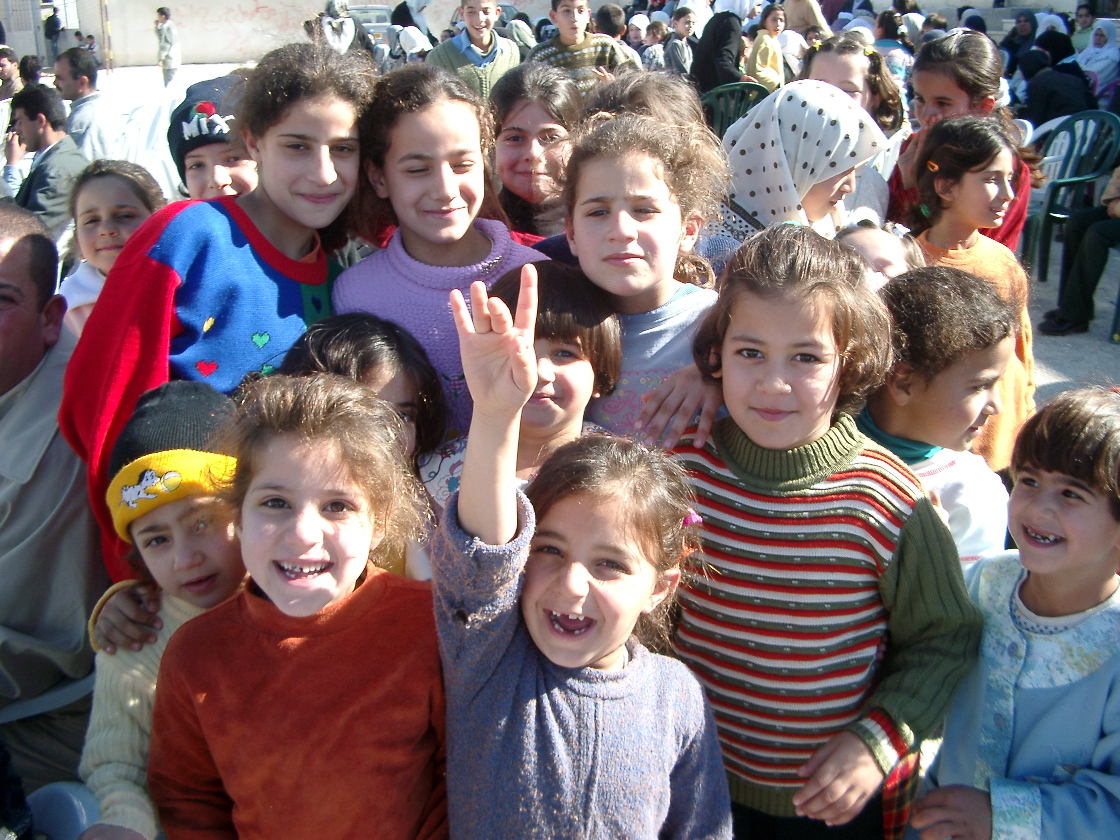
We said our last goodbye to the students and went to our last stop at a neighborhood celebration for the international day of the Red Cross and Red Crescent. The first thing I saw as I walked up the stairs into the compound where the event was being held was about 20 kids in Tae Kwon Do uniforms, the same type of uniforms and the same color belts I had used when I was kid. The next thing I noticed was that they were handing out cans of U.S. cola during the festivities. It wasn�t that this was some brand of cola from the united states. It was that the brand was actually called "U.S. Cola." It was in a red can with an image of a huge American flag wrapped around it. This was perhaps one of the more interesting products I saw while in Palestine, one that I know I will not soon forget. Oh, and in case you're wondering, it tasted terrible.
Anyway, the event was a nice one, and I enjoyed watching the children laughing as they each got their respective reward. I wondered how come we don�t celebrate this day in the states until I realized I guess people just don�t see a need for it unless they need the services of these great organizations. Just one of the many times when I realized just how little many of us appreciate what we have.
After the celebration, it was time to say our goodbyes, and as we got back into our van, with Jesus (Issa) behind the wheel, I looked back and saw a mother with her two children riding back into town in a cart being pulled by a donkey. I thought it fitting that this was what caught my attention when I first got here and when I left. That thought was soon followed with the realization that things used to be a lot different here, and perhaps one day they will be again.