| |
Information on St. Maarten
Note: St. Maarten is part of the Netherlands Antilles so all the information is here. |
 |
Information on St. Martin
Note: St. Martin is part of the Guadeloupe so all the information is here. |
| Introduction |
| Background: |
The slogan on St. Maarten's license plates is "Friendly Island." The French side lacks the slogan but not the friendliness. The main centers for activity are Philipsburg on the Dutch side and Marigot on the French side. Cruise ship passengers fill Philipsburg's streets during the day looking for duty-free bargains or casino excitement. Philipsburg with its colonial architecture is the
capital of Dutch St. Maarten. The best way to experience Philipsburg is on foot (wearing comfortable walking shoes). Many of the area's attractions are located on Front Street which is partially closed to cars.
Netherlands Antilles: Once the center of the Caribbean slave trade, the island of Curacao was hard hit by the abolition of slavery in 1863. Its prosperity (and that of neighboring Aruba) was restored in the early 20th century with the construction of oil refineries to service the newly discovered Venezuelan oil fields. The island of Sint Maarten is shared with France; its northern portion is named Saint Martin and is part of Guadeloupe. |
|
Marigot is French St. Martin's capital and largest city. The atmosphere is charming and refined with plenty of European flavor. For a great view of Marigot and its harbor, make the steep climb up the steps to Fort Louis. Shopping in Marigot is very good offering everything from open-air stalls to La Boutique Cartier. Dining is equally diverse and rewarding. If we only had
time to visit one city on this island it would be Marigot.
Guadeloupe has been a French possession since 1635. The island of Saint-Martin is divided with the Netherlands (whose southern portion is named Sint Maarten and is part of the Netherlands Antilles). |
| Geography |
| Location: |
Caribbean, two island groups in the Caribbean Sea - one includes Curacao and Bonaire north of Venezuela; the other is east of the Virgin Islands |
|
Caribbean, islands in the eastern Caribbean Sea, southeast of Puerto Rico |
| Geographic coordinates: |
12 15 N, 68 45 W |
|
16 15 N, 61 35 W |
| Area: total: |
960 sq km |
|
1,780 sq km |
| Area - comparative: |
more than five times the size of Washington, DC |
|
10 times the size of Washington, DC |
| Climate: |
tropical; ameliorated by northeast trade winds |
|
subtropical tempered by trade winds; moderately high humidity |
| Terrain: |
generally hilly, volcanic interiors |
|
Basse-Terre is volcanic in origin with interior mountains; Grande-Terre is low limestone formation; most of the seven other islands are volcanic in origin |
| Highest point: |
Mount Scenery 862 m |
|
Soufriere 1,467 m |
| Environment issues: |
NA |
|
NA |
| Geography - note: |
the five islands of the Netherlands Antilles are divided geographically into the Leeward Islands (northern) group (Saba, Sint Eustatius, and Sint Maarten) and the Windward Islands (southern) group (Bonaire and Curacao) |
|
a narrow channel, the Riviere Salee, divides Guadeloupe proper into two islands: the larger, western Basse-Terre and the smaller, eastern Grande-Terre |
| People |
| Population: |
212,226 (July 2001 est.) |
|
431,170 (July 2001 est.) |
| Age structure: |
0-14 years: 25.21%
15-64 years: 66.99%
65 years and over: 7.8% |
|
0-14 years: 24.99%
15-64 years: 66.22%
65 years and over: 8.79% |
| Life expectancy at birth: |
74.94 years |
|
77.16 years |
| Nationality: |
Dutch Antillean(s) |
|
Guadeloupian(s) |
| Ethnic groups: |
mixed black 85%, Carib Amerindian, white, East Asian |
|
black or mulatto 90%, white 5%, East Indian, Lebanese, Chinese less than 5% |
| Religions: |
Roman Catholic, Protestant, Jewish, Seventh-Day Adventist |
|
Roman Catholic 95%, Hindu and pagan African 4%, Protestant 1% |
| Languages: |
Dutch (official), Papiamento (a Spanish-Portuguese-Dutch-English dialect) predominates, English widely spoken, Spanish |
|
French (official) 99%, Creole patois |
| Government |
| Government type: |
parliamentary |
|
NA |
| Capital: |
Willemstad |
|
Basse-Terre |
| Administrative divisions: |
none (part of the Kingdom of the Netherlands) |
|
none (overseas department of France) |
| Independence: |
none (part of the Kingdom of the Netherlands) |
|
none (overseas department of France) |
| Head of government: |
Prime Minister Miguel POURIER (since 8 November 1999); Deputy Prime Minister Susanne CAMELIA-ROMER (since NA)
note: Miguel POURIER assumed prime ministership following the resignation of Susanne CAMELIA-ROMER |
|
President of the General Council Marcellin LUBETH (since NA March 1998); President of the Regional Council Lucette MICHAUX-CHEVRY (since 22 March 1992) |
| Elections: |
the monarch is hereditary; governor general appointed by the monarch for a six-year term; following legislative elections, the leader of the majority party is usually elected prime minister by the Staten; election last held 30 January 1998 (next to be held by NA 2002) |
|
French president elected by popular vote for a seven-year term; prefect appointed by the French president on the advice of the French Ministry of Interior; the presidents of the General and Regional Councils are elected by the members of those councils
note: Guadeloupe elects two representatives to the French Senate; elections last held NA September 1995 (next to be held NA September 2004); percent of vote by party - NA; seats by party - RPR 1, FGPS 1; Guadeloupe elects four representatives to the French National Assembly; elections last held 25 May - 1 June 1997 (next to be held NA 2002) |
| Diplomatic representation in the US: |
none (represented by the Kingdom of the Netherlands) |
|
none (overseas department of France) |
| Diplomatic representation from the US: |
chief of mission: Consul General Deborah A. BOLTON
consulate(s) general: J. B. Gorsiraweg #1, Willemstad AN, Curacao
P. O. Box 158, Willemstad, Curacao
tel: [599] (9) 4613066
FAX: [599] (9) 4616489 |
|
none (overseas department of France) |
| Embassy: |
NA |
|
NA |
| Flag description: |
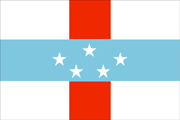
white, with a horizontal blue stripe in the center superimposed on a vertical red band, also centered; five white, five-pointed stars are arranged in an oval pattern in the center of the blue band; the five stars represent the five main islands of Bonaire, Curacao, Saba, Sint Eustatius, and Sint Maarten |
|
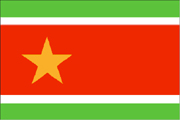
three horizontal bands, a narrow green band (top), a wide red band, and a narrow green band; the green bands are separated from the red band by two narrow white stripes; a gold five-pointed star is centered in the red band toward the hoist side; the flag of France is used for official occasions |
| Economy |
| Economy - overview: |
Tourism, petroleum refining, and offshore finance are the mainstays of this small economy, which is closely tied to the outside world. Although GDP has declined slightly in each of the past five years, the islands enjoy a high per capita income and a well-developed infrastructure as compared with other countries in the region. Almost all consumer and capital goods are imported, with Venezuela, the US, and Mexico being the major suppliers. Poor soils and inadequate water supplies hamper the development of agriculture. |
|
The economy depends on agriculture, tourism, light industry, and services. It also depends on France for large subsidies and imports. Tourism is a key industry, with most tourists from the US; an increasingly large number of cruise ships visit the islands. The traditional sugarcane crop is slowly being replaced by other crops, such as bananas (which now supply about 50% of export earnings), eggplant, and flowers. Other vegetables and root crops are cultivated for local consumption, although Guadeloupe is still dependent on imported food, mainly from France. Light industry features sugar and rum production. Most manufactured goods and fuel are imported. Unemployment is especially high among the young. Hurricanes periodically devastate the economy. |
| GDP: |
$2.4 billion (2000 est.) |
|
$3.7 billion (1997 est.) |
| Labor force: |
89,000 |
|
125,900 (1997) |
| Unemployment rate: |
14.9% (1998 est.) |
|
27.8% (1998) |
| Industries: |
tourism (Curacao, Sint Maarten, and Bonaire), petroleum refining (Curacao), petroleum transshipment facilities (Curacao and Bonaire), light manufacturing (Curacao) |
|
construction, cement, rum, sugar, tourism |
| Agriculture - products: |
aloes, sorghum, peanuts, vegetables, tropical fruit |
|
bananas, sugarcane, tropical fruits and vegetables; cattle, pigs, goats |
| Exports: |
$276 million (f.o.b., 2000) |
|
$140 million (f.o.b., 1997) |
| Exports - commodities: |
commodities: petroleum products |
|
bananas, sugar, rum |
| Currency: |
Netherlands Antillean guilder (ANG) |
|
French franc (FRF); euro (EUR) |
| Exchange rates: |
Netherlands Antillean guilders per US dollar - 1.790 (fixed rate since 1989) |
|
Euros per US dollar - 1.0659 (January 2001), 1.0854 (2000), 0.9386 (1999); French francs per US dollar - 5.8995 (1998), 5.8367 (1997), 5.1155 (1996) |
| Communications |
| Telephones - main lines: |
76,000 (1995) |
|
171,000 (1996) |
| Telephones - mobile cellular: |
13,977 (1996) |
|
NA |
| Radio broadcast stations: |
AM 9, FM 4 (1998) |
|
AM 1, FM 17 (1998) |
| Television broadcast stations: |
3 (there is also a cable service which supplies programs received from various US satellite networks and two Venezuelan channels) (1997) |
|
5 (plus several low-power repeaters) (1997) |
| Televisions: |
69,000 (1997) |
|
118,000 (1997) |
| Internet country code: |
.an |
|
.gp |
| Internet Service Providers (ISPs): |
6 |
|
3 (2000) |
| Internet users: |
2,000 (2000) |
|
4,000 (2000) |
| Transportation |
| Railways: |
0 km |
|
0 km |
| Highways: total: |
600 km
paved: 300 km
unpaved: 300 km (1992) |
|
2,560 km
paved: 965 km
unpaved: 1,595 km (1996) |
| Ports and harbors: |
Kralendijk, Philipsburg, Willemstad |
|
Basse-Terre, Gustavia (on Saint Barthelemy), Marigot, Pointe-a-Pitre |
| Airports: |
5 (2000 est.) |
|
9 (2000 est.) |
| Military |
| Military branches: |
Royal Netherlands Navy, Marine Corps, Coast Guard, National Guard, Police Force |
|
French Forces, Gendarmerie
note: defense is the responsibility of France |
| Military manpower - availability: |
males age 15-49: 54,284 (2001 est.) |
|
NA |
| Transnational Issues |
| Disputes - international: |
none |
|
none |
| Illicit drugs: |
money-laundering center; transshipment point for South American drugs bound for the US and Europe |
|
not listed |
 (St. Martin)