| Information on Martinique |
| Introduction |
| Background: |
Colonized by France in 1635, the island has subsequently remained a French possession except for three brief periods of foreign occupation. |
| Geography |
| Location: |
Caribbean, island in the Caribbean Sea, north of Trinidad and Tobago |
| Geographic coordinates: |
14 40 N, 61 00 W |
| Area: total: |
1,100 sq km |
| Area - comparative: |
slightly more than six times the size of Washington, DC |
| Climate: |
tropical; moderated by trade winds; rainy season (June to October); vulnerable to devastating cyclones (hurricanes) every eight years on average; average temperature 17.3 degrees C; humid |
| Terrain: |
mountainous with indented coastline; dormant volcano |
| Highest point: |
Montagne Pelee 1,397 m |
| Environment issues: |
NA |
| Geography - note: |
the island is dominated by Mount Pelee, which on 8 May 1902 erupted and completely destroyed the city of Saint Pierre, killing 30,000 inhabitants
Note: the only person to survive was the town drunk who happened to be in the jail at the time of the eruption. His jail cell saved his life. |
| People |
| Population: |
418,454 (July 2001 est.) |
| Age structure: |
0-14 years: 23.1%
15-64 years: 66.77%
65 years and over: 10.13% |
| Life expectancy at birth: |
78.41 years |
| Nationality: |
Martiniquais (singular and plural) |
| Ethnic groups: |
African and African-white-Indian mixture 90%, white 5%, East Indian, Chinese less than 5% |
| Religions: |
Roman Catholic 95%, Hindu and pagan African 5% |
| Languages: |
French, Creole patois |
| Government |
| Government type: |
NA |
| Capital: |
Fort-de-France |
| Administrative divisions: |
none (overseas department of France) |
| Independence: |
none (overseas department of France) |
| Head of government: |
President of the General Council Claude LISE (since 22 March 1992); President of the Regional Council Alfred MARIE-JEANNE (since NA March 1998) |
| Elections: |
French president elected by popular vote for a seven-year term; prefect appointed by the French president on the advice of the French Ministry of Interior; the presidents of the General and Regional Councils are elected by the members of those councils
note: Martinique elects 2 seats to the French Senate; elections last held NA September 1998 (next to be held September 2001); results - percent of vote by party - NA%; seats by party - PPM 2; Martinique also elects 4 seats to the French National Assembly; elections last held 1 June 1997 (next to be held NA 2002); results - percent of vote by party - NA%; seats by party - RPR 2, PS 1, independent 1 |
| Diplomatic representation in the US: |
none (overseas department of France) |
| Diplomatic representation from the US: |
none (overseas department of France) |
| Embassy: |
NA |
| Flag description: |
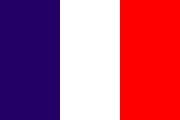
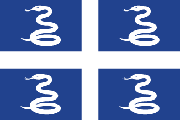
The official flag is the French one, but there is a banner of the arms: a blue field with a white cross, and in each canton a white snake in the form of an 'L'.
The "L" snakes which appear in the arms and flag recall the "L" of Lucia, although this flag never flew on that island. The snakes are in the shape of a stylised "L", a bit like the British pound sign.
The L means "Lucia" because Martinique was administered from St. Lucia before the British took that island. The flag is therefore quite old - it pre-dates the French Revolution. The white cross on blue can also be seen in the flag of Quebec,
and is in fact France's traditional national cross - equivalent to England's red cross on white. |
| Economy |
| Economy - overview: |
The economy is based on sugarcane, bananas, tourism, and light industry. Agriculture accounts for about 6% of GDP and the small industrial sector for 11%. Sugar production has declined, with most of the sugarcane now used for the production of rum. Banana exports are increasing, going mostly to France. The bulk of meat, vegetable, and grain requirements must be imported, contributing to a chronic trade deficit that requires large annual transfers of aid from France. Tourism has become more important than agricultural exports as a source of foreign exchange. The majority of the work force is employed in the service sector and in administration. |
| GDP: |
$4.39 billion (1997 est.) |
| Labor force: |
170,000 (1997) |
| Unemployment rate: |
27.2% (1998) |
| Industries: |
construction, rum, cement, oil refining, sugar, tourism |
| Agriculture - products: |
pineapples, avocados, bananas, flowers, vegetables, sugarcane |
| Exports: |
$250 million (f.o.b., 1997) |
| Exports - commodities: |
refined petroleum products, bananas, rum, pineapples |
| Currency: |
French franc (FRF); euro (EUR) |
| Exchange rates: |
euros per US dollar - 1.0659 (January 2001), 1.0854 (2000), 0.9386 (1999); French francs per US dollar - 5.8995 (1998), 5.8367 (1997), 5.1155 (1996) |
| Communications |
| Telephones - main lines: |
170,000 (1997) |
| Telephones - mobile cellular: |
15,000 (1997) |
| Radio broadcast stations: |
AM 0, FM 14 (1998) |
| Television broadcast stations: |
11 (plus nine repeaters) (1997) |
| Televisions: |
66,000 (1997) |
| Internet country code: |
.mq |
| Internet Service Providers (ISPs): |
(ISPs): 2 (2000) |
| Internet users: |
5,000 (2000) |
| Transportation |
| Railways: |
0 km |
| Highways: total: |
2,105 km (2000) |
| Ports and harbors: |
Fort-de-France, La Trinite |
| Airports: |
2 (2000 est.)
1 with paved runways |
| Military |
| Military branches: |
French forces (Army, Navy, Air Force), Gendarmerie |
| Military manpower - availability: |
note: defense is the responsibility of France |
| Transnational Issues |
| Disputes - international: |
none |
| Illicit drugs: |
transshipment point for cocaine and marijuana bound for the US and Europe |
 (offical)