| Information on Barbados |
| Introduction |
| Background: |
The island was uninhabited when first settled by the British in 1627. Its economy remained heavily dependent on sugar, rum, and molasses production through most of the 20th century. In the 1990s, tourism and manufacturing surpassed the sugar industry in economic importance. |
| Geography |
| Location: |
Caribbean, island between the Caribbean Sea and the North Atlantic Ocean, northeast of Venezuela |
| Geographic coordinates: |
13 10 N, 59 32 W |
| Area: total: |
430 sq km |
| Area - comparative: |
2.5 times the size of Washington, DC |
| Climate: |
tropical; rainy season (June to October) |
| Terrain: |
relatively flat; rises gently to central highland region |
| Highest point: |
Mount Hillaby 336 m |
| Environment issues: |
pollution of coastal waters from waste disposal by ships; soil erosion; illegal solid waste disposal threatens contamination of aquifers |
| Geography - note: |
easternmost Caribbean island |
| People |
| Population: |
275,330 (July 2001 est.) |
| Age structure: |
0-14 years: 21.68%
15-64 years: 69.44%
65 years and over: 8.88% |
| Life expectancy at birth: |
73.25 years |
| Nationality: |
Barbadian(s) or Bajan (colloquial) |
| Ethnic groups: |
black 80%, white 4%, other 16% |
| Religions: |
Protestant 67% (Anglican 40%, Pentecostal 8%, Methodist 7%, other 12%), Roman Catholic 4%, none 17%, other 12% |
| Languages: |
English |
| Government |
| Government type: |
Parliamentary democracy; independent sovereign state within the Commonwealth |
| Capital: |
Bridgetown |
| Administrative divisions: |
11 parishes; Christ Church, Saint Andrew, Saint George, Saint James, Saint John, Saint Joseph, Saint Lucy, Saint Michael, Saint Peter, Saint Philip, Saint Thomas; note - the city of Bridgetown may be given parish status |
| Independence: |
30 November 1966 (from UK) |
| Head of government: |
Prime Minister Owen Seymour ARTHUR (since 6 September 1994); Deputy Prime Minister Billie MILLER (since 6 September 1994) |
| Elections: |
none; the monarch is hereditary; governor general appointed by the monarch; prime minister appointed by the governor general |
| Diplomatic representation in the US: |
Ambassador Michael KING
2144 Wyoming Avenue NW, Washington, DC 20008
tel: [1] (202) 939-9200
FAX: [1] (202) 332-7467 |
| Diplomatic representation from the US: |
Ambassador (vacant); Charge d'Affaires Marcia BERNICHT
P. O. Box 302, Bridgetown; CMR 1014, APO AA 34055
tel: [1] (246) 436-4950
FAX: [1] (246) 429-5246 |
| Embassy: |
Canadian Imperial Bank of Commerce Building, Broad Street, Bridgetown; (courier) ALICO Building-Cheapside, Bridgetown |
| Flag description: |
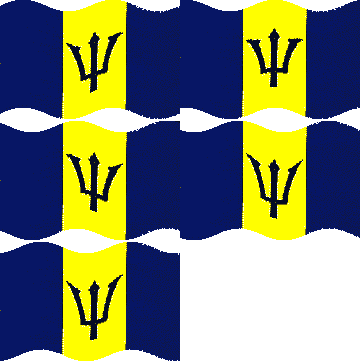
The national flag of Barbados is comprised of three equal vertical panels - the centre panel of gold and the outer panels of ultramarine. A broken trident in black is located in the centre of the flag. Blue represents the sea and sky of Barbados, while gold represents the sand of the island's beaches. The symbol at the centre of the flag represents the Trident of the mythical sea god, Neptune - the shaft of the trident is broken symbolising Barbados' break from Britain (the colonial coat of arms contained a complete trident). |
| Economy |
| Economy - overview: |
Historically, the Barbadian economy had been dependent on sugarcane cultivation and related activities, but production in recent years has diversified into manufacturing and tourism. The start of the Port Charles Marina project in Speightstown helped the tourism industry continue to expand in 1996-2000. Offshore finance and information services are important foreign exchange earners, and there is also a light manufacturing sector. The government continues its efforts to reduce unemployment, encourage direct foreign investment, and privatize remaining state-owned enterprises. Growth should remain steady in 2001, with new tourist facilities a plus factor. |
| GDP: |
purchasing power parity - $4 billion (2000 est.) |
| Labor force: |
136,000 (1998 est.) |
| Unemployment rate: |
11% (1999 est.) |
| Industries: |
tourism, sugar, light manufacturing, component assembly for export |
| Agriculture - products: |
sugarcane, vegetables, cotton |
| Exports: |
$260 million (2000 est.) |
| Exports - commodities: |
sugar and molasses, rum, other foods and beverages, chemicals, electrical components, clothing |
| Currency: |
Barbadian dollar (BBD) |
| Exchange rates: |
Barbadian dollars per US dollar - 2.0000 (fixed rate pegged to the US dollar) |
| Communications |
| Telephones - main lines: |
108,000 (1997) |
| Telephones - mobile cellular: |
8,013 (1997) |
| Radio broadcast stations: |
AM 2, FM 3 (1998) |
| Television broadcast stations: |
1 (plus two cable channels) (1997) |
| Televisions: |
76,000 (1997) |
| Internet country code: |
.bb |
| Internet Service Providers (ISPs): |
19 (2000) |
| Internet users: |
6,000 (2000) |
| Transportation |
| Railways: |
0 km |
| Highways: total: |
1,600 km
paved: 1,578 km
unpaved: 22 km (1998) |
| Ports and harbors: |
Bridgetown, Speightstown (Port Charles Marina) |
| Airports: |
1 (2000 est.) |
| Military |
| Military branches: |
Royal Barbados Defense Force (includes Ground Forces and Coast Guard), Royal Barbados Police Force |
| Military manpower - availability: |
males age 15-49: 78,069 (2001 est.) |
| Transnational Issues |
| Disputes - international: |
none |
| Illicit drugs: |
one of many Caribbean transshipment points for narcotics bound for Europe and the US |