|
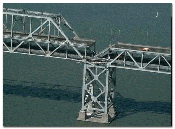
The Bay Bridge in San Francisco didn't fare too
well during the earthquake of 1989, when a portion
of its upper deck collapsed onto the lower
deck.
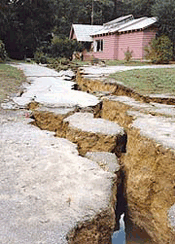
A fissure in Loma Prieta created by the
earthquake.
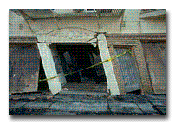
Damage to a garage in the North Beach area, near
Embarcadero.
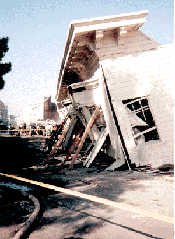
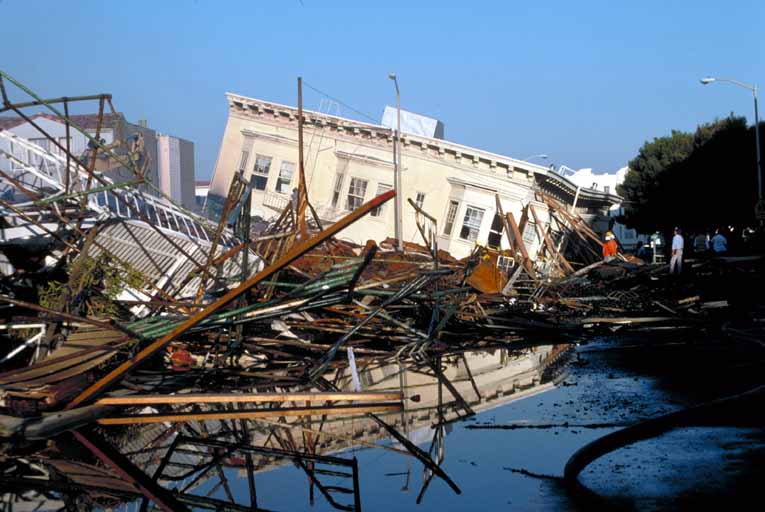
Damage to a wood-frame house in San Francisco's
Marina district.
|
1989 Loma Prieta
Earthquake
At 5:04 pm on
October 17th, 1989, a major earthquake occurred,
its epicenter in the Loma Prieta area, south of San
Francisco. It caused considerable damage to
buildings in San Francisco, especially in the
Marina district. Candlestick Park in San Francisco,
where the Giants were about to play in the World
Series, was shaken up pretty badly, and a few
baseball fans were taken to the hospital. As people
were trying to get into and out of the city, part
of the Bay Bridge collapsed. In total, the Loma
Prieta earthquake killed 63 people in the Bay
Area.
The rupture
along the San Andreas fault was relatively minor
compared to that of the 1906 San Francisco quake,
only about 30 miles long in contrast to 1906's 270
miles. The focal depth of the quake, however, was
unusually deep: 11 miles, as opposed to the typical
California earthquake focal depth of 4 to 6
miles.
|
|
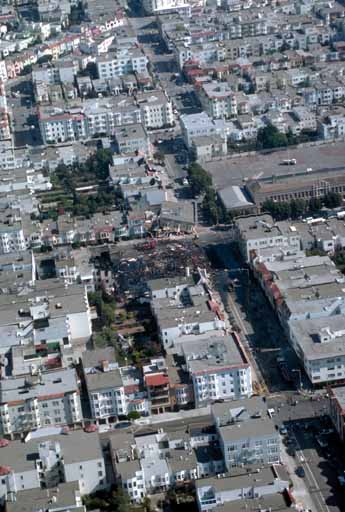
The
Marina district of San Francisco suffered
some of the worst damage of this
earthquake as a result of
liquefaction.
|
The 1989 Loma
Prieta earthquake was a moment magnitude 7.0 (7.1
Richter), not considered even among the 15 largest
earthquakes. Compared to the 3,000 casualties in
the 1906 earthquake, the only 63 deaths in the 1989
quake, while still tragic, were the result of
better building codes and more earthquake
awareness. Although some of the casualties could
have been avoided, such as by decreasing building
on bayfill and retrofitting the Bay Bridge and
other potentially unsafe structures, the Bay Area
fared relatively well in the 1989 Loma Prieta
earthquake.
As in the 1906
San Francisco earthquake, liquefaction contributed
to quite a bit of damage in the Marina district.
Fortunately, not as many buildings were dependent
upon the bayfill foundations, but damage was still
maximum in the Marina district of San Francisco as
well as portions of the East Bay, where fires broke
out.
|
A
large section of the Bay Bridge's upper
deck collapsed onto the lower deck during
the earthquake, and the Embarcadero was
badly damaged. Highways 1 and 101 were
both closed due to landslides and unstable
bridges. However, the most loss of life
occurred on I-880 in Oakland. Over 40
slabs of concrete from the upper deck,
weighing 600 tons each, collapsed onto
traffic below. It took days to discover
that 41 people had died in that incident
alone.
Much
of the earthquake damage was limited to a
few select areas. In many neighborhoods,
there was almost no evidence that a major
earthquake had even occurred.
|
|
--by Alex Hoff
�
|
�
|