|
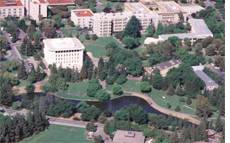
The Davis landscape today. Many residents think the
Sacramento area is immune to earthquakes, but they
have happened here before.
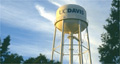
This water tower, like many other structures in UC
Davis, has been retrofitted for earthquake
safety.
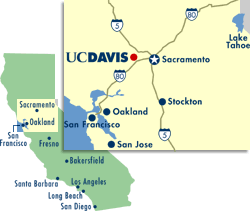
The 1892 Winters/Vacaville quakes affected mainly
the western Sacramento Valley, with effects in
Davis but barely in Sacramento.
|
1892
Winters/Vacaville
Earthquakes
In April 1892,
a series of earthquakes rattled the western
Sacramento Valley. Their epicenters were near
Winters and Vacaville, both very small towns at the
time.
The first
quake, felt most in Vacaville, occurred on Tuesday,
April 19th in the early morning. Damage was more
apparent in brick buildings than wooden ones,
shocking to many who thought brick was far more
modern and superior to wood. In Winters, the same
was true. Residents of both towns began rebuilding
that day. In Davisville, a few chimneys were
toppled, and one older building fell to the ground.
However, in Dixon, a larger town, a fire as started
after a lantern was knocked over, making rebuilding
a bit harder to accomplish. The Tuesday quake had a
magnitude of M6.5.
The second
quake struck Winters on Thursday, April 21st at
9:40 am. It was stronger than the Tuesday quake,
although only an M6.2, eliminating all remaining
brick and stone buildings in Winters. The Thursday
quake also resulted in the only fatality, Jeff
Darby, who was behind the brick Cradwick Building
as the earthquake occurred. He was pounded by
falling bricks, and died in the hospital early the
next morning. At 9:45 am, Vacaville felt the second
earthquake. It brought down much of the standing
walls and contributed to the panicked mood of the
citizens.
Rebuilding
began almost immediately. Since building codes were
nonexistent, many damaged or even badly damaged
structures were propped up to be declared in
working order. This was done because of, among
other things, impatience and lack of funds. Bricks
which had once been part of damaged and destroyed
buildings were sold to those who were rebuilding.
No thought was given to building more
earthquake-safe structures, just rebuilding as much
and as quickly as possible so the towns could
return to normalcy.
|
|
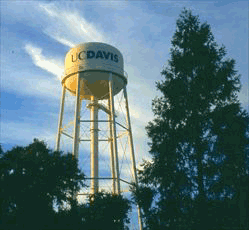
Today,
results from an earthquake would be much
different than those of the 1892
earthquakes. In Davis, the water towers
and the Memorial Union have both been
retrofitted, and many buildings downtown
are earthquake safe (although their
windows aren't!). However, because of a
dramatic population increase since 1892,
it is very important that Central Valley
residents be prepared. As improbable as it
may sound, we know from past experience
that it is possible to have an earthquake
in the Sacramento Valley.
|
--by Alex Hoff
�
�
|
�
|