There are countless tribes residing within the U.
S., Canada, and Alaska, but since I am now living in Nebraska, I have now been focused on the Oglala Sioux.
I am especially interested in the Sacred Animals of the Oglala Sioux, for I had the wonderful opportunity of experiencing
my own totem formation. These are the animals that walk with us daily, teaching and protecting us as we walk life's road.
�
Who are the Oglala Sioux of the North American Plains? The Oglala Sioux, a western division of the Teton Dakotas, are a classic example
of a namadic hunting people.
What precisely for the Oglala is their conception of "power" as manifested through the animals? What is the relationship between the multiplicity of such "powers" and a unitary concept of a "Supreme Being"?
Who, or what, is the Indian's acquired "guardian spirit," and what is the relationship between this "spirit power" and the "master" of all the animals?
Basic to the Plains Indians' culture was the vision quest, the search for the power and protection of a tutelary spirit. Among the Oglala, for whom it was termed "crying for a vision," the quest was participated
in by virtually all the men and, although less frequently and in a somewhat less rigorous form, often also by women.
�
"Every man can cry for a vision, or 'lament,' and in the old days we all - men and women - lamented all the time."
Black Elk
�
For the Oglala it seems that distinguishing between dream and vision is of little or no concern, for many of the recorded encounters with animal spirits which took place in the dream state held the same "power"
as if the experience had been a waking vision. Evidently in both dream and vision there is an intensification of the interrelationships with animal forms, and these experiences go beyond and are deeper than the
encounters which take place in the waking state. There is a shift to another level of cognition, on which the Oglala is no longer encountering the phenomenal animal, but rather archetypal "essences" appearing in animal
forms. Although these could appear in almost any of the forms of the natural world, in an overwhelming majority of documented cases the vision encounter was with representatives of a wide range of animals and birds, any
of which could become the seeker's "guardian spirit." After the quest, the 'lamenter' returns to his sponsor who interprets the vision, and instructs the man as to actions which must be taken to "actualize" the power he has
received.
Success in the vision quest brought with it certain obligations. Among other things (such as the making of a fetish or a medicine bundle) the one who had received a vision was normally obliged, especially in the case of a
powerful experience, to extend and share it by enacting it in some way, sometimes by a dance ceremonial, or by singing the songs learned in the vision.
�
So much past interpretation of Native American spirituality has regrettably been forced into preconceived molds of Western, expecially Christian, theological perspective.
Sacred Animals of the Oglala Sioux
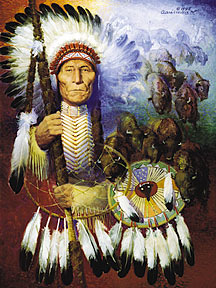 |
The bison is the chief of all animals, and represents the earth, the totality of all that is. It is the feminine, creating earth principle which fires rise to all living forms.
Black Elk |
The act of hunting as being - not representing - life's quest for ultimate truth. Hunting is a quest, which requires preparatory prayer and sacrifical purification: the diligently followed tracks are signs or intimations of the goal;
and final contact or identity with the quarry is the realization of Truth, the ultimate goal of life. |
 |
In terms of interconnections, a dominant theme of all Native American cultures is that of relationship, or a series of relationships that are always reaching further and further out; relationships within the immediate family reaching out to the extended family, to the band,
outward again to the clan, to the tribal group; and relationships do not stop there but extend out to embrace and relate to the environment: to the land, to the animals, to the plants, and to the clouds, the elements, the heavens, the stars; and ultimately those relationships that
people express and live, extend to embrace the entire universe. |
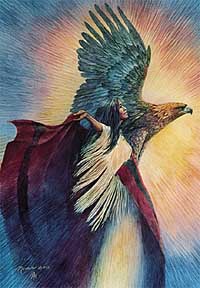
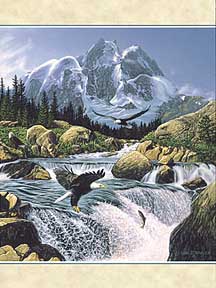
Feathers of many kinds were worn for their decorative properties or power content, and were also used for fletching arrows. Among those favored were the feathers of the prairie hen, owl, chicken hawk, buzzard, and particularly the eagel. Whistles used in the Sun Dance
were made from the wing bone of the golden eagle and had eagle plumes attached to them. Due to its elevated position in Oglala religious belief, nothing worn or used ritually could equal the sacred power associated with the feathers of the eagle.
|
 |
The tribe looks to him as a defender, and he is expected to shield the women.
The Elk was closely associated with the Indian idea of love and sensual passion.
Supernatural power lay behind manifestations of sex desire: consequently, numerous
mythical creatures were thought to control such power, and of these, the bull elk was the
most important. |
...the strength and ability to accomplish his aims. He is brave to defend himself and others and is free to do much good. He is kind to all, especially to the poor and needy. |
 |
The Bear is quick tempered and is fierce in many ways. Yet he pays attention to herbs which no other animal notices at all...we consider the bear as chief of all the animals in regard to herb medicine.
Two Shield, Standing Rock
The Bear has a soul like ours, and his soul talks to mine and tells me what to do.Bear with White Paws |
The Oglala, like all Indians who had any contact with the bear, were understandably impressed with the fierce power and unpredictable qualities this animal represented. The Indians know of the bear's lack of fear for either man or animal,
noted the bear's characteristic habit of digging with massive claws into the earth for roots and other underground products of the earth, and wondered at his mysterious habit of sleeping during many of the winter months. The Oglala men sought
to assimilate these powers which were manifested through the bear form. |
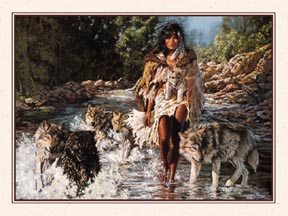 |
The grey wolf will attack fiercely when very hungry...but their courage depends upon their numbers; in this they are like white men. One wolf or two will never attack a man. They will stampede a herd of buffaloes in order to get at the calves;
they will rush upon a herd of antelopes for they are helpless; but they are always cardful about attacking man. |
Charging Thunder, recounted a dream of an old wolf who taught him to make a pipe. "...telling me to smoke it when I was on the warpath and saying that the smell of the pipe would be so strong that the enemy would not detect my approach and thus I would be able to steal their
horses. The old wolf said that by the aid of this pipe I would be able to outwit the wisest and craftiest of my enemies."
This reference to "spirit", rather than to the wolf as such, again shows that for the Oglala, as for the Plains Indians in general, each animal was really a crystallized projection of the abstract spirit. |