HOME PLACES FOOD CULTURAL AWARDS
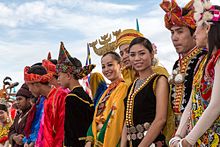
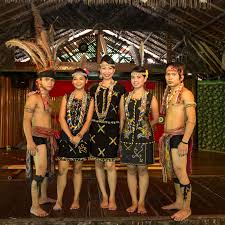
| With around 32 indigenous groups in Sabah, one can expect to see tribal dresses of various styles. Most of these have retained much of their original design and color. Many of these traditional costumes are of black material, and one of the reasons for using such a sombre color is that in the past, the people could rely on a few types of vegetables and plants from which to extract dye to color the cloth. If they needed to add color to the black, beads of red, orange, white and green were sewn on. Traditional costumes also included antique bead necklaces and belts, antique hand-engraved silver jewellery, and belts of old silver dollar coins. Most of these accessories have been handed down from generation to generation. All are very valuable and priceless. |
| Kadazandusun
•This is the largest ethnic category in
Sabah and is predominantly wet rice and hill rice cultivators.Their language
belongs to the Dusunicfamily
and shares a common animistic belief system with various customs and
practices. Their ancient beliefs on the verity that everything has life
- the
rocks, trees, and rivers are all living things. They have souls and
spirits that must be appeased from time to time through specific
rituals. In these
modern times, some of the rituals are less performed accept during
certain
festivities.
•Pesta Kaamatan
or Harvest Festival is a unique celebration of Kadazandusun
society. It's a celebration to honour
the Rice Spirit - Bambaazon or Bambarayon
and giving thanks for yet another bountiful year. The festival begins on the
first of May at many district levels
 |
| Bajau •The Kota Belud
Bajau Horseman are the famous Cowboys of the East. During special occasions,
the Bajau Horseman wears a black, sometimes white, long-sleeved shirt called badu
sampit
. Smart, gold buttons betawi
run down the front opening and the shirt is also decorated with silver flowers
called intiras
.
•The trousers are more tight-fitting
than the bajau
bridegroom's seluar
sama
. The horseman's seluar
sampit
is balck,
and both the shirt and trousers have gold lace trimmings sewn on. He also wears
a headpiece podong
similar to the Bajau bridegroom's.
•The Bajau horseman wears a
silver-hilted dagger karis
at his side. The sheath is made of wood and silver. He also carries a spear bujak
and a shipping crop pasut
. Perhaps the most interesting thing about the Bajau horseman is his horse, or
rather pony. It has its own costume and is more gaily dressed than the rider.
The ourfit
kain
kuda
almost completely covers the pony except for holes for the eyes and nose. This
cloth is tied around the pony's legs to keep it in place.
•The saddle sila-sila
is not like the cowboy saddles of the West but rather a smaller piece of
buffalo hide so shaped to fit the pony's back. A thick piece of cloth lapik
is placed under the sila-sila
. Antique brass bells seriau
, colourful
reins tingalu
and bridle kakang
all make for a very festive pony costume. In all their finery, both ride and
pony become quite an attraction.
 |
Festival
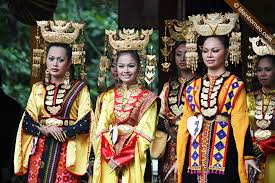
| ii)Unduk
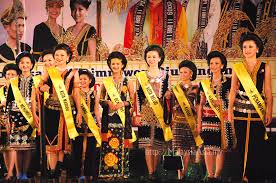
Ngadau •Unduk
Ngadau
is a beauty pageant held during the Kaamatan
cultural event normally held in Sabah, Malaysia. The title comes from the
ethnic word Runduk
Tadau
which means 'the girl crowned by sunlight'. Unduk
Ngadau
is one of the most recognizable cultural events in Sabah and the beauty pageant
is unique to the state.
•The Unduk
Ngadau
beauty contest was started to pay respect to Huminodun,
the sacrificed daughter of the Kadazandusun
spirits Kinorohingan
and Suminodun.
It is believed that she was the one who taught the priestesses, known as
locally as Bobohizans
their ritual mantras which exist today.
•Contestants in the state-level
pageants are generally the winner of their district's pageant. However, some
districts hold joint pageants which produce more than one state-level
contestant. Notably, Tuaran
and Tamparuli
hold a joint pageant in Tamparuli,
with the first-place winner going on to represent Tuaran,
and the second-place winner representing Tamparuli.
•In recent years, participants from
Peninsular Malaysia have been able to participate in the pageant by
representing Klang
Valley.
•The state-level pageant is held on
the 31st of May each year at the Hongkod
Koisaan
building in Penampang,
and is the highlight and ending point of the monthlong
Kaamatan
celebrations.
 |