

 |
 |
 |
 |
 |
 |
 | ||

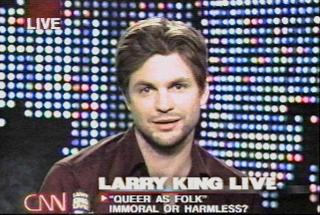
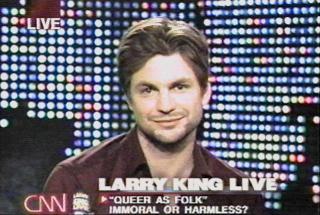
CNN's Larry King Live
Interview: "Queer As Folk" Immoral or Harmless?
Aired April 24, 2002.
KING: Randy, do we know who the audience is? Do we know who's watching?
RANDY: You know, it's a huge audience, a lot of straight people, a lot of teenagers, a lot of
gay people, too. I think the fact that the show appeals to so many people on so many
different levels sort of is a testament to the legitimacy of it.
KING: Hal, do you know -- do you have friends who watch who are straight?
HAL: Oh, yes.
KING: And what do they say?
HAL: Yes, they're sort of, you know, as friends of mine they are proud of me for taking on
the challenge, you know, and doing something that a lot of people wouldn't do.
KING: No one has complained to you? No one has said to you what are you doing?
HAL: No. Some guy friends of mine say, you know, I can't watch that part. I've got to turn
that part off. Or, you know, I'll tape it and I'll fast forward through those things because it is
hard for me. But they all agree that the storylines are compelling. The flashpoint of the show
is the sex and that's what people attach themselves and go this is what it's about.
But if you watch the show, it's really about relationships. And in a lot of ways, it portrays
relationships honestly, in a way that even straight portrayal of relationships doesn't do
anymore. It becomes part of a cliche. So the first time you're seeing people having real
arguments, and a lot of times -- I've said this before -- but I have dialogue on the show
where I'm saying -- my character is saying to his boyfriend stuff that my ex-girlfriend has
said to me. You know? And that's an interesting place to be in as a man, you know, and
really come to terms with having those honest feelings.
KING: You play, Peter, the character you play, I understand, is really out there.
PETER: He's really out there.
KING: He's sort of �swishy' as you might say.
PETER [laughing]: You could say swishy. I wouldn't, but you could.
KING: Danger in stereotyping there or do you know people like that?
PETER: I know people like Emmett. I wanted very much -- what I think is so great about
Emmett is he's very effeminate. He's out there, He's unapologetically gay and he really likes
himself. He's sort of figured out that he was OK. Whether or not you think so doesn't really
matter to him. And I thought that was really revolutionary to see on TV.
KING: Randy, as a gay man, does Peter's part offend you in any way?
RANDY: Oh, not at all. Not at all. It's really affirming actually.
KING: Because?
RANDY: Because you can see someone who is so out there and in a lot of ways, is so much
of what people assume is negative about being gay or what people make fun of in
homosexuality or the way they view potentially homosexual behavior. And you see someone
who loves himself and is loved by everyone around them. And, you know, the audience loves
him. You know, it is great.
KING: Hal, did you know this show would be as controversial as it is?
HAL: Yes, absolutely.
KING: No doubt about it?
HAL: No doubt whatsoever. You could tell from the initial script, and from being a person out
in the world and aware of how things presently are. This show is important because it pushed
that envelope, and therefore it couldn't have -- even if the controversy isn't hyperverbal.
You know, there isn't a lot of fighting between us and the moral majority going on. What
controversy truly is there is between people and their own biases, their own homophobia that
they didn't address.
KING: Gale, do you have any regrets over taking the part?
GALE: No.
KING: Not at all.
GALE: Not at all. I mean, I've had an amazing experience growing as an actor, growing with
my fellow actors. I've learned and...
[Off-camera, we hear Randy whisper what sounds like "I love you" or "I love him"]
KING: What did he just whisper to you?
GALE [grinning]: I can't repeat it.
[Laughter in the studio]
KING: OK. We'll use that as a grabber. We'll take a break and come right back. We'll include
some phone calls as well. At the bottom of the hour, other members of the cast and later,
we'll meet the producers and a critic of "Queer As Folk." You're watching LARRY KING LIVE.
Don't go away.
[Video clip from QAF is played]
DALE: There are many pleasures to be found here, places that you are afraid to
even think of going. I can take you there. But first you must surrender to me
completely. Do you surrender? TED: Yes, I surrender. DALE: Sir. You will call me
sir.
[Video clip ends]
[Commercial Break]
[Video clip from QAF is played]
DEBBIE: So how long you been positive then?
MICHAEL: Mother.
DEBBIE: I just like to know.
BEN: That's OK. I'm fine with it. Five years.
DEBBIE: What's your T-cell count?
BEN: About 600.
DEBBIE: Ever been hospitalized?
BEN: Nope, not yet, knock wood.
DEBBIE: Viral load?
BEN: Undetectable.
DEBBIE: On the cocktail?
BEN: Anti-virals.
MICHAEL: What the fuck do you think you're doing?
DEBBIE: This is the reality, sweetheart. And you're just going to have to live with it.
[Video clip ends]
KING: Randy, your character is 17 years old, as I understand it.
RANDY: He's 19 now, but he began at 17, yes.
KING: When he was 17, was there criticism over that since he's a minor?
RANDY: Some, yes, there was.
KING: Didn't bother you?
RANDY: Not really because it happens all the time. And, you know, I was happy to put it out
there.
KING: As we saw from that scene, Hal, your lover has HIV.
HAL: Yes. Michael's dating a character named Ben this year and he's HIV positive.
KING: Do you think this enlightens people about this?
HAL: Absolutely. I mean, when the episode where I meet him and all that, it first aired,
Michael can't sleep with him. And he breaks up with him because he can't handle the HIV
element in the relationship. And we got a lot of criticism from that. People picketed us. And
then when they finally watched how the story progressed and how this relationship grows, I
think it really opens a lot of people's eyes. And I'm really happy that that storyline came into
the fore.
KING: Peter, there are those who say Pittsburgh was a bad choice to be the city --
no, that the gay communities are more prevalent in San Francisco, Houston than in
Pittsburgh.
PETER: Right. You know, I mean, I think you should talk about that with the producers.
Obviously, that was their choice. But I think it's about being a real city. It's just about being
a city with real people with people who might be neighbors.
KING: Just happened to be Pittsburgh.
PETER: Yes. Exactly.
KING: Tacoma, Washington, hello. Tacoma, are you there?
CALLER: This is Houston, Texas.
KING: OK. I was told Tacoma. I'm on five, but OK, Houston, go ahead.
CALLER: I just wanted to comment about the show. First of all, I love the show. Everybody is
great on that show. I'm an African- American female who has dealt with discrimination in her
own life and it's great to see how you all have overcome all of that.
KING: Do you have a question? Do you have a question, dear?
CALLER: Well, I just wanted to give a comment. I mean, I love the show. You're all doing
great work. Keep it up. I mean, you've helped me and my family bridge...
[King disconnects the caller]
HAL [speaking to the caller]: Thanks a lot.
KING: Thank you. Do you hear a lot of that?
PETER: We do quite a about it, actually. I think the universality of the relationships, I think,
it touches people. And, you know, straight people, gay people, people of color, often come
up and just say, I get it. That's my relationship. I understand that.
HAL: A big portion of our audience is straight women. And a lot of times it is because they're
seeing emotions portrayed that they don't get to see anywhere else.
KING: Gale, do you have any fear that this could typecast you in a way that, oh, he's the
guy that's on "Queer As Folk"?
GALE: The only real answer I have to that, you know -- it is asked a lot is that I really
wouldn't want to work with someone who would typecast me based on what I'm doing in this
job. I mean, we're actors and we want to grow and we want to perform different parts.
So if I'm going to take a part that's challenging to me and that's feeding me as an actor, if
someone were going to typecast me because of that -- I know that it has happened. But I
really feel like it's 2002. Hopefully we're beyond that.
PETER: Amen.
GALE: My goal is to work with people like I'm working with now that have an interest in
pushing forward ideas and issues that, you know, are important and speak to people.
KING: Randy, as a gay man, are you consulted by -- by the way, are the writers gay?
RANDY: Some of them.
KING: Are you ever consulted with questions like, does this happen?
RANDY: No. Sometimes, yes, sometimes.
KING: No?
RANDY: Not all the time. I mean, I think people are pretty aware that this sort of does
happen. You know, in the show, it very much represents a small subgroup of the gay
community. But you know, most people I know who watch the show are aware of the reality
of these kinds of situations and relationships.
KING: Do you ever see a script, Peter, where you have to say, no, that's not the way it
happens?
PETER: No. I've seen scripts where I said, I wonder about this. And we engage the producers
in a great conversation about it. They're really collaborative and really open that way. And
the only question I've ever been asked by other actors on the show was do you really do it
like that?
KING: And what do you say?
PETER: Harder.
KING: Sharon, I know you've never shirked controversy. Did you expect what you've gotten
out of this?
GLESS: I'm sorry, Larry. I couldn't hear you.
KING: Did you expect the controversy this has gotten?
GLESS: Yes. That's sort of reason I signed on because I thought -- I mean, I was up for the
fight. But that's what's exciting about this show to me. There's never been anything like it.
I've been getting trouble from that scene you just saw, from people writing me and talking to
me on the street, how could you?
KING: There are conservatives, Hal, who are saying it glorifies a lifestyle.
HAL: I think TV has an opportunity to be a window. And that's what it is in this case. There
are a lot worse lifestyles to glorify than a young man falling in love with a man who has HIV
and persevering through that relationship, or a character such as Emmett who falls in love
with a much older man and really has an enduring relationship with him. If that's what we're
promoting, then, tough.
PETER: You know, it ain't glorifying what. These characters are flawed. They struggle. They
have problems. It is drama. That's what it is.
GLESS: They're real people.
KING: It's a show.
PETER: It's a show. To say we're glorifying something I think is really inaccurate.
KING: Any script coming going deal with the Catholic church?
HAL: Boy, we've been really prophetic throughout. And, yes, that actually is addressed.
KING: Thank you all very much. We'll break and meet other members of the cast, four more coming. We thank Peter Paige, Sharon Gless, Gale Harold, Randy Harrison and Hal Sparks, all of the hit show "Queer As Folk." More to come and more phone calls. Don't go away.
|
|
For a printable version
|


QAF: Queer As Folk © QAF-QueerAsFolk.cjb.net 2002.