

 |
 |
 |
 |
 |
 |
 | ||

CNN's Larry King Live
Interview: "Queer As Folk" Immoral or Harmless?
Aired April 24, 2002.
LARRY KING: Tonight, too hot for TV? Showtime's hit series "Queer as Folk" steams up the
screen. It's not another "Ellen." It's graphic, raw and controversial. And while it's produced by
gays about gays, most of its stars are straight.
We've got all the key players and they'll answer your calls and criticisms. The full scope on
the show that's stirring up a major fuss, next on Larry King Live.
They were supposed to be with us last week. It's good to have them back tonight. We're
going to have the complete cast of "Queer as Folk" as our guests and a major discussion
about that.
[King holds up a stack of magazines]
KING: Now, this is what we've been talking about and is our bulk of the show tonight. And if
you've seen any magazines, New York Magazine with Randy Harrison -- he'll be with us in a
little while -- on the cover. All these magazines -- "OUT," et cetera, et cetera, regular
magazines, gay magazines, straight magazines have been talking about a television show.
That show is "Queer As Folk," the most successful show on Showtime.
What's it like? Here's an example.
[Video clip from QAF is played]
JUSTIN: No matter how long they're together, even if it's forever, they can never
do it raw.
BRIAN: Neither have we.
JUSTIN: Yes, but we could if we wanted.
[Video clip ends]
KING: We begin with, here in Los Angeles, Peter Paige. He plays Emmett Honeycutt. And he's
out as a gay man in real life. In Miami is Sharon Gless. You know her very well. She plays
Debbie Novotny, the mother of Michael. Debby is overwhelmingly supportive of her gay son.
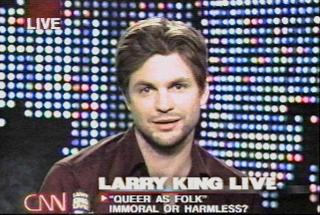
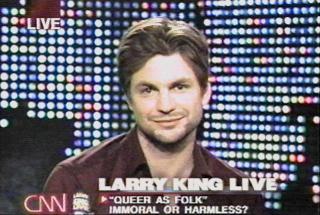
In New York is Gale Harold, who plays Brian Kinney, a successful ad executive unapologetic
about his feelings. Also in New York is Randy Harrison, who plays Justin Taylor. Justin is a
teenager who lost his virginity to the much older Brian. And here in Los Angeles is Hal Sparks
who plays Michael Novotny, the son of Sharon Gless. Michael is smart but somewhat naive.
[The cast members are shown individually as they are being introduced by King]
KING: The only two actual gay characters on the show are Peter Paige here in Los Angeles
and Randy Harrison here in New York. Why did you take this part, Peter?
PETER: I've always been drawn to controversial projects. I thought there was something
really exciting, really dynamic here. What I think has caused so much of the controversy
around this show is this combination of being about a group of gay men and women and its
unapologetic use of sexuality as part of the dramatic storytelling. And I just think those are
really human, human components.
KING: It's true.
PETER: It's true. That's exactly why. It's true.
KING: When did you come out? PETER: I started coming out as a teenager. It's a life-long
process. I, you know, still am, I guess.
KING: And Randy is the only other actual gay person in the show. Why did you take the part?
RANDY: I took the part because I got it. (LOL) You know, I was excited to do it. I wanted to
work. I just graduated from school. And it was a great way to begin my professional career.
KING: Did you have any doubts about displaying the character this way?
RANDY: Not really. I mean, I felt the sexuality especially in Justin's case was a really
important part of his development as a character. So, you know, I was actually excited to do
it and ready to do it.
KING: Sharon Gless, how did they get you involved?
SHARON: Well, a friend of mind sneaked me the script. And I called Showtime and asked if the part had been cast. And they said no, nothing had been cast. And I said, well, I'd really like to have that part. So, they sent me to the producers and it was one of the most fun interviews I've ever been on.
KING: Why did you want it?
SHARON: Because I smelled trouble and I wanted to be part of that.
KING: You like trouble.
SHARON: Yes. And, actually, there's been very little trouble around this show. I was
surprised. But it was very shocking, very graphic. I'd never read anything like that on
television and I wanted to be there.
KING: Peter Paige -- let me go to Peter. We want to get everyone established. Peter, who is
a straight actor, right, Peter?
HAL: No, he's Peter.
KING: I'm sorry. You're Peter. Hal, as a straight actor, why did you take the role of a gay
person?
HAL: Well, the script was excellent. And the character was something that I really felt like I
could resonate to and find a heart for. And, frankly, a lot of other actors I heard were afraid
to do it, gay and straight. They just wouldn't take a lot of the roles that were offered in the
show. And any time I can be 200th choice for something and actually get the part, I'm there.
But truthfully it was part of that. It was like other people wouldn't do this. And it felt
important. It felt historic. And I felt like I could really bring something it.
KING: You liked the script you got?
HAL: Yes. Yes. It was impressive. And it had a lot of intelligence to it.
KING: In New York, Gale Harold, who is also straight. We have to point that out because it is
unusual to have this kind of a complete program dealing with the gay lifestyle, male and
female, and everyone but two on it is straight. So, Gale, why did you take it?
GALE: Because it was a very interesting, challenging part and compelling for those reasons
initially. And the more I thought about it and considered what the impact was going to be, I
think socially, it just was a challenge I couldn't really pass up, to at least pursue, you know.
And when I got the job, I got the job.
KING: Was it tough, Gale, and also we'll ask Hal the same thing, was it tough to play scenes
out of natural concept for you, that is, having to make love to a man?
GALE: It was new and different, but it wasn't -- I wouldn't say tough. I mean, the implication
there being that -- I wouldn't want to say that it was anything other than a challenge. I
mean, that is the character that I signed on to play. And very much a part of his persona,
his personality is his sexual life. And so, I had to be committed to that. I knew that from the
time I decided to go and test for the part. And that's just part of the job, you know.
KING: In other words, it's acting.
GALE: Of course, it's acting.
KING: Hal?
HAL: I took the part knowing full well what would be asked of us. But I also wasn't
necessarily prepared in any way for what it would take. And for me, it is difficult. And I have
no qualms about saying that. But it's still worth doing. So a lot of things I've done in my life
are very hard to do, but they're important to do.
KING: I want to get everybody's thoughts and I wanted to establish everybody. We'll have
everybody correctly identified, too. I'm Larry King. The show is a hit on Showtime, a major
hit, in fact.
Later, we'll be meeting its executive producers and one of its critics. Don't go away.
[Commercial Break]
[Video clip from QAF is played]
MICHAEL: I'm taking you home. Where do I turn?
BRIAN: He's going with me.
MICHAEL: Oh, no, he's not.
BRIAN: Pop quiz, no talking. Here's the question. Multiple choice. Do you want to come home with me? A, yes; B, yes; or C, yes. Tick, tick, tick, time's up. Pencils down. What do you say?
MICHAEL: None of the above. He's going home.
JUSTIN: I'm going with him.
BRIAN: Good boy. You get an A-plus.
[Video clip ends]
KING: You are seeing scenes from "Queer As Folk," the highest rated original series on
Showtime, the premium cable network that brands itself with the phrase "No Limits." It is
based on a highly successful British series of the same title, "Queer As Folk." Focuses on a
group of gay men and women living in Pittsburgh. "Queer as Folk" is shot in Toronto. Returned
for its second season on Showtime in January, is a major hit on that network.
Now, you know, Peter, that there are many gays complaining that they don't like the way
this lifestyle is portrayed. How do you respond?
PETER: Well, I think they're, A, not watching the show. I think they're only responding to the
press about the show which is, oh, it's provocative. There's a lot of sex in it. There's drug
use in it, which is true. My mainstay of all is that it's real. This is real. This happened. This is
going on.
KING: This is the gay life?
PETER: The people who are complaining about it are either ashamed of their own lives and
mad that we're telling secrets or they're looking for some sort of politically correct best foot
forward, you know, "Cosby Show" type programming, which is not what this show set out to
do. This show set out to tell the story of these people's lives, warts and all. And it is pissing
people off. I don't apologize for that.
KING: Sharon Gless, you're a two-time Emmy winner for "Cagney and Lacey." This is not
"Cagney and Lacey."
SHARON [laughing]: No.
KING: Is realism just more coming to the fore?
SHARON: I'm sorry, what?
KING: Is that what this is about, that television just gets more real all the time?
SHARON: More real? Well, I hope so. I hope so. I mean, that was the success of "Cagney and
Lacey" was that it was so real, first time out for a show like that. And I say the same thing
for this show. I mean, you can't get too real. I mean, it's...
KING: Can you understand where it's disturbing to people?
SHARON: Well, it depends on who the audience is. I imagine there's -- yes, there are some audiences that it disturbs. But everyone I talked to loves it because it's -- I hate that expression, �pushing the envelope.' But it is taking that next step towards showing the reality of the life of these kids. It is not everybody. It's just this group of youngsters.
|
|
For a printable version
|


QAF: Queer As Folk © QAF-QueerAsFolk.cjb.net 2002.