149 - 146 BC
The regrowth of Carthage's power was soon seen as a potential threat to those in Rome. The most prominent advocator of war was Marcus Porcius Cato, known to history as 'Cato the Censor'. It is said that this man, at the end of every political speech he made, regardless of the subject, always ended with the words "censeo Carthaginem esse delendam" which means "I declare that Carthage must be destroyed."
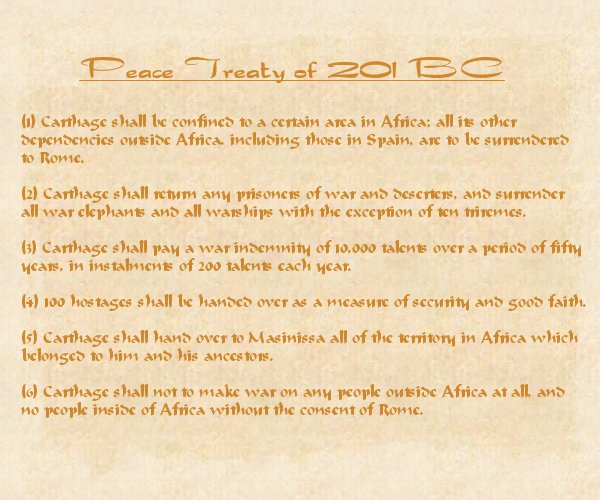
Masinissa, the Numidian king who had fought alongside the Romans at Zama, by terms of the peace treaty had been given 'all of the lands belonging to him and his ancestors'. This wording on the part of the Romans was quite precarious as there was no real limit to what Masinissa could claim as his own, and the African king began to exploit this fact. He reminded his subjects that the Phoencians had been welcomed by their ancestors in the face of refuge, but had eventually coveted all of the land which was once their own, including the ground on which the city of Carthage lay itself. With this in mind he made it his clear intention to drive the Carthaginians out of Northern Africa and retake possession of their territory.
The Carthaginians, terrified and willing to do anything to save their city, handed over 200,000 sets of armour and 2000 catapults, but even this was not enough to save them. The Senate in Rome had deliberately held back their final demand from the men negotiating in Africa, and this was that the Carthaginians should abandon their city and build a new one no less than ten miles from the sea, a proposal which was clearly impossible for a major trading state. The people of Carthage refused and no doubt feeling betrayed and helpless, they sealed the gates and prepared to raise an army. The Carthaginians worked night and day and the whole city contributed in some way to making weapons and other necessities, and in a short time these people had fully prepared themselves for a siege, taking the Romans by complete surprise when they finally moved in.
The war moved slowly for the first few years until around 147BC when Scipio Aemilianus took command of the troops in Africa. This man was the son of a distinguished general and adopted grandson of Scipio 'Africanus' and had made consul even though he was both too young and had not yet held the office of praetor (chief magistrate of the state, a position which was required at this time to become a consul). Scipio built a huge stone wall surrounding the Carthaginian harbour in order to trap her naval fleet, but the Carthaginians cleverly built another exit for their warships. This fleet may have had some success had they attacked the unprepared Romans straight away, instead due to lack of experience they let time slip away and the Romans were able to recover and subsequently defeated them.
According to ancient historians, in 146BC the Roman forces commanded by Scipio Aemilianus, surrounded Carthage whose people had locked themselves in and put up a fierce resistance in the face of the Roman onslaught. As the legions advanced their fate was sealed, but for seven days after the Romans had broken through the walls, the Carthaginians continued to fight, an example of their true patriotism and warlike spirit.
When the Romans finally surrounded their citadel the men inside offered to surrender on the condition their lives be spared, and when Scipio assured them, 50,000 people emerged. 900 deserters of Rome refused to give up and eventually set fire to a temple they were inside and burned themselves to death. Hasdrubal had initially supported them but when he too surrendered, it is said that his wife called him a coward and immersed herself and her children in the flames.
The remaining citizens were sold into slavery and although Scipio wished to save the city from further destruction, the Senate ordered that Carthage should be burned for ten days. After the troops carried out this order, what was left of the Carthaginian Empire ceased to exist completely and their territory in Northern Africa became a Roman province.
The massacre of the people of Carthage was probably the largest ever slaughter of civilians at one time in the ancient world, guilty of nothing more than defending their homeland. Out of an estimated population in excess of 700,000 people, only 50,000 were left alive at the final surrender. As Scipio watched the flames he turned to Polybius and remarked on his fear that one day the same terrible fate would become of his own city, and his words were to be echoed some six centuries later when the mighty Roman Empire fell.