Hannibal's father, Hamilcar, was the most accomplished general on the Carthaginian side during the first war, and after Carthage was defeated by the Roman fleet at the Aegates Islands, it was he who negotiated the peace terms which led to the evacuation of Sicily. Hamilcar went on to win victories and territorial gains in Spain, rebuilding the empire and preparing a future base for war against Rome. Hannibal had accompanied his father to Spain, and as a child he soon inherited from him the same distrust and hatred of Rome that he had.
"At the time when his father was about to set off with his army on his expedition to Spain, Hannibal, who was then about nine years old, was standing by the altar where his father was sacrificing to Zeus. The omens proved favourable, Hamilcar poured a libation to the gods and performed the customary ceremonies, after which he ordered all those who were present at the sacrifice to stand back a little way from the altar. Then he called Hannibal to him and asked him affectionately whether he wished to accompany the expedition. Hannibal was overjoyed to accept and, like a boy, begged to be allowed to go. His father then took him by the hand, led him up to the altar and commanded him to lay his hand upon the victim and swear that he would never become a friend to the Romans." (Polybius)
In 230 BC Hamilcar Barca died and his second son Hasdrubal took command of the Carthaginian provinces in Spain. As the result of growing Carthaginian power, in 226 BC Rome signed a treaty limiting their expansion to south of the Ebro river in Spain. Five years later Hasdrubal was assasinated and Hannibal was elected commander by the army. Hannibal quickly secured his influence over all of the Spanish tribes, and his reputation as a military leader began to grow.
Saguntum, a small city south of the Ebro river, had been establishing friendly ties with Rome. Confident in their alliance, the Saguntines became less cooperative with the other Spanish cities and were also committing offences against subjects of Carthage. In 219 BC Hannibal attacked. He laid siege to Saguntum and after eight months the Carthaginians captured the city.
Hannibal had his own reasons for capturing Saguntum, he saw that he could deny the Romans the chance of basing their army there in the event of war, that the city would supply his army with sufficient funds and supplies for his expedition, and most importantly that he wouldnt be leaving an enemy behind him when he advanced into Italy.
The Roman senate, furious at this, demanded that Carthage surrender Hannibal to them. When they refused Rome declared war, and in 218 BC the Second Punic War began.
Journey Across the Alps
In spring Hannibal assembled his troops for the march, some 90,000 infantry and 12,000 cavalry, while at the same time receiving news that two Roman envoys sent to Carthage to demand his surrender had witnessed an enthusiastic response for war by the Carthaginian senate. His spirits were raised and he was about to embark on one of the most fascinating military campaigns in history.
Hannibal's plan was to march northwards crossing the Pyrenees and the Alps and then descend into northern Italy, recruiting Celtic tribes to join him along the way. He waited until the moment when the Romans would think it was too far into winter for an army to cross and then he struck, crossing the Alps in just fourteen days. Thousands of Carthaginians perished during the journey, many either freezing to death or killed by hostile tribes as the army was strung out loosely and easy prey for attack. Not until nearly two thousand years later was such an astonishing manouvre attempted again by the armies of Napoleon.
Hannibal crossed the Ebro river and quickly subdued all of the Celtic tribes living in the area, leaving behind a force of around 10,000 men with his brother Hanno and sending an equal force home to Carthage. His army now numbered around 50,000 infantry, 9,000 cavalry and 38 elephants as Hannibal crossed the Pyrenees, outmanouvered a Roman army near the river Rhone, and then began the journey across the Alps.
The Carthaginian army suffered enormous losses during the march and by the time they descended into Northern Italy they numbered just 20,000 infantry, 6,000 cavalry and only a few of the elephants. But Hannibal had acheived his goal, he had managed to bring an army of largely mercenary soldiers over extremely hazardous terrain more quickly than anyone could have anticipated and now he was in Italy where he subsequently linked up with allied Gallic tribes and was able to recruit his army with another 30,000 men.
The Roman army had advanced to meet him, two legions under Scipio the elder were stationed on the north bank of the Po, where they awaited the arrival of another two legions under Tiberius Sempronius Longus. In November, after strengthening his army with Gauls, Hannibal soon moved towards Scipios position and the two armies met near the river Ticinus. In a relatively small battle involving mainly cavalry, Hannibal defeated the Romans and Scipio was severly wounded, retreating with his army to nearby Placentia.
The Battle of the Trebbia
By Decemeber 218 BC Scipio had linked up with Longus and the two armies were camped near the river Trebbia. Because Scipio was still recovering, Longus was in command of the action and he was eager to engage the Carthaginians, in the hope of glory for himself alone. If he waited until Scipio recovered or until the new consuls were voted in he would be denied the decisive victory in the campaign and therefore he was anxious to take the offensive, despite Scipios view to the contrary. Hannibal was fully aware of this and quickly devised a plan to lure Longus into battle.
The Carthaginian general placed a force of 2000 men under the command of his younger brother Mago and when night fell he ordered them to advance and take position near the river in a place predetermined for an ambush. The men were to conceal themselves under dense bush that lined the riverbank and wait there until the decisive moment. At daybreak Hannibal ordered his Numidian cavalry to advance on the Roman camp and try to lure them out by firing missiles at them and withdrawing. As soon as Longus saw their approach he ordered the Roman cavalry to move out and attack them. Then he sent forth 6000 javelin-throwers, followed by the main body of his army who were completely unprepared and most had yet to eat breakfast. The weather was bitterly cold and raining and as the day progressed the Romans began to suffer both from hunger and the temperature - in comparison to the Carthaginians who had all eaten, annointed themselves to help with the cold and were fresh and ready for battle.
When the Romans crossed the river, Hannibal sent forward his pikemen and slingers and then advanced with the rest of his army, placing the infantry in a single line, dividing his cavalry between the wings and reinforcing them with the Elephants. With blind confidence in himself and his troops, Longus drew up his infantry in the standard fashion and divided his cavalry between the wings.
The battle opened with the light-armed troops, the Carthaginians proving far more effective as the Romans had used up most of their missiles and the rest were ineffective due to the wet. When they retired, the infantry moved forward to engage and Hannibal immediately ordered his cavalry to attack the enemy's wings. The Romans fell back under the charge, and with their flanks now open the Carthaginian pikemen and Numidians emerged from behind the front line and attacked. The Romans now faced troops attacking them from both the sides and the front, but managed to keep up with the intense fighting that was taking place in the centre.
Next Hannibal implemented the stroke of genius. The troops under his brother Mago who had been hiding, emerged from their position and suddenly charged the enemy from behind, creating chaos among the Roman ranks. The wings of the infantry were forced back by the Elephants and the skirmishers and when the main body saw this, although they had made progress, they closed their ranks and managed to retreat safely to Placentia. The majority of the troops that were left were killed by the Carthaginians and only a few managed to escape.
The army was exultant at the outcome of the battle, losing far less men than the Romans had, but nevertheless they had been severely affected by the rain and snow, and this resulted in the loss of all but one elephant and large numbers of men and horses. When the news reached Rome about what had happened near the river Trebbia, the senate put all their energy into strenghtening their forces and reinforcing positions that lay in the enemy's path.
"It is when the Romans stand in real danger that they are most to be feared" (Polybius).
The Battle of Lake Trasimene
It was now the year 217BC and Hannibal was about to lure the Romans into one of his legendary and deadly traps. The new consuls, Gaius Flaminius and Servilius Geminus had taken command and were stationed west and east respectively, covering both possible routes for the Carthaginians. Hannibal advanced in the direction of Flaminius, taking the most difficult and therefore least suspected route. He knew his enemy's character well and decided if he were to move ahead of him and ravage the Roman countryside, that Flaminius would find it hard to resist an attack before teaming up with the other army, and by doing so he would win the victory for himself. Hannibal cleverly outmanouvered the enemy and managed to get past them and then began attacking the surrounding villages. The sight of smoke rising as the Carthaginians burned the countryside was too much for Flaminius to bare and although cautioned by his officers, he broke camp and advanced hastily towards Hannibal, completely confident in himself and his resources.
Hannibal had predetermined the ideal spot for his plan, he had found an area next to Lake Trasimene with steeply rising hills surrounding a valley and very narrow passes at the bottom.
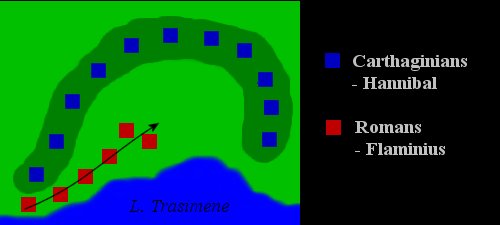
Flaminius himself was killed in the action, along with 15,000 Roman troops. The men in the rear were either driven or ran themselves into the lake and when the Carthaginian cavalry bore down upon them relentlessy, they cried out for their lives to be spared. Many drowned in the lake or put themselves to the sword, the rest being killed by Hannibal's horsemen. 6,000 Romans managed to get away and retreated to a nearby village where later the Carthaginians surrounded them and they surrendered.
Hannibal decided against marching on Rome at this point, the reason he did so was because he was pursuing a strategy of getting Romes allies to defect to him and if a direct attack on the capital failed he would have thrown away the fruits of victory. His only chance of winning the war and defeating Rome rested in having the other states on his side.
With this in mind he marched the troops southward and pitched camp along the eastern coast. Meanwhile in Rome the people were shocked and devestated by the news of their army's defeat, but the Senate remained calm and adopted a new policy, appointing Quintus Fabius as dictator. His plan was not to face Hannibal in open battle but to follow his army closely, slowly reducing his limited manpower and resources, while doing their utmost to keep their allies loyal. This strategy worked, they attacked small groups that strayed from the Carthaginian camp, and this encouraged the troops, whose spirits had been shattered by their recent defeats.
Not a single Italian city had defected to Carthage and Hannibal was losing the political side of the war, even though he was yet to suffer a defeat. "Such was the awe and the respect with which the allies regarded the Roman state."
Fabius refused to give a pitched battle, instead keeping on the heels of the enemy, and so Hannibal decided to march boldly into the most fertile area of the countryside, with the intent of showing Romes allies that they had abandoned the open plains. Fabius held fast to his policy and held his troops back, parading them around the hills to show he had not deserted the allies. He placed a unit of 4,000 men near Hannibals most likely exit from the valley and planned to ambush his army at the right moment.
The Romans commanded the heights and were certain they had Hannibal right where they wanted him with no chance of escape. Hannibal however, was about to spring his biggest surprise yet, and he accurately guessed what his enemy was most likely to do, as he always did so well. When night fell the Carthaginians tied sticks to the horns of a herd of oxen, set them on fire, and then chased them up one of the hills. When the Romans saw the lights they immediately assumed it was Hannibal making a dash out of the valley and they rushed towards the hill to stop him, only to find they had been tricked. The men guarding the exit had abandoned their position and the Carthaginians made it safely out of the valley under cover of darkness.