(Page 2)
The Battle of Cannae
Hannibal had brought Rome closer to her destruction than at any point in her history. The people were terrified and wondered if things would ever be the same, but the Senate once again changed their strategy and decided to go all out against the Carthaginians, recruiting an enormous army to face them. According to Polybius, Rome mobilised eight legions, by far the largest force they had ever put into the field. Their army was backed by experienced and confident generals, the most prominent of whom was Lucius Aemilius Paullus, who had proved his skills in earlier campaigns. With these considerations in mind, the Romans this time were certain of victory over the Carthaginian menace.
The ancient historians record that on the 2nd of August 216 BC, Hannibals army stood to the left of the Aufidus river in the vicinity of the village of Cannae in south-east Italy. Opposite them were the Roman legions, under the command of Caius Terentius Varro, he and Paullus were consuls for the year and it was customary to take command of the army on opposite days. The Romans had almost 90,000 men, a massive force compared to the Carthaginians who only had around 40,000. The battle that was about to take place is still studied around the world today as a supreme example of brilliant military tactics, the perfect encirclement manouvre.
Before the encounter the generals on both sides had adressed their troops with inspiring speeches. "..Wherefore, men of the army, apart from any words of mine place before your eyes the momentous difference to you between victory and defeat, and all their consequences. Enter upon this battle with the full conviction that in it your country is not risking a certain number of legions, but her bare existance...All she has in confidence and strength rests on you, all her hopes of safety are in your hands. Do not frustrate those hopes, but pay back to your country the gratitude you owe her, and make it clear to all the world that the former reverses occured not because the Romans are worse men than the Carthaginians, but from the lack of experience on the part of those who were then fighting.."
These were the words of Aemilius Paullus and with them he dismissed the troops.
Hannibal paraded his army and similary spoke to them with the intention of rousing their spirits for battle. "..Now seeing that you have undeniably beaten the Romans in three successive battles of such magnitude, what arguements could have greater influence with you in confirming your courage than the facts? By your previous battles you have gained possession of the country and all its wealth in accordance with my promises...But the present contest is for the cities and the wealth in them and if you win it, all Italy will at once be in your power, and freed from your present hard toils and the masters of the wealth of Rome, and you will by this battle become the leaders and lords of the world. This then, is a time for deeds not words: for by God's blessing I am persuaded that I shall carry out my promises to you forthwith."
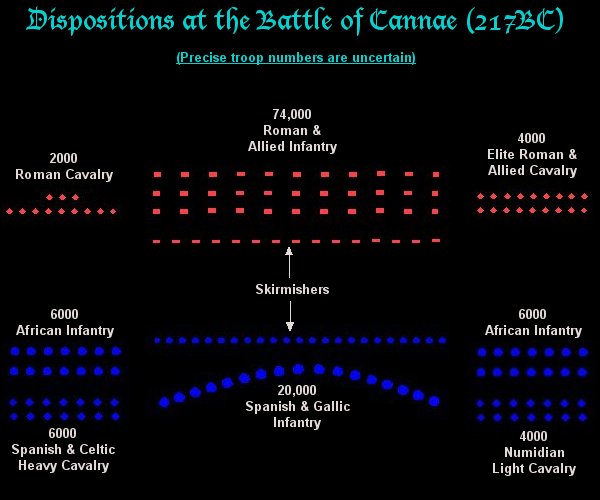
On the right wing the cavalry engaged and eventually the Numidians chased the Romans off the battlefield, with the help of Hasdrubals cavalry who had been victorious on the opposite flank. The Roman legions, as they pushed into the centre of the fighting, had now penetrated so far that they suddenly found themselves surrounded on both sides by Hannibals veteran infantry, who subsequently wheeled around and attacked the Romans on both flanks. The Roman soldiers were now forced to break ranks and fight men from both directions as the pressure enclosed around them. The fighting was intensely aggressive and barbaric as the Carthaginians relentlessy hacked away at the enemy, their spirits raised even higher when Hasdrubal returned with the heavy cavalry and charged at the enemy from the rear.
The Roman army now found themselves trapped on all sides, Hannibal had effectively encircled their entire force, and the battle at this point turned into a massacre at the hands of the Carthaginians. The terrified men could do nothing to save themselves and the devestation began to sink in, as Hannibal had once again cleverly outhought his opponents and had completely annihilated their much larger force.
An estimated 70,000 Roman soldiers gave their lives fighting gallantly on the battlefield at Cannae, including Lucius Aemilius Paullus who charged into the centre on his horse, dismounted, and joined the frontline fighting. The pro-consuls Marcus Atilius Regulus and Gnaeus Servilius were amongst other prominent leaders who, in Polybius' words "had conducted themselves in the battle as brave men who were worthy to be citizens of Rome."
Hannibals military genius had prevailed yet again and he had won a supreme and decisive victory over Rome. His brilliant tactics, the supreme confidence his men had in his command, and his superiority in cavalry, allowed him to defeat a first class army over twice the size of his own, marking one of the most famous and important battles in ancient history.
"So ended the battle between the Romans and the Carthaginians at Cannae, a struggle in which both victors and vanquished fought with indomitable courage."
Hannibal's overwhelming victory at Cannae was not enough to win the war however, and it continued on for some years, the Romans yet again refusing to surrender and putting yet another army into the field. They had some success in the following years, but what Rome really needed was a confident and brilliant general to finally bring an end to Hannibal Barca. The man they were looking for soon appeared in the form of Publius Cornelius Scipio 'Africanus' (236-184BC).
In 210BC Scipio took command of the Roman forces in Spain and succeeded in destroying New Carthage, Hannibals original base. From there he planned an invasion of Africa and an attack on Carthage itself, and in 204BC he landed with a veteran army of around 30,000 men. The following year, after a sixteen year campaign in enemy territory, Hannibal was finally forced to leave Italy to defend his homeland against the Roman invasion.
The Battle of Zama
The decisive confrontation arose in 202BC and the two armies met on a plain just west of Zama Regia in North Africa. The battle of Zama is probably far more important to history and the shaping of the world than that of Cannae, it was both the end of one of the greatest military campaigns and greatest leaders ever and also a major step in the direction of world supremacy for the Roman Empire.
Before the battle Hannibal had asked his adversary to meet with him personally, and the two generals rode out on the next day and met to discuss the situation of the war. During their conversation the Carthaginian warned the young Scipio about the uncertain nature of fate, "I am that Hannibal who after the battle of Cannae became master of almost the whole of Italy, who later advanced up to Rome itself, pitched camp within five miles of her walls, and there took thought as to how I should deal with you and your country. Today I am here in Africa, on the point of negotiating with you, a Roman, concerning my country's very existance and my own."
He then pointed out his peace terms which Scipio was certainly not about to accept, the Romans now had a well trained army with a confident general and were deep inside enemy territory and threatining the capital itself. Scipio replied by stating that in both wars Carthage had been the aggressor, which Hannibal could not dispute. He believed that the gods would grant final victory to those who had taken up arms in defense of their country, as had been the case in the first war. He then went on to comment about events in the war and Carthage's violation of the treaty and ended by stating, "The fact is that you must either put yourself and your country unconditionally into our hands, or else fight and conquer us."
Both sides were fully aware of how much was at stake, Carthage was fighting for Africa and the survival of their empire and Rome was fighting for possession of the entire western Mediterranean.
Scipio drew up his army in three lines with gaps between the ranks instead of the usual checkerboard formation and this was to allow Hannibals elephants to pass through. To the left he placed the allied Italian and Roman cavalry and on the right the Numidian cavalry, with the light-armed troops along the front.
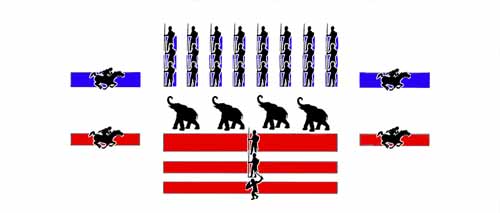
Left wing: 3000 Numidian cavalry
Centre: 36,000 infantry,
80 elephants
Right wing: 2000 Carthaginian cavalry
Left wing: 2000 Roman cavalry
Centre: 29,000 infantry
Right wing: 4600 Numidian cavalry
Hannibal gave the command and the elephants charged at the Romans who simultaneously broke into loud cheers, sounding trumpets and banging their weapons together, creating such a noise that most of the elephants either turned back and charged at their own army or fled between the gaps in the Roman ranks as Scipio had planned. Taking advantage of the chaos, the Roman cavalry charged the enemies right wing and around the same time the cavalry on the left wing also engaged, both sides pushing the Carthaginians so far back that they ended up chasing them from the field. The heavy infantry was now marching towards each other at a slow pace and when they drew near, both sides broke out in warlike spirit and engaged in furious battle causing heavy losses on both sides. Eventually the Carthaginians in the second line gave way and the mercenaries in front them, seeing that they had been abandoned, fell back upon these men and began attacking them.
Scipio rallied the Romans and advanced on Hannibal's veterans who were still waiting in the back line, the gap between the troops "covered with blood, corpses and wounded men ... the bodies lying in blood drenched heaps and the spaces between encumbered with arms that had been thrown away at random." The legions fell upon Hannibals veteran infantry and more intense fighting broke out, both sides keeping up for a long time as they were very evenly matched in both experience and weapons. Finally, and just in time, the Roman and allied cavalry returned from their pursuit and attacked the Carthaginians from the rear, killing the majority of them where they stood and chasing down the rest.
This was the end for Hannibal, his cavalry had been defeated and fled, his infantry was destroyed and he himself managed to retreat safely to a nearby town. Of the Romans, only around 1500 men had lost their lives, but more than 20,000 Carthaginians lay dead on the field and almost as many taken prisoner. The Roman Empire had finally defeated the greatest opponent that they ever went to war against.
The end of the war
Hannibal Barca's lifelong dream of crushing Rome was shattered, and although he had fought to the end with the courage and judgement of a good general, he was finally defeated on his home soil by a nation whos military might would go on to conquer the world. Scipio was given the title 'Africanus' in honour of his magnificent victory and was hailed as a hero by the people in Rome. He had vanquished one of history's greatest ever commanders.
The Battle of Zama in 202BC brought an end to the Second Punic War between the Romans and the Carthaginians. Romes victory was a testament to their relentless strength and driving will even in the face of unimaginable danger, as well as their enormous resources and availibility of troops. The lessons learnt between these two great empires during the Punic Wars still serve as valuable knowledge today, and over two thousand years later the expedition of Hannibal of Carthage continues to fascinate historians, artists, and filmakers from all over the world.