250-242 BC
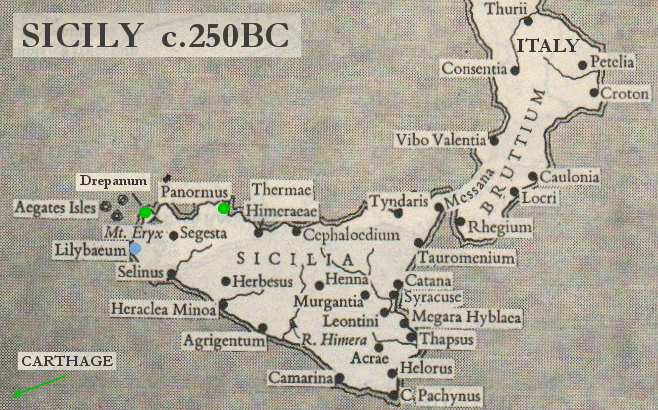
In the final years of the First Punic War, Rome had abandoned all military operations in North Africa and began to concentrate its forces in Sicily, where they were now in control of almost the entire island with the exception of the port cities Lilybaeum and Drepanum which were in Carthaginian hands.
The Romans had suffered several major disasters at sea and as a consequence they decided to give up the idea of building any more ships, ultimately giving back to the Carthaginians complete naval supremacy in the western Mediterranean. And although the land forces had made substantial progress in Sicily, capturing most of the major cities, they had become terrified of an exaggerated fear of the Carthaginian war elephants.
Because of this and the destruction of the navy, morale amongst the troops declined and one of the consuls even returned to Italy with half the entire army, leaving behind c.Lucius Caecilius Metellus, who's forces remained at Panormus to protect their allies at harvest time. This gave the commander of the Carthaginian army the motivation to march out from Lilybaeum and attack the Romans at Panormus.
The Carthaginians advanced right up to the gates, but this time the tactics employed by Caecilius overcame the elephants, allowing him the opportunity to charge out with his troops and attack the surprised enemy, killing many and driving away the rest. "By achieving this success it was generally agreed that he was responsible for restoring to the Roman troops the will to fight and to regain control of the open country."
The Senate, who had already given the orders to begin building a new fleet, were encouraged by this news and decided to send out the consuls with 120 ships. In 250BC these ships sailed south to Sicily where they anchored not far from Lilybaeum, and in co-operation with the land forces the Romans began to surround and lay siege to the city.
The beginning of the siege
The Roman army set up camps on either side of Lilybaeum and then constructed a ditch and a wall to fortify the area in between. As soon as this was complete they began building siegeworks with great enthusiasm and advanced little by little on the defense towers which surrounded the city. These were manned by the Carthaginian mercenary force which consisted of 10,000 Greeks and Celts under the command of a general Himilco, and although the citizens of Lilybaeum were overcome with fear and despair, Himilco defiantly resisted the enemy with every available means.
For its part in the relief of Lilybaeum, the Carthaginian government decided to mobilise fifty ships filled with 10,000 soldiers and sent them out with orders to advance without hesitation, making a daring attempt to land as soon as the opportunity was favourable. The ships sailed towards the west Sicilian coast and anchored near the Aegates Islands not far from Lilybaeum. As soon as the winds were suitable, under the command of a general Hannibal, the Carthaginians raised their sails, and with the soldiers standing armed on the decks they headed directly for the opening of the harbour.
The Romans were taken by surprise and were completely shocked by this audacious move, so much so that they didnt dare to prevent the entry of the fleet. They were also concerned about becoming locked up in an enemy port with the invading force by the wind, and so they did nothing but remain in position offshore and watch the Carthaginians in bewilderment.
Thousands of people had lined the city walls intensely watching the arrival of the reinforcements and when they approached they all broke into loud cheers, mainly due to the fact that the Romans had made no attempt to stop them. Hannibal managed to safely disembark all of the soldiers and join forces with the garrison inside the city, making a total of 20,000 men now under the command of Himilco, and the ships sailed away by night to nearby Drepanum.
The mercenaries spirits were now heightened by the arrival of these fresh troops, and Himilco, taking advantage of the situation, delivered an inspiring speech in front of them, promising generous rewards to men who showed bravery in action. The general's words were received with huge enthusiasm, and accordingly he dismissed the troops and set about preparing for a dawn raid on the Roman siegeworks.
The commanders on the Roman side had calculated Himilco's possible intention and the army was fully prepared when he ordered the offensive. They made quickly for the areas under attack and fought with everything they had to defend the siege equipment, which the Carthaginians were making every attempt to destroy by fire.
As the Romans surrounded the siege engines, desperately resisting the enemy, violent fighting broke out between the two sides and spread along the length of the city walls. Himilco had sent forward his entire force of 20,000, the Roman army was even larger, and the battle had developed in such chaos that neither side were able to join ranks and fight as units ... "so that something of the spirit of single combat pervaded the whole battlefield."
The Carthaginian soldiers relentlessly pushed forward as other men rushed in with blazing torches and kindling, setting fire to the siege engines wherever they could, while the Romans furiously fought back, and large numbers from both sides were killed. Eventually though, Himilco decided he was losing too many men and wasnt reaching his objective, and so he called off the attack and retreated back inside the city walls, the Romans managing to keep most of the siegeworks intact.
The members of the Carthaginian senate were largely unaware of what was happening at Lilybaeum because they had no lines of communication into the besieged city. Apparently a prominent citizen by the name of Hannibal spoke up and offered to sail into the harbour and bring back a first hand report of the events taking place. The senate, although desperate to receive news, were sceptical that this man, who was nicknamed "The Rhodian", could achieve such a thing with the Roman fleet anchored at the mouth of the harbour. Neverthesless, he prepared his own small vessel and sailed to an island close to Lilybaeum where he waited for favourable winds.
The very next morning, "The Rhodian" sailed directly into the city in broad daylight in complete view of the startled Roman fleet. On his return the following morning, the Roman commander had decided he should maintain better control over the harbour, and had prepared ten of his best and quickest ships, which waited either side of the entrance in anticipation. The entire army was also lined along the shore awaiting to see what would happen when this daring Carthaginian sailed out, and the patrol ships waited in silence "..their oars stretched out like wings, ready to strike the water.."
The Rhodian again sailed out with no attempt to conceal himself from the Romans, and surprisingly managed to outmanouvre and outrun the awaiting patrol and get through with no damage to his vessel or the crew. The Carthaginians were expert ship builders with years of experience, The Rhodian's craft was sleeker and faster than those of his enemy and his personal skill in accomplishing such bold manouvres is self-evident. Once he was through the Roman line and had rowed out to sea a little way, he halted and about faced with his oars drawn, daring the them to attack. He was mainly doing this to spite the Romans, and when none of them advanced he sailed away and safely crossed back to Carthage "..having successfully defied the entire Roman fleet with his single ship."
Hannibal The Rhodian managed to repeat this act on several occasions, and contributed greatly by providing information both to and from Carthage during the siege of Lilybaeum. Along with the superior quality of his vessel, he also had profound knowledge of the waters in and around the harbour, and his success encouraged others with experience along this part of the Sicilian coast to run the blockade and provide what help they could. All this helped to heighten the spirits of those captured inside the city, while it also humiliated the Romans, who tried desperately in vain to construct a wall in the ocean to block the harbour entrance. In one shallow area they did eventually manage to build up a pile of rubble, and one night one of the blockade runners hit the mound and was captured by them.
The Romans were now in possession of a Carthaginian quadrireme (a wooden ship with four decks of oars), they manned it with a selection of their finest troops, and then went on the hunt for The Rhodian. They were also on watch for any enemy vessels passing through, but it wasnt long before they actually sighted the Rhodian and began in pursuit. The Carthaginian was alarmed as he recognised the ship and did his utmost to pull away, but the Romans now rowed faster and compelled him to engage. When they drew near, the pursuers boarded the deck of the Carthaginian ship and overcame the crew who were no match for the selected Roman soldiers that outnumbered them, and they were all taken prisoner along with Hannibal The Rhodian.
The Roman fleet now had two exceptionally well crafted Carthaginian ships which were faster than anything that they previously had the use of. By using these ships and keeping them manned with their finest soldiers, the Romans eventually managed to put an end to the daring men who defied them by penetrating the blockade.
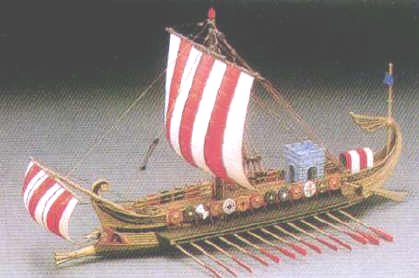
This is probably the type of ship the Romans fought with during the First Punic War. This galley has only one set of oars, however some had up to five horizontal rows (quinquireme).
In these early years, all of the Roman ships were direct copies of those of the Phoenicians, and their first fleet was actually built from the plan of a captured Carthaginian ship.
As the troops locked up inside Lilybaeum continued to do their utmost defending the Roman assault, rebuilding and reinforcing where they could, a fateful event suddenly offered them a huge advantage over the enemy. Gale force winds had arisen and blown away or destroyed the penthouses which the Romans used to cover their siege-engines. Seizing the opportunity, the Carthaginians immediately prepared for a counter attack, and rushed up to the walls with firebrands and missiles of every kind, launching them down at the unprepared Romans.
This move, aided by the wind, was so effective that fire broke out all along the enemy siege train, and as the Romans desperately ran in to defend, they were caught amongst sparks and smoke and flying debris, and many fainted as they gave their best to hold onto the equipment. The attempted rescue was useless, the Carthaginians had managed to burn most of the siege engines to the ground, and accordingly the Romans gave up on the idea of taking Lilybaeum with this method.
Both sides now settled in to await the outcome of further events, the Romans held firm by constructing a moat and a fortified wall, and the garrison, who's spirits were reasonably high from their recent victory, continued rebuilding and waited for the next development.
Drepanum
The Romans had suffered heavy casualties throughout their operations at Lilybaeum and in 249BC the senate dispatched a fresh contingent of 10,000 troops to assist in holding the siege. The consul for that year, Publius Claudius Pulcher, decided he should take the opportunity and surprise the Carthaginian fleet at Drepanum, his officers agreed and they sailed out at night with 120 ships towards the city. As they approached the harbour at dawn, the Carthaginian commander, Adherbal, was at first surprised, but his naval experience was far greater than that of Pulcher's. Adherbal unexpectedly sailed out to give battle, forcing the convoy of Roman ships to retreat to the open water, and this caused huge confusion and collisions within the fleet. Eventually both sides were ranged in a battle line, but Adherbal with a force of about half that of the Romans, won the day from his superior skills and Pulcher's lack thereof. Ninety three out of the 120 ships that attacked were captured by the Carthaginians, and Claudius Pulcher narrowly escaped execution for his reckless endangerment of the Roman forces.
Meanwhile the Carthaginians were planning to attack the Roman ships holding the blockade at Lilybaeum, and a man named Carthalo led the attack into the harbour, setting fire to some of the ships and towing away others. The soldiers who were inside the Roman camp poured out in their thousands when they saw what was happening, in an attempt to rescue the remaining ships, and Himilco, who had been alerted by the noise, subsequently led his troops out of the gates so that the Romans were suddenly pressed in on both sides. Eventually though, Carthalo sailed away from Lilybaeum as he planned to intercept a Roman supply fleet who were making their way along the south Sicilian coast.
This supply fleet, which was escorted by warships, decided to anchor near land instead of risking a battle against the Carthaginians, and meanwhile another fleet under the consul named Pullus, was also beginning to make their way along this route. Again instead of giving battle, Pullus risked anchoring the fleet in a rocky area, and the Carthaginians waited patiently in between both of these fleets, having by now only captured a few of their ships. Before too long the Carthaginian captains warned Carthalo of an approaching storm and suggested that they sail east around Cape Pachynus and put in there while the storm passed. Carthalo agreed and not a moment too soon, the storm hit with fury and both of the Roman fleets that were still on the southern side were totally annihilated.
Hamilcar Barca and the end of the war
The people in Rome were greatly affected by this news, as were the land forces in Sicily, and the senate decided once again to abandon the idea of a naval force altogether. The army continued to hold the blockade at Lilybaeum despite their setbacks, and the consul Pullus captured a mountain named Eryx, placing camps on both the top and the bottom.
The war was given some fresh heart when Hamilcar Barca (father to the legendary Hannibal) took command of the Carthaginian forces and after raiding the Italian coasts, landed his army northwest of Palermo in 247BC. The Romans reinforced their position at Palermo and the war raged between these two evenly matched sides for the next three years. Hamilcar then managed to capture the town of Eryx, which was on the mountain, directly in between the two Roman garrisons holding it. This was obviously a bold move on the part of the Carthaginians, and the fighting again raged between the two sides for another two years, with neither side in the end being either the victor or the defeated.
In the end events elsewhere led to the end of the war, which had now gone on steady for 22 years, the longest of all three wars and one of the longest ongoing conflicts in the history of mankind. Polybius uses an excellent metaphor to describe the feeling of the final years of the First Punic War :
"....In general the struggle between the two nations might be compared to a fight to the death between two game-cocks. It often happens that when the two birds have lost the use of their wings from sheer exhaustion, their courage remains high to the end, so that they go on striking blow after blow at one another, until at last without any intervention from outside they fall into a mortal grapple, and once this has happened one or the other will drop dead. ... And so, like the victorious fighting-cock, the Romans braced themselves for a final life or death effort. "
The Romans once again built another naval fleet, designed entirely off the quadrireme captured from Hannibal the Rhodian, and as the country's resources were severly depleted, this was financed by a group of wealthy citizens.
On March 10, 241 BC, under the command of c.Gauis Lutatius Catalus, the Roman fleet of 200 gave battle against an opposing force of 170, near the Aegates Islands, just off the west Sicilian coast near Lilybaeum. This time the battle was decisive, around 50 Carthaginian ships were sunk, 70 were captured, and almost 100,000 soldiers were taken prisoner. With the Romans now in possession of complete naval supremacy, supplies were blocked from reaching Hamilcar's forces in Sicily and this effectively ended the war.
Hamilcar negotiated the peace terms and evacuated Sicily, while the victorious commander Catalus enjoyed a triumphant reception back in Rome. After a twenty four year struggle where both sides had learnt some hard-fought lessons and paid heavily for their actions, the rapidly expanding state of Rome had finally driven the Carthaginian aggressors from Sicily, and as a result the island now fell into their own hands.
The Barca family however, would not accept the harsh penalties that the Romans had imposed on their people in the final treaty, and after the war Hamilcar moved his army to Spain where he planned a reprisal against Rome, and with the Carthaginian general on that expedition was his nine year old son Hannibal.