| LINEAR CONTROL SYSTEM |
| PAPER NO. 1 |
 |
 |
 |
|
| PUT ON: 9th June, 2K3 |
|
IC-204 LINEAR CONTROL SYSTEM (B.Tech 4th Semester,2063) Time : 3 Hours Maximum Marks : 60 NOTE:- This paper consist of Three Sections. Section A is compulsory. Do any Four questions from Section B and any two questions from Section C Section-A Marks : 20 1 Answer the following short questions: (a) How is a servo-mechanism different from a regulating system? Give examples. (b) Differentiate between the order and the type of control systems with illustrative examples. (c) How are sensitivity and stability of an open loop control system modified, if it is incorporated a negative feedback? (d) How is state variable modeling superior to differential equation modelling ? Explain. (e) Draw the block diagram of a non-unity feedback control system and distinguish between loop TF and closed loop TF if feedback is negative. (f) Explain necessary and sufficient conditions of Routh-Hurwitz criterion and mention its limitations. (g) Obtain TF of the two-phase a.c. servomotor and explain briefly its applications. (h) Explain briefly the use of M-circles and N-circles for stability study of a feedback system. (i) Explain how will you obtain Transfer Function of the system if its db-plot vs frequency is given. (j) A unity f.b. system is described by its open loop TF, G(s) = 4/s(s + 5) Obtain unit-step response of above system. Section-B Marks:5 Each 2. What do you mean by Mason's gain formulla in signal flow graph? Obtain the expression for overall gain of a system whose signal flow graph is given below: 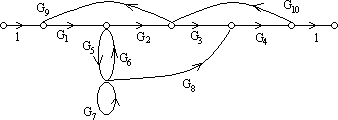 with armature voltage (ea) as input and θ(t), the load position as output. 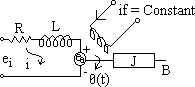 system shown in figure C(s)/R(s) has a zero lying in right half of s-plane. Obtain c(t) when r(t) is a unit step for the system. 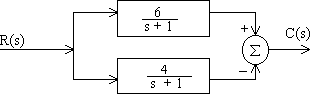 G(s) = K(s + 13)/s(s + 3)(s + 7) Obtain the range of K for the system to be stable. Use R-H criterion. 6. Discuss various schemes for error detection using (i) Potentiometers and(ii) Synchros. Describe merits and demerits of above schemes of error detection. Section-C Marks : 10 Each 7. Define gain margin and pahse amrgin for a system and show these margins on Bode' Plots and Nyquist Plot. A system is described by its loop TF G(s) = 10/s(1 + 0.5s)(1 + 0.25s). Obtain GM and PM from Bode's Plots and varify your results usingh the Nyquist Plot. 8. State and explain the rules for sketching the roots loci for a feedback control system. The open loop TF of an unity feedback control system is G(s) = K/s(s + 1)(s + 5). Sketch tne root loan diagram for the system and obtain K for which the system is critically stable. 9. Write short notes on the following: (a) Importance of state-variable modeling (b) On compensating network (c) Applications of magnetic amplifiers. |
| SIMILAR PAPERS:- CONTROL AND INSTRUMENTATION |