




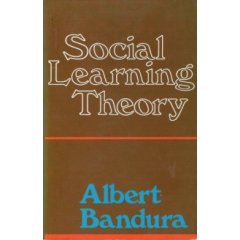
"Learning would be exceedingly laborious, not to mention hazardous, if people had to rely solely on the effects of their own actions to inform them what to do. Fortunately, most human behaviour is learned observationally through modeling: from observing others one forms an idea of how new behaviours are performed, and on later occasions this coded information serves as a guide for action."
Albert Bandura, Social Learning Theory, 1977 (as cited in Van Wagner, n.d.)
What is the Social Learning Perspective?
Overview:
Developed by Albert Bandura, social learning theory argued "...that people can learn new information and behaviours by watching other people" (Van Wagner, n.d.). As Kenrick, Neuberg & Cialdini (2007) define, "social learning perspective [is] a theoretical viewpoint that focuses on past learning experiences as determinants of a person's social behaviours (p. 9). Additionally, this perspective "...assumes that current behaviours are a product of past learning experiences and patterns of reinforcement and punishment" (Kirichenko, 2008).
For example, Social learning experiences can be direct and indirect (Kenrick, Neuberg & Cialdini, 2007, p. 9). An example of direct social learning could be a child's parents encouraging them to eat healthy, exercise regularly and get plenty of sleep so can live a healthy life. An example of indirect social learning could be that same child observing their friends eating McDonald's, playing video games instead of exercising and staying up late. Therefore, the child may choose the latter as they have observed that their friends are having more fun living that way.
Additionally, social learning theory "...searches for the causes of social behaviour in a person's environment" (Kenrick, Neuberg & Cialdini, 2007, p. 9). "Social learning theorists emphasize the individual's unique experiences in a particular family, school, or peer group...and have generally assumed that habits learned early in life may be difficult to break" (Kenrick, Neuberg & Cialdini, 2007, pp. 9-10).