

4 - CONTROL LOGIC'S
The control logic circuit is the combination of logic gates (like AND, OR); The flip-flop K controlled by the one pulse switch (chatterless switch [S]). This is to clear the output Q, or in other words to switch off the alarm. We have to design a logical circuit that will operate when the circuit is connected to the computer and the computer is switched on. This means we can make the circuit to work independently or to work with the computer showing status.
Buffer Circuits :
Buffer circuits are used to isolate or to configure one device with another. Many different buffer circuits have different specifications for specified jobs. Here we want to connect our circuit board with the computer and so that we can see the status of the circuit. Most of the time the CPU will output information at a faster rate than the peripheral devices can accept it. So the interface will interact with the CPU to restrain its output until the peripheral device is ready to receive it. In this way the interface acts as a buffer between the CPU and the external device. However such a buffer is inside the computer printer port itself. Which is however not our concern. But another buffer circuit is to be build so as to provide the protection for the computer and the circuit.
One way is to use three-state buffers.
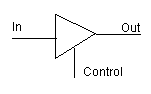
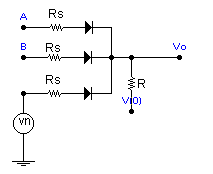
The above symbol stands for three state buffer. If the control = 1 then whatever is inputted will be seen at the output. And the signal cannot flow in opposite direction. If the control = 0 then nothing will flow in either direction. Which means the output will not be effected by the input and it will remain zero.
The more simpler way to construct a buffer circuit is by putting the logical gates. In this project we have used an AND gate to buffer the circuit. If one terminal of the AND is grounded the gate behaves as a buffer. This could be done by OR gate also. If we connect one terminal of two input OR gate to logic 1 then whatever we input in the other terminal will appear at the output of the gate. For more we can observe the equivalent circuit given below for the AND gate.
Relays:-
For an ordinary relay, a continues supply of current is needed and a circuit as shown in fig 5.2 is connected to make it work as a latching relay.
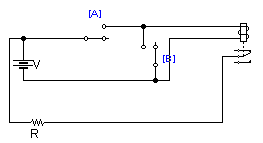 fig
3.2
fig
3.2
A push on switch a supplies full voltage to the coil armature pulls in. The change over contacts now allow a small amount of current limited by R, to flow through the coil. Since the magnetic field required to hold the relay is much smaller than that required than that required for the plug-in, this small current is sufficient to keep the relay energized. This operation minimizes the heating of the coil in continuous operation.