Cross contour
Cross contour refers to lines that describe a surface but unlike primary
or secondary contour lines do not represent horizons, edges, changes of
directions , coloration or shadow edges. Their direction and placement
may be arbitrary. They represent planar sections, slices, or straight lines
drawn on the surface of the form. The viewer translates these lines into
surface information.
Do This:
Start by drawing a wavy line in pencil from edge to edge near the
bottom of your 18"x 24" white paper. Draw another line that follows on
top of the first, except make it 1/8" away from the first line on the left
side of the first "hill" in the wavy line, and 1/2 " away on the right
side of the hill. reverse these with the second hill. return to the first
pattern with the third hill and so forth to the edge of the paper. Repeat
this with a third, fourth anmd fifth line.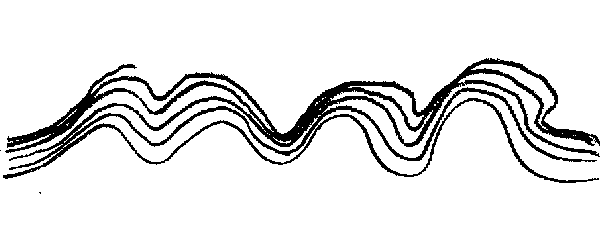
When you finish the fifth line, stop. Step back from your paper and
notice that the five lines now describe a kind of wavy ribbon. Or it may
resemble fried bacon, especially if you're hungry. But, in any case it
will take on a three dimensional appearance of ridges and valleys running
perpendicular (define)
to the length of the "ribbon". This is caused by a perspective effect known
as "foreshortening" (define)
.
You will learn more about that later. Notice that the ridges and valleys
appear to be receding back at a slight angle. The ridges whose line are
farther apart on their right side, appear to be veering toward the right.
Those with wider lines on their left slopes, are heading back toward the
left.
Do This:
Now draw five more lines, but this time, reverse the narrow spaces
and the wide spaces. In other words, draw lines closer together on the
slopes where before you made them farther apart, and draw wider spaces
where you made them close. Notice that the direction of the ridges change
as they recede.
Experiment in other ways. Make a small bump on a line. On the next
pass of the pencil, make it larger, being careful to draw the second line
closer to one side of the bump than the other. Continue to enlarge this
bump with each pass.
Make a line closer at the top of a ridge and farther at the nadir
of the valley. after several passes the ridge will appear to be somewhat
flatter, as though it "eroded" and filled the valley. 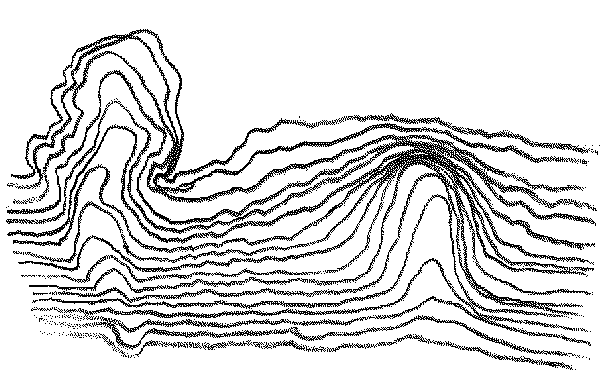
Make a line disappear behind another line and reappear on the oher
side of a hill. Draw some parallel lines closer together to fill in background
behind your ridges.Notice that you may stop at anytime and the white space
on the top of your paper will appear as "sky".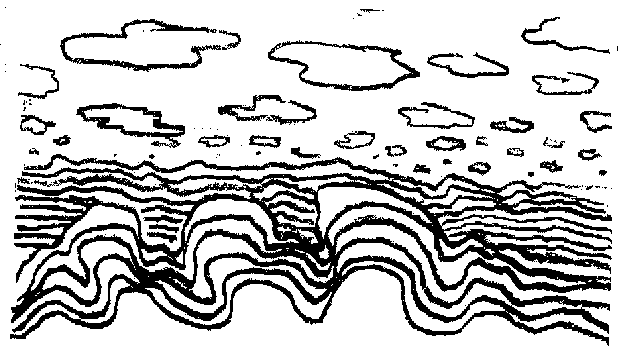
Now, make a hole appear in the ground. Think about what the lines
would do as they disappear down the hole.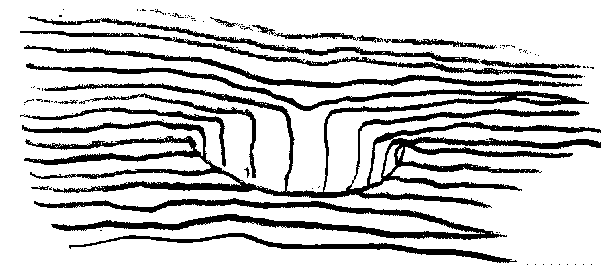
A rock sitting on the ground is more difficult than it looks. Be
sure and DON'T start in the middle of the rock. And make the lines closer
together as they surface of the rock curves back from the viewer around
the edge of its shape.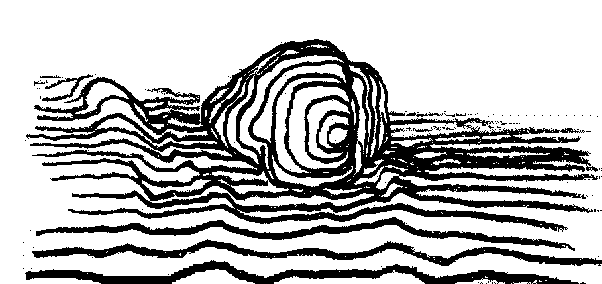
Now put it all together into an exciting fantasy landscape. Try to
make the ground feel continuous so that the viewer could imagine walking
into the terrain (define).
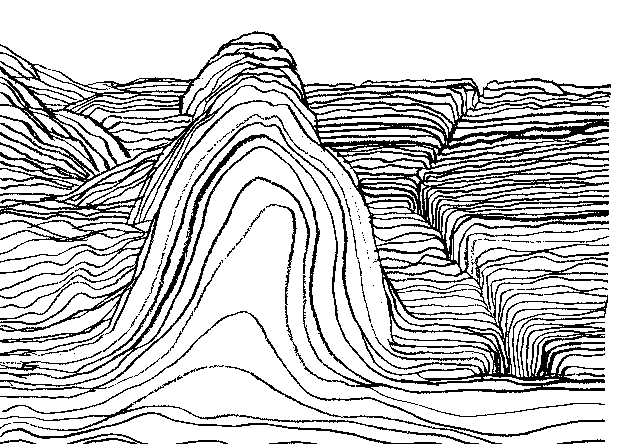
Student Liz Shock's "Landscape"
Previous assignment (Flying Contour)
Next assignment: (Gesture)
Pallas' First Day Handout.
Macomb Community College.
Jim Pallas Homepage.