


|
|
The Ascent of Man (continued) Contrary to many other explanations for bipedalism, the Isbell and Young Hypothesis does not require a shift to savanna-dominated environments. This is advantageous considering that countless studies (e.g., Kingston et al., 1994) have indicated a myriad of paleoenvironments existing in Africa simultaneously during the Miocene-Pliocene transition. It was not until about two million years ago that savannas truly reigned supreme on the African landscape. Also, micro-mammals discovered in association with Ardipithecus ramidus fossils in East Africa indicate a fairly tropical or densely wooded environment. Even certain South African sites, espeically the lower members of Sterkfontein and Taung, display a remarkably tropical milieu (Klein, 1999). Therefore, proposals requiring a dramatic environmental shift (Newman, 1970; Wheeler, 1984; Hunt, 1994; Rose, 1991; Wrangham, 1980a) can be discredited, at least as possible primary causes. There were other advantages to evolving bipedalism, as our hominid ancestors soon discovered. For instance, an upright stance decreased body surface area directly exposed to solar radiation, while exposing more to the cooling winds above the savanna grasses. The result is more foraging time, the decreased likelihood of brain overheating, and the ability to support larger group sizes.8 (Wheeler, 1984). In addition, this rendered the creature more impressive, which aided in scaring off dangerous predators. Also, the increased height meant a better vantage point from which to spy food sources and detect predators from longer distances. Furthermore, upright feeding positions were much more energy-conservative due to the small size and lack of good nutritious value in food sources.9 (Hunt, 1996). Lastly and probably most importantly, the adoption of bipedalism freed the hands, which cleared the road for better provisioning and tool-making. Lovejoy also believes this to have heralded forth the general practice of monogamy as opposed to polygyny. (Lovejoy, 1981). Understanding the purpose and necessary mechanisms of bipedalism may be useful in shedding light on many other areas of paleoanthropology. It would be especially useful in clearing up the muddled identity of Ardipithecus ramidus and Australopithecus anamensis, and their relation to the later australopithecines. 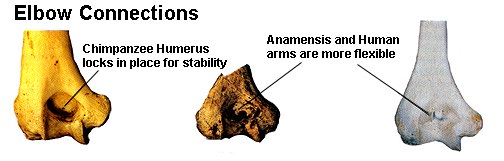 The Isbell and Young Alternative Responses Hypothesis is one of the most eloquent of all theories that attempt to explain the purpose of bipedalism. Thus, bipedalism was an ecological adaptation that rewarded its owners with the greater ability of exploiting the surrounding food sources. With this tool, our proto-hominid ancestors carved a niche for themselves amidst the thinning fabric of rainforests that had laced Africa for eons. Notes:
 
Copyright ©2001-2003, Allegra H., all rights reserved. Please contact me via e-mail if you wish to reproduce this material.
|