
pentium : Internal Structure.
photo courtesy:
Intel corporation ®.
Your resource to the fundamental assembly language programming . © 2004
An Evolution Of The Microprocessors .
Part II.
The Fourth Generation.
|
Pentium |
|
pentium : Internal Structure. photo courtesy: Intel corporation ®. |
|
Designs Available : Pentium . Transistors : Pentium ( 60MHz and 66MHz) : 3,100,000. Pentium ( 75MHz ) : 3,200,000. Pentium ( 90MHz and 100MHz ) : 3,200,000. Pentium ( 120MHz ) : 3,200,000. Pentium ( 133MHz ) : 3,300,000. Pentium ( 150MHz ) : 3,300,000. Pentium ( 166MHz ) : 3,300,000. Pentium ( 200MHz ) : 3,300,000. clock speed : Pentium : Introduced at 60MHz and 66MHz then subsequently upgraded to 200MHz through the steps of the 75MHz, 90MHz, 100MHz, 120MHz, 133MHz, 150MHz, 166MHz respectively . Microns (size) : Pentium ( 60MHz and 66MHz) : 0.8 Micron, BiCMOS. Microns (size) : Pentium ( 75MHz ) : 0.6 Micron, BiCMOS. Microns (size) : Pentium ( 90MHz and 100MHz ) : 0.6 Micron, BiCMOS. Microns (size) : Pentium ( 120MHz ) : 0.6 and 0.35 Micron, BiCMOS. Microns (size) : Pentium ( 133MHz ) : 0.35 Micron BiCMOS. Microns (size) : Pentium ( 150MHz ) : 0.35 Micron BiCMOS. Microns (size) : Pentium ( 166MHz ) : 0.35 Micron BiCMOS. Microns (size) : Pentium ( 200MHz ) : 0.35 Micron BiCMOS. MIPS (Million Instructions Per Second) : Pentium ( 60MHz and 66MHz) : 100 MIPS, 70.4 SPECint92, 55.1 SPECfp92 on Xpress 256K L2 and 112 MIPS, 77.9 SPECint92, 63.6 SPECfp92 on Xpress 256K L2 respectively. Pentium ( 75MHz ) : 126.5 MIPS, 2.31 SPECint95, 2.02 SPECfp95 on Gateway P5 256K L2. Pentium ( 90MHz and 100MHz ) : 149.8 MIPS, 2.74 SPECint95, 2.39 SPECfp95 on Gateway P5 256K L2 and 166.3 MIPS, 3.30 SPECint95, 2.59 SPECfp95 on Xxpress 1ML2 respectively . Pentium ( 120MHz ) : 203 MIPS, 3.72 SPECint95, 2.81 SPECfp95 onXxpress 1MB L2. Pentium ( 133MHz ) : 218.9 MIPS, 4.14 SPECint95, 3.12 SPECfp95 on Xxpress 1MB L2. Pentium ( 150MHz ) : >230 MIPS, 4.27 SPECint95, 3.04 SPECfp95 on Xxpress 1MB L2. Pentium ( 166MHz ) : >247 MIPS SPECint95, 3.37 SPECfp95 on Xxpress 1MB L2. Pentium ( 200MHz ) : >270 MIPS 5.47 SPECint95,3.68 SPECfp95. The iCOMP� Index 2.0 rating is 142. Addressable Memory : 4 GB, Virtual Memory 64 TB, 16K L1(Level 1) Cache. Bus Width : External: 64 bits Bus and Internal: 32 bits address Bus . Interrupts : available. stack : Stack Pointer. Pentium( 60MHz and 66MHz ) Pin count: 273 (Pin Grid Array Package)Package dimensions: 2.16" (5.49 cm) x 2.16" (5.49 cm) Pentium( 75MHz ) Pin count: 320 Lead Tape Carrier Package (TCP) 296 Staggered Pin Grid Array (SPGA)Package dimensions: PGA: 1.95" (5 cm) x 1.95" (5 cm) TCP: 0.94" (2.4 cm) x 0.94" (2.4 cm) Pentium( 90MHz and 100MHz, 120MHz, 133MHz, 150MHz, 166MHz and 200MHz( Plastic pins). ) Pin count: 296 (Pin Grid Array Package)Package dimensions: 1.95" (5cm) x 1.95" (5cm) Features : The first Pentium copyrighted 32 bit processor .Like 80486 it is also completely compatible with previous 80x86 processors. Typical Usage : Extensively implemented in the Note book PCs and high end user applications. Gave a new definition to the PC( Laid the foundation for the multimedia support ) and emerged as a good supporting processor for the servers. Speedy applications , the 3d graphics applications. |
|
Pentium |
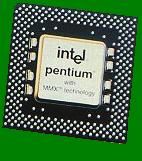
pentium mmx : chip. 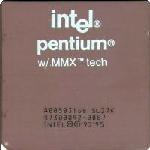
pentium mmx : chip. photo courtesy : www.PCMECH.com. |
|
Designs Available : Pentium MMX� ® . Transistors : Pentium MMX( 166MHz and 200MHz) :4,500,000. Pentium MMX( 233MHz ) : 4,500,000. clock speed : Pentium : Introduced at 166MHz and 200MHz then subsequently upgraded to 233MHz. Microns (size) : Pentium MMX( 166MHz and 200MHz) : 0.35 Micron, CMOS. Microns (size) : Pentium MMX( 233MHz) : 0.35 Micron, CMOS. MIPS (Million Instructions Per Second) : Pentium MMX( 166MHz and 200MHz) : 5.59 SPECint95, 4.30 SPECfp95. The iCOMP� Index 2.0 rating is 160 and 6.41 SPECint95, 4.66 SPECfp95. The iCOMP� Index 2.0 rating is182. Pentium MMX( 233MHz ) :7.12 SPECint95, 5.21 SPECfp95. The iCOMP� Index 2.0 rating is 203. Addressable Memory : 4 GB, Virtual Memory 64 TB. Bus Width : External: 64 bits Bus and Internal: 32 bits address Bus . Interrupts : available. stack : Stack Pointer. Pentium MMX( 166MHz, 200MHz, 233MHz Plastic pins. ) Pin count: 296 (Pin Grid Array Package)Package dimensions: 1.95" (5cm) x 1.95" (5cm) Features : The successor to Pentium-I .Like Pentium it is also completely compatible with previous 80x86 processors. Typical Usage : Extensively implemented in the Note book PCs and high end user applications. Boosted the performance of the multimedia support and emerged as a good supporting processor for the servers and high-end PC networks. Speedy applications , the 3d graphics and the acoustics applications like games such as Wolfenstein came to life. |
|
Pentium |
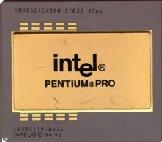
pentium pro : chip. photo courtesy : www.PCMECH.com. 
pentium pro : internal structure. photo courtesy : Intel museum®. |
|
Designs Available : Pentium PRO� ® . Transistors : Pentium PRO : 5,500,000. clock speed : Pentium : Introduced at 150MHz, 166MHz, 180MHz, 200MHz. Microns (size) : Pentium PRO( 150MHz ) : ( 0.6 micron), 5.5 million ; (0.6 micron) , 256K L2: 15.5 million . Microns (size) : Pentium PRO( 166MHz ) : ( 0.35 micron), 5.5 million 512K L2: ; (0.35 micron) , 31 million . Microns (size) : Pentium PRO( 180MHz ) : ( 0.35 micron), 5.5 million ; (0.6 micron) , 15.5 million . Microns (size) : Pentium PRO( 200MHz) : ( 0.35 Micron), 5.5 million ; (0.6 micron), 256K L2: 15.5 million ; (0.35 micron), 512K L2: 31 million . MIPS (Million Instructions Per Second) : Pentium PRO( 150MHz) : 6.08 SPECint95, 5.42 SPECfp95 on Alder 256K L2. Pentium PRO( 166MHz ) : 7.11 SPECint95, 6.21 SPECfp95 on Alder 512K L2. Pentium PRO( 180MHz) : 7.29 SPECint95, 6.08 SPECfp95 on Alder 256K L2. Pentium PRO( 200MHz) : 8.09 SPECint95, 6.75 SPECfp95 on Alder 256K L2. Addressable Memory : 64 GB, Virtual Memory 64 TB. Bus Width : ( Front Side Bus) External: 64 bits Bus and Internal: 32 bits address Bus , 64 bits Bus to L2 cache. Interrupts : available. stack : Stack Pointer. Pentium PRO( 150MHZ, 166MHz, 180MHz, 200MHz . ) Pin count: 387 (Dual Cavity Pin Grid Array Package)Package dimensions:2.46 (6.25cm) x 2.66 (6.76cm) Features : Developed in tandem with MMX .Like Pentium MMX it is also completely compatible with previous 80x86 processors. Typical Usage : Extensively implemented in the Note book PCs and high end user applications like MMX. It inspired Intel to continue it's R&D on Pentium-II . Speedy 32- bit applications , the 3d graphics and the acoustics applications like games such as Wolfenstein, Prince came to life. The first truely multimedia PC. Ideal for WINDOWS 95 ® and WIN-32 based applications. |
 This is one of the two PC based processors I own (150MHz ) . I had purchased it during SEP 1997. I do sometimes still employ this processor to carry out tasks related to the text applications such as ( assembly, C/C++ ) programming, MS-Excel, MS-Word.The best part about this processor is that it is absolutely sturdy and a heavy duty/workload processor. However it does'nt support extremely high speed 3D graphics applications ( Direct 3D - which requires an AGP card / Hardware Acceleration ). ( ' Road-Rash ' works fine on this processor!!! )
The Fifth Generation.
|
Pentium |
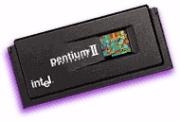
pentium II : chip. photo courtesy : www.PCMECH.com. 
pentium II : internal structure. photo courtesy : Intel museum®. |
|
Designs Available : Pentium II� ® . Transistors : Pentium II : 7,500,000. clock speed : Pentium II : Introduced at 233MHz, 266MHz, 300MHz,333MHz ( 66MHz bus speed ), 350MHz, 400MHz and later upgraded to 450. Microns (size) : Pentium II( 233MHz ) : (0.35 micron), 512K L2. Microns (size) : Pentium II( 266MHz ) : (0.35 micron), 512K L2. Microns (size) : Pentium II( 300MHz ) : (0.35 micron), 512K L2. Microns (size) : Pentium II( 333MHz) : (0.25 micron), 512K L2. MIPS (Million Instructions Per Second) : Pentium II( 233MHz) : 9.49 SPECint95, 6.43 SPECfp95. Pentium II( 266MHz ) : 10.8 SPECint95, 6.89 SPECfp95. Pentium II( 300MHz) : 11.6 SPECint95, 7.20 SPECfp95. Pentium II( 333MHz) : 12.8 SPECint95, 9.14 SPECfp95, 8.32 SPECfpbase. Addressable Memory : 64 GB, Virtual Memory 64 TB. Bus Width : ( Front Side Bus) External: 64 bits Bus and Internal: 32 bits address Bus , 64 bit System Bus w/ECC; 64 bit Cache Bus w/opt. ECC. Interrupts : available. stack : Stack Pointer. Pentium II( 233MHZ, 266MHz, 300MHz, 333MHz . ) Pin count: Single Edge Contact cartridge (S.E.C.), 242 pins.Package dimensions:5.505" (12.82cm) x 2.473" (6.28cm) x 0.647"(1.64cm). Features : The first "SUPER-SCALAR" processor .Like Pentium PRO it is also completely compatible with previous 80x86 processors. Typical Usage : It paved way to the most demanding high-end graphics in the 3D games as it's motherboard had an AGP slot. It also became a huge success as far as the business was concerned. |
|
Pentium |
 photo courtesy : Intel museum®. |
Date of the release :
1999.( 450MHz )
|
Typical Usage : digital content creation, and electronic and mechanical design automation. |
|
Celeron� |
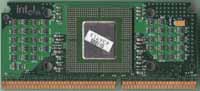 Celeron Chip. photo courtesy : www.PCMECH.com. |
 workstation edition. photo courtesy : Intel Corporation. |
 mobile edition. photo courtesy : Intel Corporation. |
Date of the release :
1998.
( Celeron-3A ( 233-433MHz ) )
Designs available :
( slot 1 ( 233-433MHz ), PPGA - Plastic Pin Grid Array or Socket 370 - Celeron-3A ( 300MHz ) )
|
Features : Removed L2 cache from Pentium II, devoid of dual processor support and plastic core Sytem Bus - 66MHz - ran at the same speed as that of the clock ( not half the speed of the clock as it's predecessors !!! ) The 300A came with 128KB ( PentiumII had 512KB) of L2 cache on board. . Typical Usage : Intel's budget chip. Could be used for optimum requirements. |
The Sixth Generation.
|
Pentium |
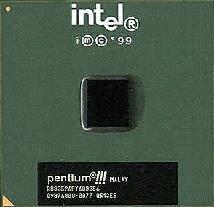
pentium III : chip. photo courtesy : www.PCMECH.com. 
pentium III : internal structure. photo courtesy : Intel museum®. |
|
Designs Available : Pentium III� ® . Transistors : Pentium III : 9,500,000. and for ( 500MHz, 533MHz, 550MHz, 600MHz, 650MHz, 667MHz, 700MHz, 733MHz. ) 28,000,000 clock speed : Pentium III : Introduced at 450MHz, 500MHz, 533MHz, 550MHz, 600MHz ( System Bus 100MHz ), 650MHz, 667MHz, 700MHz, 733MHz, 933MHz, 1GHz and eventually upgraded to 1.13GHz. Microns (size) : Pentium III( 450MHz, 500MHz, 550MHz, 600MHz. ) : (0.25 micron), 512K L2. Microns (size) : Pentium III( 500MHz, 533MHz, 550MHz, 600MHz, 650MHz, 667MHz, 700MHz, 733MHz. ) : (0.18 micron), 512K L2. Microns (size) : Pentium III( 933MHz, 1GHz, 1.13GHz ) : (0.18 micron), 512K L2. Addressable Memory : 64 GB, Virtual Memory 64 TB. Bus Width : ( Front Side Bus) External: 64 bits Bus and Internal: 32 bits address Bus , 64 bit System Bus w/ECC ; 256 KB Advanced Transfer Cache (Integrated) . Interrupts : available. stack : Stack Pointer. Pin count: Single Edge Contact Cartridge (S.E.C.C. 2) and Flip Chip Pin Grid Array (FCPGA) . Features : Intel� Processor Serial Number P6 Architecture, 133- or 100-MHz System Bus .Like Pentium II it is also completely compatible with previous 80x86 processors. Pentium III ( 1GHz ) introduced 70 new instructions. Typical Usage : It paved way to the superfast high-end graphics in the 3D games as it's Intel 810G motherboard had an AGP slot. It also gave a momentum to super-fast computing; especially the internet related softwares. Pentium III introduced SIMD ( Single Input Multiple Data ) , MMX2, SSE instructions. |
|
Pentium |
Date of the release :
MAR 17, 1999
OCT 25, 1999
MAY 2000.
|
Clock Speeds/Frequencies : 500MHz, 550MHz, 600MHz, 667MHz, 733MHz and 933MHz( System Bus 133MHz ) . Features : Single Edge Contact (S.E.C.) Cartridge 2 System Bus - the surrounding cartridge only covered one side of the package as opposed to it's predecessors. Typical Usage : High speed demanding applications, higher server and faster workstations. |
|
Pentium |
pentium IV : chip. |
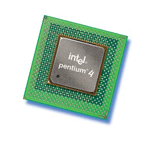
pentium IV : chip. photo courtesy : www.PCMECH.com. |
photo courtesy : Intel museum®.
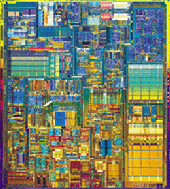
pentium IV : internal structure. photo courtesy : Intel museum®. |

pentium IV ( Hyper Threading Technology ) : logo. |

pentium IV ( Hyper Threading Technology ) Extreme Edition. : logo. |
|
Designs Available : Pentium IV� ® . Transistors : Pentium IV : 42,000,000 for Williamette ; 55,000,000 for Northwood clock speed : Pentium IV : Introduced at 1.3GHz, 1.4GHz, 1.5GHz, 1.8GHz, 1.9GHz, 2GHz , 2.2GHz, ( Hyper-Threading ( optional ) introduced here onwards ) 2.4GHz, 2.53GHz ( system bus 533MHz ), 2.66GHz, 2.8GHz, 3GHz, 3.2GHz and presently upgraded to 3.6GHz. Microns (size) : Pentium IV( Williamette ) : (0.18 micron), 256K L2. Microns (size) : Pentium IV( Northwood ) : (0.13 micron), 512K L2. Bus Width : ( Front Side Bus) External: 64 bits Bus and Internal: 32 bits address Bus , 64 bit System Bus w/ECC ; 256 KB Advanced Transfer Cache (Integrated) . Interrupts : available. stack : Stack Pointer. Pin count: Single Edge Contact Cartridge (S.E.C.C. 2) and Flip Chip Pin Grid Array (FCPGA) initially socket 423 - heat sink retention bases considerations , socket 478( 1.9GHz onwards ) . Features : 80x86 family - Intel� NetBurst� micro-architecture, 400MHz system bus Hyper-pipelined technology - ( CPU pipeline increased from 10 stages (of Pentium III ) to 20 stages.), Rapid execution engine - ( Two ALUs :- performance twice the speed of the processor. ) , Execution trace cache - ( <1> branch target buffer size to eight times that of the Pentium III , <2> Improved latency 8K L1 cache and 256K L2 cache, <3>holds instructions that are already decoded and ready for execution - time saved in the individual instruction decoding ) , Advanced transfer cache , Advanced dynamic execution , Enhanced floating point/multimedia Streaming, SIMD extensions 2 , Hyper-Threading technology (HT�) presently only supported by Windows-XP ® and the latest versions of LINUX, Initially Pentium IV came with the two 64MB sticks of RDRAM ( Rambus -DRAM) before switching to DDR RAM . Typical Usage : It paved way to the superfast high-end graphics in the 3D games as it's latest Intel 845G / 850 ( not so popular ) / Springdale 865G / 865PE ( FSB 800MHz ) / Canterwood 875P( FSB 800MHz ) chipsets are equipped to provide the same. It also gave a momentum to super-fast computing; especially the internet related softwares. Pentium IV introduced SIMD2( Single Input Multiple Data 2 -extension ) . |
This is the other PC based processor I own ( 2.4GHz - HT technology ) with 865G chipset ( 800MHz FSB ). I had purchased it on 25th AUG 2003. I frequently work on this splendid machine. Running a fast 3D graphic applications is a mind-blowing experience ( the chipset has an onboard AGP and sound cards. )The Seventh Generation.
|
( The era of the truely "64 bit" architectural microprocessors. )
|
|
Itanium® |
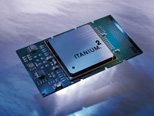
Itanium_2 : chip. photo courtesy : Intel museum®. 
Itanium_2 : logo. photo courtesy : Intel museum®. |
|
Designs Available : Itanium 64� ( IA-64 ) ® . clock speed : Itanium 64� ( IA-64 ) : Introduced at 1.3GHz, 1.4GHz ( System Bus 400MHz, 128-bit wide, 6.4 GB/s bandwidth ) and currently available at 1.5GHz. Cache : Level 3: integrated 1.5MB , Level 2: 256 KB, Level 1: 32 KB (Instruction and data) . Bus Width : ( Front Side Bus) External: 64 bits Bus and Internal: 64 bits address Bus , 128 bit System Bus . . Interrupts : available. stack : Stack Pointer. Features : Intel� Processor EPIC Architecture with Dual processor optimised, Enhanced Machine Check Architecture (MCA) with extensive Error Correcting Code (ECC). 62 Watts maximum power consumption .Like Pentium IV it is also completely compatible with previous 80x86 processors ( All Itanium� 2-based systems support IA-32 software. Intel now offers a technology called IA-32 Execution Layer (EL) which enhances support for IA-32 applications ). Typical Usage : It has paved way to the superfast industrial graphical applications as it's Intel ® E8870 chipset has a powerful supporting hardware. |
|
What's Next!!! |
 PREVIOUS |
 NEXT |
| © 2004 by Pratik.M.Tambe. |
|
| PRIMITIVEASM© |