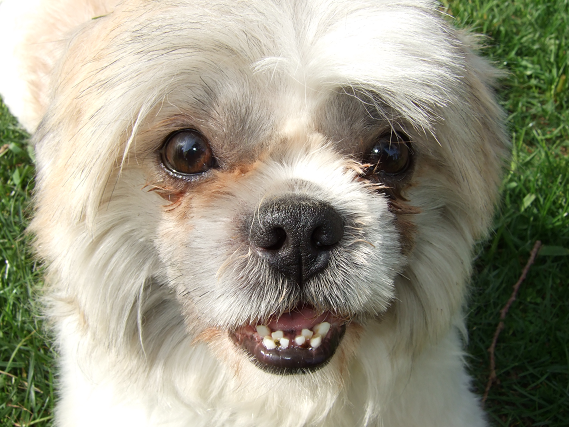
Who was it that said, �You can�t teach an old dog new tricks?� I need to find them and set them straight �any dog can be taught a new trick, as long as they like attention, and lots of treats! With a little patience, and consistency, any dog can learn!
Throughout the following pages I mention collars and/or leashes a few times, it is vital that you have your dog on leash as you train these tricks, as it can be used to keep his attention, and gently guide him. You don�t need your dog running off as you try to teach him.
For training, I suggest using cheddar cheese and/or tiny pieces of chopped hot-dog. If your dog is allergic to either, just offer him something that he really likes. Some dogs respond to you throwing a ball for them for completing a task, or a short game of tug of war. It all depends on your dog, and it�s up to you to decide.
My method throughout is to use the treats as a �lure� to guide your dog into the positions you want; get him doing that smoothly; add the command; stop luring him, and rely on vocal commands as well as hand signals, rewarding him once he�s sat (or whatever command you are teaching); and finally weaning him off of treats, so your love and affection is all he needs to willingly complete the tasks you set for him.
It�s also up for you to decide if you want to use treats for training your dog. Sometimes people don�t like to, and that is understandable, but my personal preference (as the author) is to use treats �they really help make the dogs enjoy each session so much more. Of course if you decide to opt out of treats, and one of these training techniques can be adapted to simply guiding the dog into position, and praising him.
I really suggest that while teaching your dogs these tricks that you practice at least 5-10 minutes a day, two or even three 5-10 minute sessions, evenly spaced throughout the day is even better and will help your dog learn faster. Whatever you do, don�t do long training sessions, and always stop before your dog gets bored and doesn�t want to do it anymore. Would you like being made to sit down over and over and over and over again until you were going crazy?
It�s a good idea to make sure your dog hasn�t eaten for at least 2 hours before you begin training �it will make them keener on getting those tasty treats you have for him. It also helps to tire your dog out a little before each training session, �especially if you have a young rambunctious puppy, or high-energy large dog �with playing/running/jumping/barking ect. out of their system, they�ll be more apt to listen to what you have to say to them.
It is also recommended that you only teach your dog one trick at a time, trying to teach too many tricks at once will only confuse your dog. However- if your dog already knows a few tricks, do a warm up �review� of them before training the new trick, each lesson. This will keep him perfecting the old tricks, while learning the new ones you set before him.
Sit
Step 1: Start with the dog in front of you, the leash in your left hand, and lure in your right. Bring the lure up and over your dog�s head, he should follow it eagerly with his nose, bringing his head up, and his rump down. The moment his rump touches the ground, give him the treat, and lots of praise.
Get another treat and repeat luring your dog into position, rewarding him each time his backside is on the ground, don�t worry about complete perfection just yet, just getting him to sit is all you need.
Continue to do this for as long as needed for your dog to readily and comprehensively sit down.
Step 2: Now you can start adding the vocal command to this trick (guess what! You�ve already taught your dog the hand signal!). Again taking the lure in your right hand and the leash in your left, with the dog in front of you, begin to lure him into the sitting position, accompanied by the command �Sit�, once his rump is on the ground, give him the treat, and praise him, again saying, �Sit�.
If you repeat this enough, your dog will no longer need you to lure him into position, but will sit automatically when you give the command and raise your hand over his head. You can do this by keeping the treats in a bait pouch (a little cup shaped bag, hung on your belt), or a pocket, and giving him the treat after he�s completed the command. Note: A treat is NOT necessary for every single repetition- if you have your dog this far its time to start weaning him off of treats.
Tips
For dogs that just back up when you try to lure them into the sitting position try backing them into a corner, so they meet a barrier and are forced to stop.
For dogs that try to stand up when you are luring them try using the leash to hold them down so that their front feet can�t leave the ground, if your dog is excessively large, or strong, you can also stand on the leash so they can�t get their feet off the ground.
And for those dogs that are just plain stubborn, sometimes a gentle push on the rump helps, sometimes they need it harder �some dogs respond to pulling up on the leash, and pushing on the rump. It all depends on your dog and how creative you are in getting them to do what you want them to.
Weaning your dog off treats: It�s simple, really. Practice the trick with your treats in your pocket, or in a bait pouch, and award your dog randomly. Sometimes for sitting, your dog will get a lot of verbal praise �at other times, a few loving pats or a treat. The trick is to keep him guessing, and diminish the amount of treats you give him at the same time.
If your dog doesn�t know what he�s going to get for doing a trick, he�ll be more interested.
Imagine that each day you get chocolate ice cream for a simple task like putting the dishes from breakfast in the sink. You know that every day you�re going to get the chocolate ice cream. The first time it�s great �the second time, it�s still great �the third time is good, but not so great, and on and on. If you knew you could get it at anytime you actually wanted, would you be so eager to do it each time you were told?
After time, your loving praise will be all your dog needs for him to complete your tasks �but remember � a little treat is always nice, if only every once in a while.
Down
Step 1: With your dog sitting in front of you, hold the leash in your left hand and the lure in your right. Cup the lure (a piece of cheese is exceptional in this case) in your hand and let your dog sniff it and give it a lick (this way they have to get their tongue inside your hand). Then slowly, with the opening facing downwards at an angel towards the dog, bring your hand downwards and out. Hopefully, your dog, in his desperation to get another taste of the treat, will follow it with his nose and eventually lie down to get at it better. The moment his belly touches the floor, praise him and open your hand so he gets the treat. Hold his leash so he doesn�t try to stand up while he eats the treat.
Repeat this as much as necessary until he readily and comprehensively sinks onto his belly when you bring the treat downwards.
Step 2: Now you can begin adding the verbal command, �down� (or �drop� if you prefer. I do �I use down as in �Get down� when the dogs are trying to jump on people). Follow the same method outlined in �sit�. Your dog will be sinking smoothly into the down position at your command before you know it!
Tips
For little dogs �Sometimes your little dog needs a little help learning the down command. One thing that can help is to place them on a chair, the top of the stairs or a low ledge, and bring the treat down over the edge. They should follow it with their nose and lay down to keep their balance. The same method can be applied to a large breed dog, using the top of the stairs, or a low ledge -an easy way to get it done without having to force the dog down.
|