“You will, I know appreciate that as this bridge is being constructed
free of cost to the Government, there is a limit to the economic burden
that we can place on the new residents of the (Portmore) area, who in
effect are amortizing (i.e., paying for) the cost of the structure
(i.e., bridge) on the (housing) lands they are acquiring in the area.”
Source:
http://www.portmore.org/articles/hiway2000-3.html (10/09/05)
“It appears that the authorities will have to employ the most creative
techniques of persuasion to convince the residents of Portmore to
use a toll road along the Causeway at $65 per way.” (our emphasis)
Source: Stone Team Survey Repot, Oct. 2004
source:
www.portmore.org/articles/hiway2000-2.html
Background
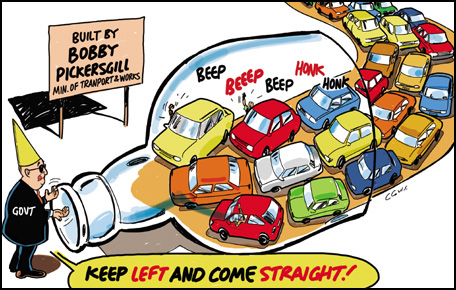
The Portmore Toll Road
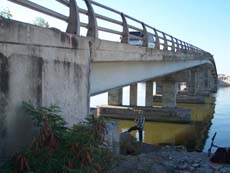
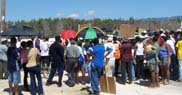
issue came to public attention when Portmore citizens held public
demonstrations in response to information indicating that the Portmore
Causeway Bride was to be demolished, and the open access road linking
the community to Kingston via the Bridge, closed. In particular,
citizens objected to the designation of the Mandela Highway as the
alternate route in view of the additional distance and travel time due
to congestion. At the same time citizens made it clear that they
did not object to the existence of the toll road; indeed they welcomed
it as a means of easing chronic congestion during peak hours.
Several community meetings were held where citizens voiced dissent and
indicated their willingness to challenge the decision of the authorities
to close the open access road without providing a reasonable
alternative. Consequent to the public expression of dissatisfaction, the
Prime Minister indicated that a special committee would be set up to
examine the citizens’ concerns and requested that a report be submitted
to him within a month. More than six months have since passed and there
has been no public mention of the requested report.
Law
suits: In the meantime
two lawsuits were filed in the Courts. One on behalf of the Joint
Portmore Citizens Associations (JPCA) and the Portmore Citizens
(Municipal) Advisory Council (PCAC), and the other initiated by
political representatives of the JLP on behalf of their constituents.
Both petitions have since been heard by the Supreme Court. That filed by
the JPCA/PCAC has been rejected by the Court, while a determination in
regard to the petition filed by the JLP’s political representatives is
yet to be announced.
Law suit dropped:
Media reports regarding the rejection by the Court of the JPCA/PMAC
petition was followed by a community meeting to consider possible
reactions to the reported decision. The meeting was advised via a
representative from the lead counsel’s office that a recommendation
would be made subsequent to a review of the written judgment when
received. To signal its willingness to appeal the judgment, it was
reported in the media that citizens donated over $30,000 at the meeting
in support of the expected appeal. This community meeting was apparently
followed by a closed meeting with lead
counsel at which advice was allegedly given that there was no valid
legal basis for an appeal. A press release was subsequently provided to
the media which confirmed that no further action would be pursued by the
JPCA/PCAC regarding the matter. To date no public meeting has been held
with the community to indicate the specific content of the judgment and
reasons supporting discontinuance of the matter. These developments have
created a public perception that the Portmore citizens’ challenge to the
closure of the Causeway bride has fizzled.
Jamaica for Justice.
In reaction to the absence of information and a public briefing by their
representatives, some citizens held a number of informal meetings to
discuss how the challenge might be revived and an appeal was made for
suggestions. One was that Jamaicans for Justice (JFJ), a citizens’
rights action group, be approached for assistance. A meeting was
subsequently held with JFJ’s executive director on August 26th
and the matter discussed. The executive director indicated that JFJ
would be willing to explore how assistance could be provided, but made
it clear that any new initiative must be led by the Portmore citizens
themselves, and that this required organized community support. The
discussion identified two critical issues presented by from the Portmore
Causeway matter: 1) inadequate representation and ineffective
governance; and 2) social injustice arising from citizens’ right of
access to their community.
The significance, and some
implications, of further action are summarized below.
What is at stake?
The Highway 2000 project
can be judged as likely to be a marginally viable project for at least
three reasons: (1) the absence of low cost international funding;(2) the
existing toll charges; and (3) recent media reports concerning the
possibility of a loan from Venezuela to fund the project.
It is standard for
infrastructure projects of this size to be partly funded by low interest
loans provided either by foreign governments or multilateral agencies.
The North coast Highway Project, for example, is partly funded by a loan
from Japan. Two mobile telecommunications providers sourced
international funds to finance their network construction costs –one
from the International Finance Corporation. According to a document
(posted at:
www.portmore.org/articles/hiway2000-1.html) the foreign contractor
is to source 72.5% of the estimated US$283 million of Phase 1 of the
project through a combination of equity and commercial debt. Equity is
more expensive than commercial debt, and commercial debt is more
expensive than bilateral/multilateral debt. The apparent absence of low
cost funds alongside the social desirability of the project, suggest
that the financial viability of the project is highly suspect, in spite
of the assurance of no government guarantee to the foreign investor.
Media reports of an appeal to Venezuela for low cost loan funds support
our speculation about project viability.
Secondly, the toll highway
is a monopoly transport facility since there are no competing providers.
It is standard that the regulated prices of essential monopolized public
utility facilities reflect ‘cost based pricing’ principles. Otherwise
the consumer is exposed to the risk of price gouging due to the absence
of competition. In this case, cost would include construction and
maintenance costs and the toll charge should allow the operator to
recover costs plus a reasonable rate of return on investment.
Maintenance costs should account for the ‘wear and tear’ from individual
vehicles. In turn, ‘wear & tear’ depends on vehicle weight and the
number of tyres ‘gnawing’ at the road surface. A reliable measure of the
number of tyres per vehicle is the number of axles. But in this case,
toll charges also account for vehicle height, which has nothing to do
with ‘wear and tear’. What this clearly points to is a need for revenue
to help shore up the financial viability of the project.
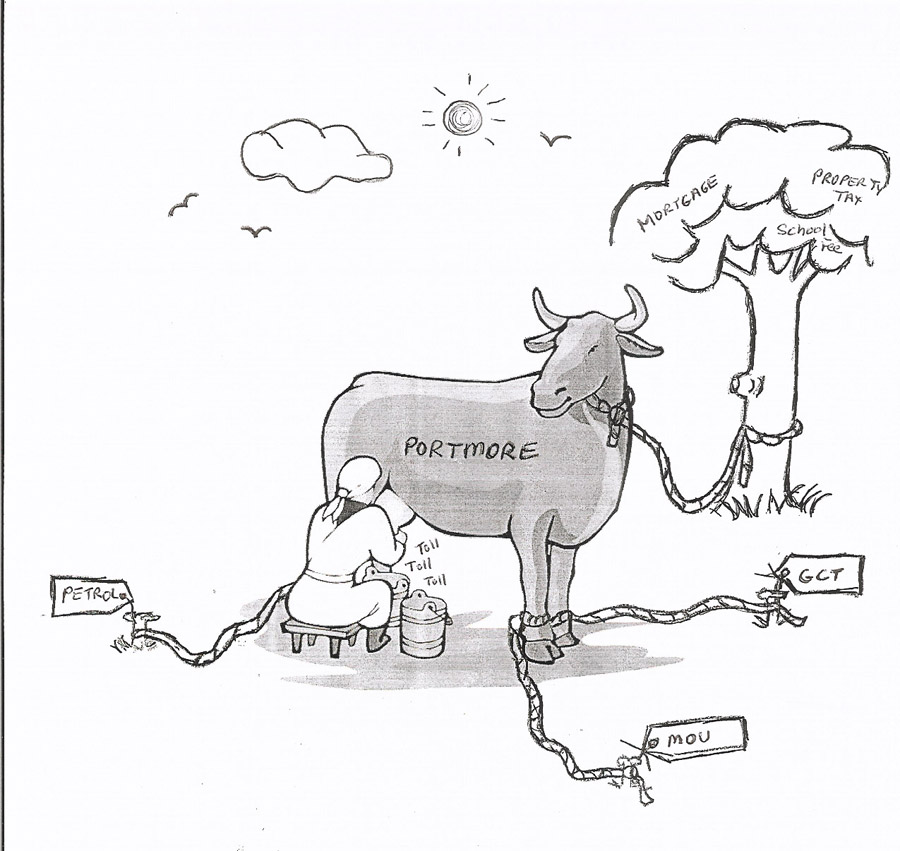
This is where the closure
of the Portmore Causeway comes in. It is most unlikely that toll charges
which exclude the expected revenue contribution from Portmore residents,
can justify extending the highway beyond May Pen due to the sharp
decline in traffic volumes. If the project is marginally viable, then
the revenue to be extracted from Portmore via toll charges becomes
critical to the build out of the project beyond May Pen. Indeed, it is
likely that Portmore’s revenue contribution is critical to the entire
project. Apparently, very little revenue leakage can be allowed from
Portmore, hence the need to literally force (i.e., ‘creatively persuade’
–see Stone Team Report) residents to use the toll road by closing the
open access road and providing an unreasonable alternative. To put it
simply, no Portmore, no project!
The Highway 2000 project is
a very important political project and the cost to the public will be
enormous if it proves unviable –there are reports of buyback provisions
in the contract if the contractor fails to realize the expected minimum
rate of return from toll charges. Therefore, any citizen’s initiative
that might threaten its financial viability should expect strong
resistance since powerful interests ride on this project. Add to this
the interests that benefit (i.e., eat a food) from the construction of
the project and what you have is a powerful, highly motivated coalition
ready to confront the Portmore community.
Issues
1.
Representation
The determination of a toll
and the decision to close the Causeway seem not to account for the
concerns of the citizens of Portmore, and their elected political
representatives appear not to have advocated on their behalf. The
failure of local citizen leaders to report back to citizens has raised
speculation about betrayal and collaboration with the political
directorate which has a vested political interest in the project. The
adequacy of representation needs to be strongly questioned and political
consequences considered by the Portmore community.
2.
Social
Justice & Right of Access
To issue a Ministerial
directive without consulting with the affected community is
anti-democratic, not to mention authoritarian. To deny a community the
right of open access to an existing road facility, apparently paid for
via home mortgages (see quote above), without making adequate provision
for a reasonable alternative is unjust -even if the law allows it. The
stipulated alternative is burdensome and unreasonable both in terms of
cost and travel time. Peak hour travel time considerations alone
indicate that the Mandela Highway option is unreasonable.
3.
Risks & Long
Term Commitment
Given the political
significance of the project and the strength of the political interests
tied to it, plus control of the state machinery, and the ease of
politicization of criticism of public policy, there are significant
risks to any citizen who volunteers to lead any challenge to the
Ministerial directive. Leadership can expect to be targeted, to weaken
and break resolve, and these include risk to livelihood and person, and
extend from low-level, to high-level threats. For the Portmore community
to ignore these risks is not only idealistic but foolish. History
provides a classic example in the case of the Wellington Glades Citizens
Association when the receipt of a bullet in an envelope was sufficient
to silence complaints from the head of the association about
construction nuisance. The community can expect that its resolve will be
tested, and should be prepared to stick unflinchingly to the cause even
where bribes are offered –possibly in the form of a promise of a lower
toll. It also goes without saying that a long-term commitment by the
community is required –perhaps as much as 10 years.
4.
Organisation
& Support
The need for organization
to sustain leadership support and facilitate coordination of action does
not require argument. Communications to persons involved in pursuing the
challenge suggest the likelihood of strong national support. It is also
possible that international support may be forthcoming since a host of
government affiliated and non-governmental organizations in developed
countries exist that are concerned with the deepening of democracy in
developing countries. Indeed this is a position that is supported by the
World Bank via its Social Capital – Civil Society Initiatives. However,
support is only likely to be forthcoming if the initiative is driven by
the citizens of Portmore themselves.
Finally, the Portmore Toll
Road issue raises many other questions that relate to the adequacy of
the Toll Act, in particular, whether a Minister should be given the
power to make a declaration affecting citizens without being mandated to
conduct a public proceeding where affected parties can register
objections in writing, and a written response provided. If such a
procedure was followed in this case, there would be a clear paper trail
to follow. If citizens failed to register objections there would be no
legitimate basis for complaint, however if they did and the response was
inadequate, or the matter avoided, then, asking a Court to review the
matter should not be problematic.
While
not all questions need be pursued, Portmore can set an example to the
rest of Jamaica about how to go about improving the quality of
governmental decision making through citizen activism. If the largely
middle-class, and reported relatively high concentration of persons with
tertiary education residing in the community cannot set an example, what
should be expected of the frustrated, unorganized mass of our fellow
citizens who lack education, organizational skills, contacts and have
difficulty articulating their views? While a few individuals can start
an initiative it is unlikely to gather momentum and be successful if it
is not ultimately supported by the community. It is therefore critical
that the community provide some signal regarding its willingness to make
the next move. Portmore it is now time to consider what then that move
should be
TOP


 LEG OF HIGHWAY 2000 OFFICIAL WEB SITE