The Power of Ten
Causes
People
Institutions
Effects
On May 7, 1945 the German High
Command unconditionally surrendered to the Soviet, British, American and French forces, ending World War II. Germany was divided among the victorious forces.
The capital of Germany, Berlin, was located
in the Soviet sector. Consequently, the city was divided as well.
In post war conferences, the differences in
ideologies embraced by the victors became starkly evident. The once
Allied forces could not decide how Germany should be governed in a manner with which all parties would be satisfied.
A power struggle ensued between the Soviets who embraced a communist ideology and the Americans, who promoted “democracy.” Each side wished to expand its influence in economically unsound Western Europe.
Which ever nation could dominate the economic system in Germany would exert the most influence over the post-World War
II global system. The Western Allies introduced a new currency, the
Deutschemark, to Western Germany. In opposition, the Soviets responded
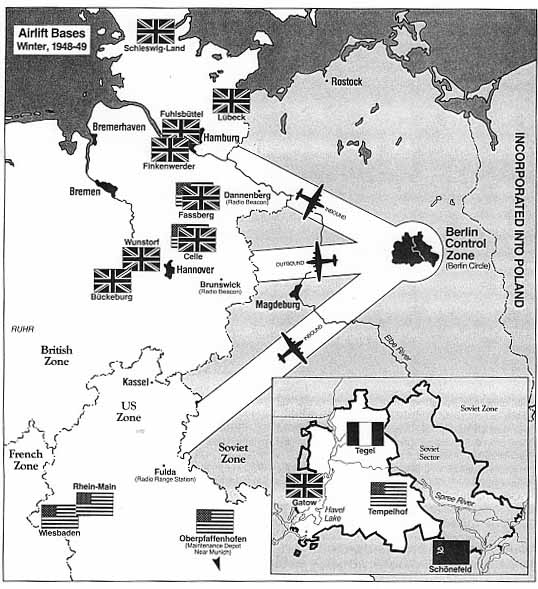
with a rail, highway and water blockade of West Berlin.
The United States position on the containment of communism refused to let West Berlin fall into Soviet control. The Western Allies, led by
President Harry Truman, began what was to become the greatest military
airlift in history: “The Berlin Airlift”.
" meeting with General Marshall
and Jim Forrestal on Berlin and the Russian situation. Marshall states
the facts and the condition with which we are faced. I made the decision
ten days ago to stay in Berlin. Jim wants to hedge... I insist
we will stay in Berlin - come what may.
Royall, Draper and Jim Forrestal come in
later. I have to listen to a rehash of what I know already and reiterate
my "Stay in Berlin" decision. I do not pass the buck, nor do I alibi
out of any decision I make.
---taken from the personal diary of President Harry Truman. July 19, 1948
Bibliography