C. A. Mey.), and smooth sumac (Rhus glabra L.), were cut in and around the prairie remnants and the stumps
of the later two were chemically treated. Both of these species will resprout after being cut.
Before the arrival of European settlers fire was a natural part of the ecology of prairie. Just as chaparral areas
in the American West burn from lightning strikes, so did the short grass and tall grass prairies in the Midwest.
In both instances fire set back large areas from a woody vegetation to an earlier successional stage, grassland
or prairie. With the advent of the Smokey the Bear campaign, fires were routinely put out and fire was viewed
as being bad.
The main consequence of putting fires out has been the expansion of woodland and the retraction of prairie.
At Waubonsie State Park the prairie pieces have been shrinking and getting smaller every year since the
1950s. Some of the prairie remnants in the Park were also burned, using drip torches, flappers, backpack
water sprayers, etc., in a controlled or prescribed manner.
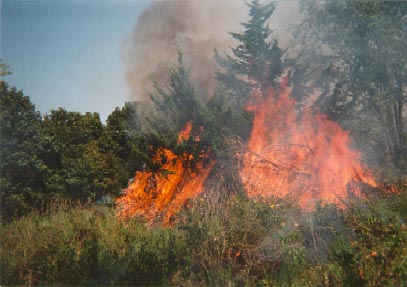
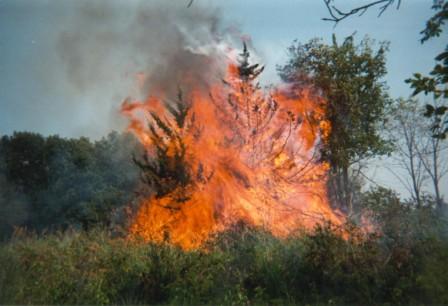
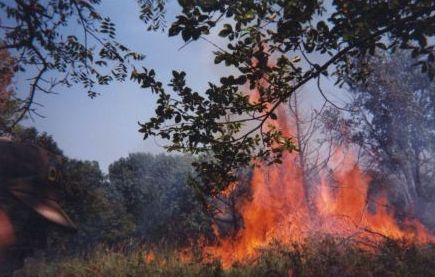
We found one method very effective in reclaiming land from woody invasives. Woody cuttings were piled around live eastern redcedar trees in a tee pee fashion and allowed to dry for several weeks. Then when the prairie remnants were burned, the "tee pees" were also set ablaze.
The above pictures show two eastern redcedar trees "going up" on the east side of the entranceway to the Equestrian Area at Waubonsie. How important is this restoration work? According to Diana Horton, Biological Sciences Department of the University of Iowa Herbarium, "habitat destruction has left Iowa with less natural landscape than any other state; less than .1% of the prairie remains, less than 14% of the non-riverine wetlands, and less than 50% of the forests. Any remnants with potential for restoration must be protected!" The AmeriCorps will be back at Waubonsie State Park in 2000 to continue this work,the second year of a three-year program.
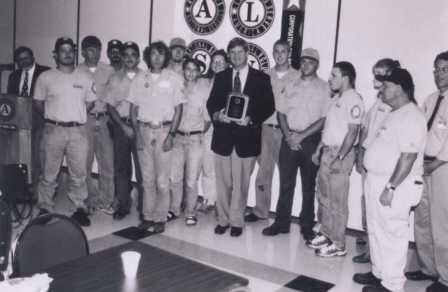
Iowa Governor Vilsak is a strong supporter of volunteerism. On October 1, 1999 he gave out awards to all the different AmeriCorp groups in Iowa. Here he is posing with AmeriCorp workers from Dolliver Memorial State Park, Lacey Keosauqua State Park, and Waubonsie State Park. Among those pictured is Kyle Ehlers, Trail Supervisor (Waubonsie State Park), Iowa D.N.R.(second person to the left of the Governor.
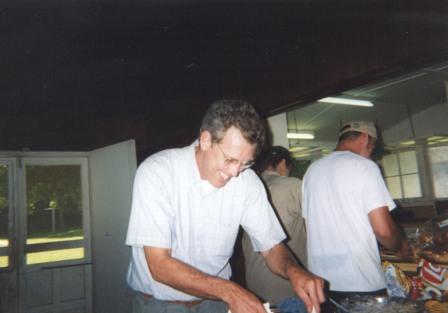 Mark Edwards, Trails Coordinator for the Iowa Department of Natural Resources, has spearheaded the effort to restore prairies in Waubonsie State Park and to maintain trails in all 3 parks. By writing proposals for grant money, he made it all possible. He brought the 3 park crews together several times over the 6 month season which lasted from late May to late November. One of the times we all got together was at Dolliver Memorial State Park, where their crew prepared dinner for us.
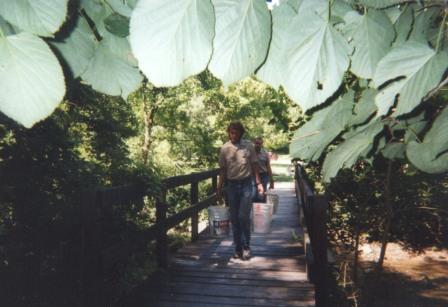 Mark's design for railroad tie steps is used in Iowa's state parks. They are built into the ground. If improperly constructed, built with the sides above ground, steps can cause severe erosion problems. Here the author, under a canopy of eastern redbud (Cercis canadensis, helps to fill in steps with gravel at Dolliver Memorial State Park.
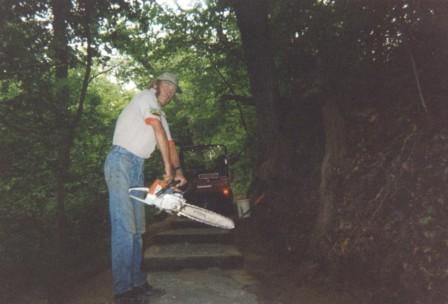 The Entrance trail at Waubonsie State Park winds through an oak-hickory forest before connecting up with the Bridge trail.
PRAIRIE SPECIES COLLECTED:
Scientific Name, (Common Name)
- Amorpha canescens Pursh (leadplant)
- Andropogon gerardii Vitman (sideoats grama)
- Brickellia eupatorioides var. eupatorioides (L.) Shinners (false boneset)
- Calylophus serrulatus (Nutt.) Raven (yellow sundrops)
- Dalea candida Michx. ex Willd. (white prairie clover)
- Dalea enneandra Nutt. (nineanther prairie clover)
- Dalea purpurea Vent. (violet prairie clover)
- Delphinium carolinianum ssp. virescens (Nutt.) Brooks (Carolina larkspur)
- Elymus virginicus L. (Virginia wildrye)
- Euphorbia corollata L. (flowering spurge)
- Euphorbia marginata Pursh (snow on the mountain)
- Gaura mollis James (velvetweed)
- Hypericum sphaerocarpum Michx. (roundseed St. Johnswort)
- Liatris aspera Michx. (tall blazing star)
- Linum rigidum Pursh (stiffstem flax)
- Linum sulcatum Riddell (grooved flax)
- Lithospermum canescens (Michx.) Lehm. (hoary puccoon)
- Lobelia cardinalis L. (cardinalflower)
- Lygodesmia juncea (Pursh) D. Don ex Hook. (rush skeletonplant)
- Mirabilis nyctaginea (Michx.) MacM. (heartleaf four o'clock)
- Monarda fistulosa L. (wild bergamot)
- Orbexilum pedunculatum (P. Mill.) Rydb. (Sampson's snakeroot)
- Panicum virgatum L. (switchgrass)
- Penstemon digitalis (Nutt.) ex Simms (talus slope penstemon)
- Penstemon grandiflorus Nutt. (large beardtongue)
- Physalis virginiana P. Mill. (Virginia groundcherry)
- Ratibida pinnata (Vent.) Barnh. (pinnate prairie coneflower)
- Rosa arkansana Porter (prairie rose)
- Salix humilis Marsh. (prairie willow)
- Silphium laciniatum L. (compassplant)
- Solanum rostratum Dunal (buffalobur nightshade)
- Solidago missouriensis Nutt. (Missouri goldenrod)
- Sorghastrum nutans (L.) Nash (Indiangrass)
- Spartina pectinata Link (prairie cordgrass)
- Sporobulus compositus var. compositus (Poir.) Merr. (composite dropseed)
- Symphoricarpos occidentalis Hook. (western snowberry)
- Verbena bracteata Lag. & Rodr. (bigbract verbena)
- Vernonia fasciculata Michx. (prairie ironweed)
- Yucca glauca Nutt. (soapweed yucca)
LINKS:
1) AmeriCorps
2) Student Conservation Association
3) DesMoines Register Articles
4) Iowa Prairie Network
5) Native prairie management guide
6) Prairie wildflowers of Illinois
7) Bringing Fire Back: The Changing Regimes of the Appalachian Mixed-oak Forest
MY PAGES:
Home Page
1) 1999 PLANT LIST FOR WAUBONSIE STATE PARK
3) 1940 Plant List for Waubonsie State Park
4) Riverton Wildlife Area
5) The Lakota and footbridge
6) SIU Home Page
LINKS:
1) AmeriCorps
2) Student Conservation Association
3) DesMoines Register Articles
4) Iowa Prairie Network
5) Native prairie management guide
6) Prairie wildflowers of Illinois
7) Bringing Fire Back: The Changing Regimes of the Appalachian Mixed-oak Forest
MY PAGES:
Home Page
1) 1999 PLANT LIST FOR WAUBONSIE STATE PARK
3) 1940 Plant List for Waubonsie State Park
4) Riverton Wildlife Area
5) The Lakota and footbridge
6) SIU Home Page