

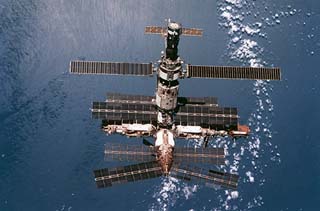
Mir means "peace" and "community" in
Russian. The Mir space station contributed
to world peace by hosting international
scientists and American astronauts. It also
supported a community of humans in orbit
and symbolized the commonwealth of the
Russian people. Mir was constructed in orbit by connecting
different modules, each launched
separately from 1986 to 1996. During the
Shuttle-Mir Program, Russia's Mir
combined its capabilities with America's
space shuttles. The orbiting Mir provided a
large scientific laboratory in
space where people could live. The visiting space shuttles provided
transport and supplies, as well as
temporary enlargements of living and
working areas, creating the largest spacecraft
in history, with a combined mass of 250
tons. The 100-ton Mir was as
big as six schoolbuses. Inside, it looked
more like a cramped labyrinth, crowded
with hoses, cables and scientific
instruments�as well as articles of
everyday life, such as photos, children's
drawings, books and a guitar. It noramlly
housed three crewmembers, but it
sometimes supported as many as six, for
up to a month. Except for two short
periods, Mir was continuously occupied
until August 1999. The journey of the 15-year-old
Russian space station ended March 23, 2001, as Mir
re-entered the Earth's atmosphere near
Nadi, Fiji, and fell into the South Pacific.
Despite its inconveniences, many
cosmonauts and astronauts grew to love
Mir, comparing it to a living being with
qualities, needs, and eccentricities.