Space Shuttles
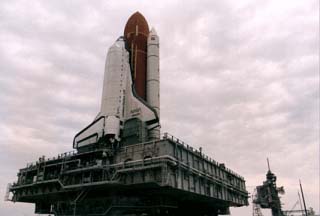
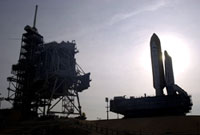
NASA's four space shuttle orbiters are the
first spacecraft capable of routinely
launching into orbit like rockets and then
returning to Earth as gliders. They are the
main element of NASA's Space
Transportation System, and are used for
scientific research and space applications,
such as deploying and repairing satellites.
During the Shuttle-Mir Program, the
shuttles' space access capabilities were
combined with the Mir space station's
long-duration spaceflight qualities to create
a new and effective combination.
On its own, a space shuttle can carry to
orbit a payload of about 65,000 pounds.
Typical missions have crews of about
seven astronauts, orbit at altitudes of
around 150 to 250 miles, and stay in space
for ten days to two weeks. In special
circumstances and different configurations,
a shuttle can support a crew of up to ten,
attain an altitude of up to 600 miles, or
remain in orbit for up to 28 days.
The space shuttle system is composed of
several large components: the orbiter,
three main engines, the external tank, and
two solid rocket boosters.
There are currently four Orbiters that NASA has, these are
- Columbia - First flight 1981 has been on 27 flights
- Discovery - First flight 1984, has been on 30 flights
- Atlantis - First flight 1985, Has been on 26 flights
- Endeavor - First flight 1992, has been on 17 flights
- Challanger - First flight 1983, Exploded in mid air on its 10th flight in 1986