 Jean-Baptiste Pitre
The Deportation Order
Escape from Deportation
Pitre Relatives Deported
Pitre Family in Louisiana
Jean-Baptiste Pitre
The Deportation Order
Escape from Deportation
Pitre Relatives Deported
Pitre Family in Louisiana
Cécile Boudreau
Michel Boudreau
Marie-Cécile Leblanc
Boudreau Relatives Deported
Their children
Generation 4
5
6
7
8
9
Main
1
2
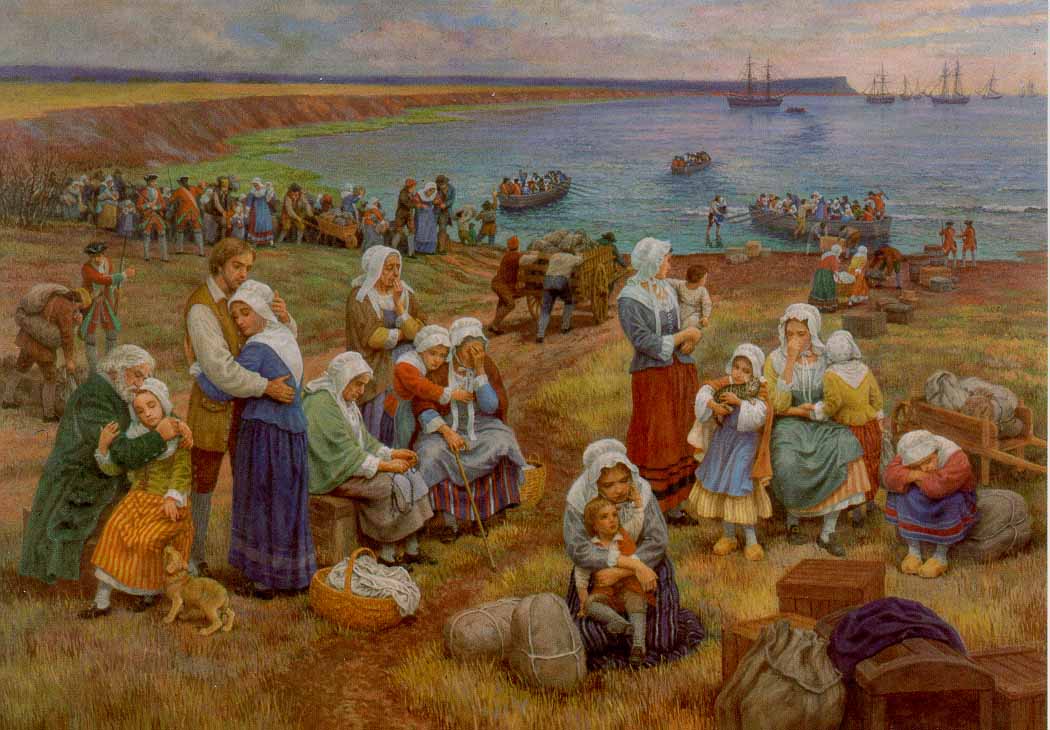
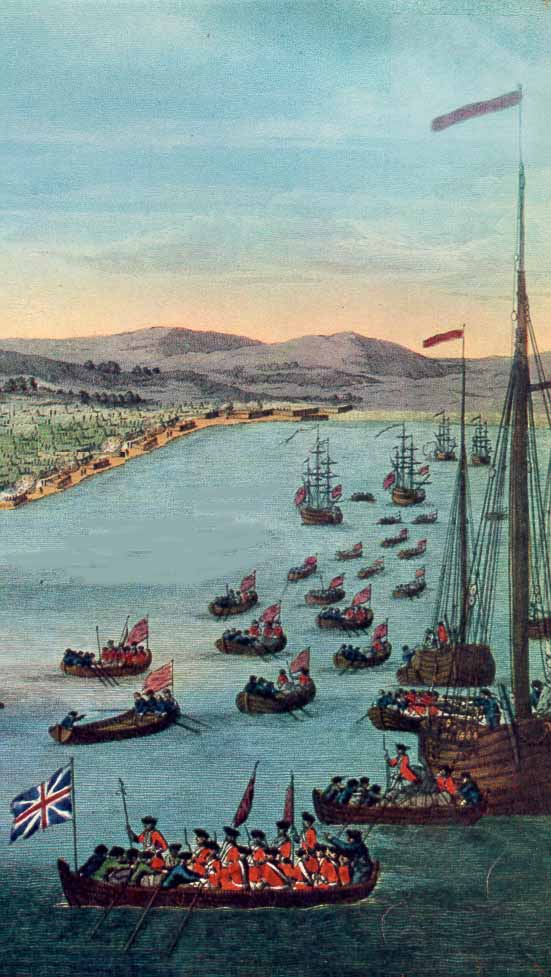
Ships take Acadians into exile - Painting by Claude Picard
Jean-Baptiste Pitre
Son of François dit Nordest Pitre and Anne Préjean le Breton, Jean-Baptiste was born in 1711 in Port-Royal. He was only 14 when he lost his father.
He was married on October 28, 1733 to the nineteen year old Cécile Boudreaux. Although this marriage took place in Port-Royal, the following year the young couple lived in the Parish of Saint-Charles des Mines in Grand-Pré. It is there that their son Michel is born in 1735. By 1737, their young family is living in Beaubassin.
 The fact that Jean-Baptiste & Cécile moved farther inland with their families was a symptom of the times they were living in Acadia. The Acadian population was growing fast much to the concern of the British authorities, Acadians were forced to find new areas to settle. By the end of the 17th century, new settlements developed in Les Mines (Grand Pré) and later in Beaubassin.
Like Jean-Baptiste's father, many acadians had taken the oath of allegeance to the King of England between 1719 and 1730. Because of this oath and the fact that they lived under British Authority, the Neutral Acadians were no longer trusted by France. Also at that time in history, Britain distrusted all catholics and felt that Acadians could ally themselves with France in a conflict. This left our ancestors in the precarious position of being mistrusted by both political powers.
From 1749 to 1755, the increase of English settlers in Nova Scotia added tensions for the Acadians. The native Micmacs who conducted raids on the British settlements, were said to have close links with the Acadians. England wanted Nova Scotia as their territory because of its strategic military location. The Governor of Massachusetts coveted this area for its access to Québec and the French Fortress of Louisbourg on Cape Breton Island. Louisbourg was the commercial and administrative centre of the French Colonies in Acadia at the time.
These would become the decisive factors in the eventual Deportation Order.
Source: Centre Acadien, Université Sainte-Anne, N.S.

Escape from Deportation
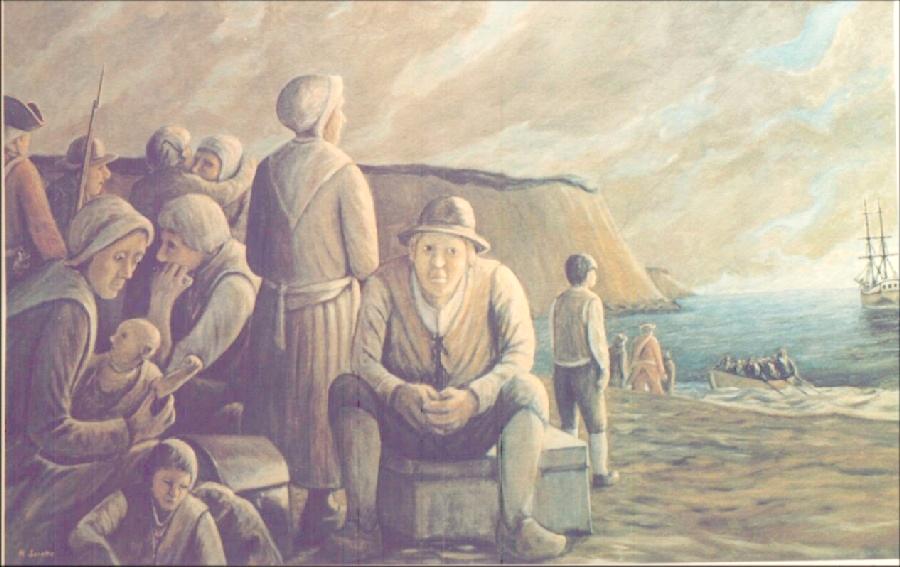
Acadians in the areas of Memramcook, Chipoudy, and Petitcodiac rivers were hearing rumors of deportation in August of 1755 and on the advice of their Missionnary L'Abbé François Le Guerne, hundreds took refuge in the woods of what is now part of New Brunswick. They were forced to remain hidden in the forest as the British authorities had put a price on their heads. Some of these Acadians were successful in reaching their destinations but many died along the way from starvation & exhaustion.
Jean-Baptiste Pitre and his family were among 200 Acadian families from the areas of Memramcook, Chipoudy, and Petitcodiac rivers who had followed this advice and hid in the forest.
They were fortunate that Charles Deschamps de Boishébert, a captain in the French colonial regular troops, was nearby. Accompanied by a group of natives, the 125 French soldiers surprised about 200 English soldiers who were about to set fire to the 250 houses in Petitcoudiac. Both L'Abbé Le Guerne and Lieutenant Boishébert are credited for having ensured the survival of the Acadians.
The acadians foresaw the second phase of the expulsion of 1758 and Jean-Baptiste Pitre's family accompanied others up the coast to Miramichi in 1757. Exhaustion and lack of provisions took its toll on the Acadians and many died of starvation. As a result, several decided to follow Boishébert's troops recalled to Québec for the winter of 1757-58.
Unfortunately, the circumstances in Québec City were not much better. The war had brought on a lack of supplies and famine, the Acadian refugees became an extra burden and were fed cod and rotten meat. It is said that these unfortunate living conditions caused the death of many Acadians.
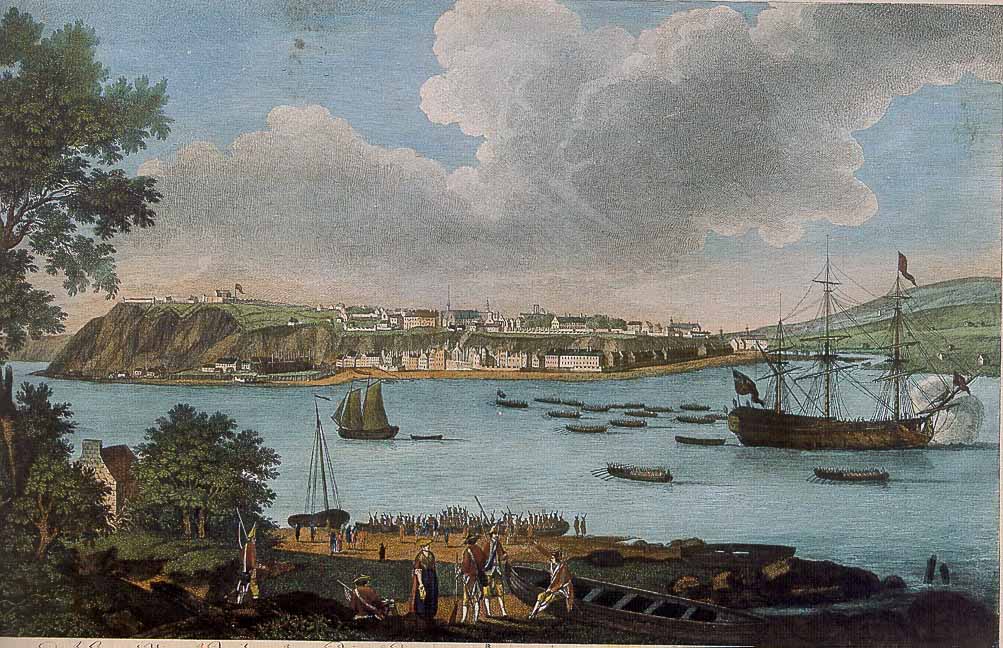
View of Quebec City, circa 1758
There are approximately 1,500 Acadian refugees when the City is hit by a smallpox epidemic. Already weakened by their journey, hundreds succumbed to this illness. Jean-Baptiste Pitre and his family were among this ill-fated group and on June 9th, 1758, our ancestor passed away in Quebec at the age of 47.
Source: Dictionary of Canadian Biographies, Vol. V, 1801-1820
 Cécile Boudreau
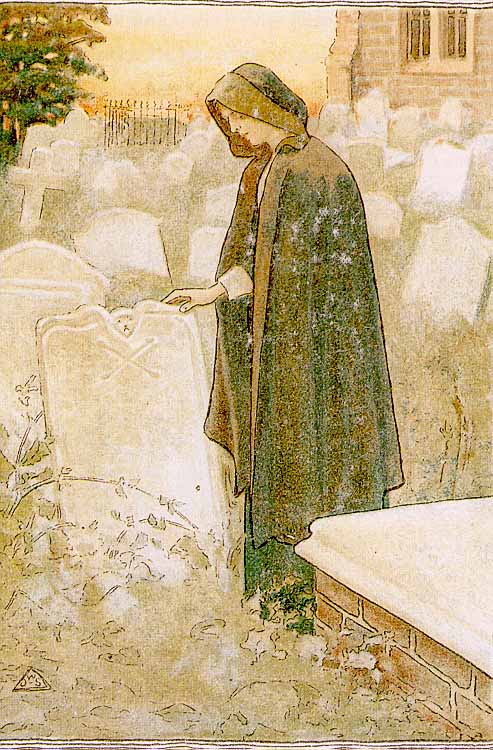
On June 9th, 1758, Cécile Boudreau saw her husband of many years Jean-Baptiste Pitre pass away during the smallpox epidemic in Quebec City. She had buried her son Jean-Baptiste, eight years old, the month before. Four days after her husband's funeral, her daughter Anne Pitre died at the age of 14. On December 21st of that same year, she lost her baby Isidore, who was only 4 years old.
Cécile Boudreau still had five children with her when she moved to what is now Nicolet, Quebec. This area is said to have been recommended by their missionaries and the Abenakis and became a good place to settle. Near the St. Lawrence, it permitted access to the gulf and Acadia where many hoped to return.
Cécile would settle there with her family and in 1762, she married her second husband, Pierre Pellerin. Thirty years later, her husband passed away and she became a widow again. According to the Dictionary of Canadian Biographies : She apparently reached the age of 97, still strong, lucid, and courageous. An unfortunate fall then forced her to take to her bed. After 18 days during which she was willing to drink "only a little water and two shots of rum," she died.
Source: Dictionary of Canadian Biographies, Vol. V, 1801-1820
Michel Boudreau
Cécile Boudreau was born around 1714. Her parents Michel Boudreau and Marie-Cécile Leblanc were married in 1708 and had settled in Grand Pré (Les Mines). The ‘Village de Michel' in Des Mines was named after Cécile's father Michel Boudreau. On May 26, 1731, Marie-Cécile Leblanc passed away leaving 11 children motherless and her youngest child Olivier only 3 years old. Michel Boudreau was now a widower. That same year his son François dit Lami Boudreau had married Marguerite Pitre, daughter of the deceased François Pitre and the widow Anne Préjean. Less than a year after his wife's death, Michel Boudreau marries Anne Préjean on April 16, 1732 in Port Royal. The following year, on October 28th Cécile Boudreau married Anne Préjean's son, Jean-Baptiste Pitre.
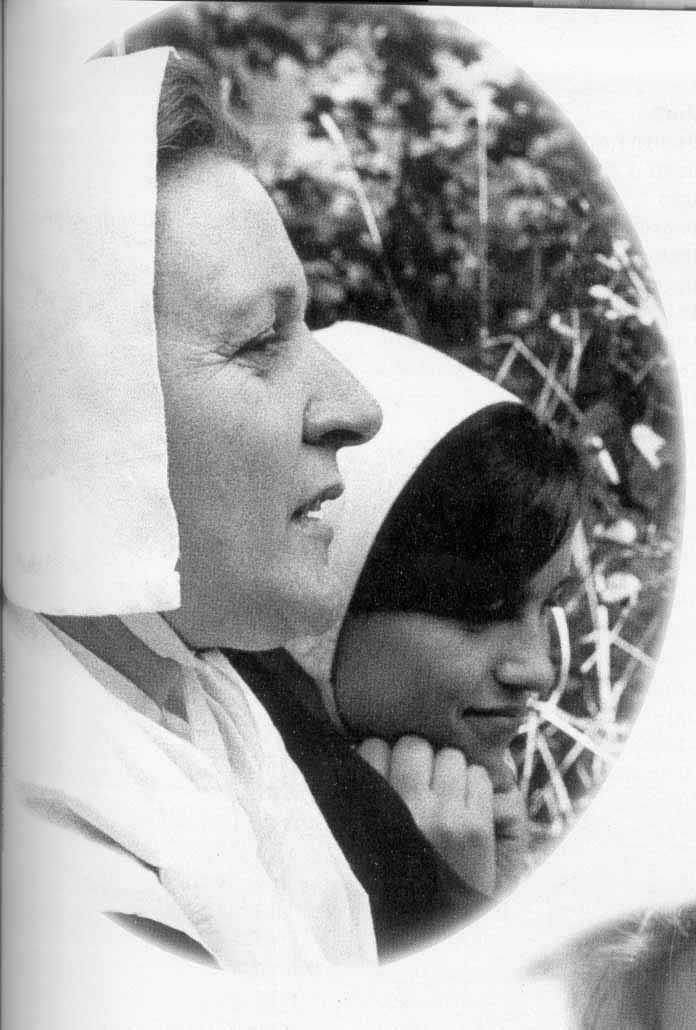 Marie-Cécile Leblanc
Cécile Boudreau was named after her mother Marie-Cécile Leblanc. Born around 1686, Marie-Cécile Leblanc was only 45 when she passed away leaving 11 children motherless.
Marie-Cécile Leblanc was one of the thirteen children of Jacques Leblanc and Catherine Hébert. According to the Centre of Acadian Studies, Daniel Leblanc is the progenitor of the Acadian family with the most descendants. He was born in France around 1626. Daniel Lablanc arrived in Acadia before 1650, he was married that year to Françoise Gaudet, daughter of Jean Gaudet, & widow of Mercier. Among their sons, five formed families. The LeBlanc family grew very rapidly and left many descendants in North America.
Jacques Leblanc, born in Port-Royal around 1651, was the eldest son of Daniel. He married around 1673 , Catherine Hébert, daughter of Antoine Hébert & Geneviève Lefranc.
Source: Centre d'études acadiennes
Marie-Cécile Leblanc married Michel Boudreau, son of Claude Boudreau & Anne-Marie Thibodeau around 1708.
Typical of many Acadian families, her brother François Leblanc had married Marguerite Boudreau, also of Claude Boudreau & Anne-Marie Thibodeau. During the expulsion of 1755, François & Marguerite were deported to Massachussets with their family.
Cécile Boudreau was not the only one going through hard times between 1755 and 1763 and like many other acadians, members of her family were subject to deportation.
- In the Village de Michel, her brother, Michel Boudreau ‘fils' was on Colonel Winslow's list of acadians who were deported. He died before May 21, 1763.
- Her brother Olivier and his family were later found in Louisiana.
- Her sister, Marguerite was deported to Connecticut and after making her way to St-Domingue, passed away there on October 20, 1764.
- Her sister Marie with her husband, disappeared sometime between March 19, 1757 and January 17, 1761.
- Her brother François dit Lami died in Quebec City on November 24, 1757.
- Her brother Pierre died sometime before 1763.
- Her brother René died around 1756 or 1757.
- Her brother Jean-Baptiste also died from the smallpox epidemic in Quebec City on January 9, 1760.
Jean-Baptiste Pitre & Cécile Boudreau had eleven children:
- Marie-Josephe-Agathe Pitre, born 1734, Grand-Pré, married Jean-Baptiste Desfossés, October 28, 1760, Nicolet County, Quebec
- Michel Pitre, born October 2, 1735, Grand-Pré, married Marie-Josephe Orillion on May 14, 1759 in Québec
- Charles-Modeste Pitre, born 21 December 1737 in Beaubassin died Abt. 1769 married Madeleine Vincent b: Abt. 1739 m: Abt. 1759. His family was found in Louisiana.
- Marguerite-Anastasie Pitre, born 10 December 1739 in Beaubassin
- Marie-Louise Pitre, born 1740 in Beaubassin; married Gabriel Coltret on October 10, 1760
- Rosalie Pitre, born 8 April 1742 in Beaubassin
- Anne Pitre, born 15 February 1744 in Beaubassin, died on June 12, 1758 in Quebec
- Joseph Pitre, born 30 January 1746 in Beaubassin, married Marie-Antoinette Lupien on June 07, 1770 in Nicolet County, Quebec d: 5 May 1823 Nicolet, Quebec
- François-Mathurin Pitre, born 21 December 1747 in Beaubassin. d: 14 January 1830
- Jean-Baptiste Pitre, 25 March 1750 in Beaubassin, died May 8, 1758 in Quebec
- Isidore Pitre born 30 July 1754 in Beaubassin, died on December 21, 1758 in Quebec
The following are some of our ancestor Jean Baptiste Pitre's relatives who were deported, disappeared or died with their families during the deportation years of 1755 to 1763.
- Charles-Modeste Pitre (son) His family is found later in Louisiana
- Antoine Pitre, (Brother) died sometime between 1755 and 1763
- Marie-Josephe Pitre, (Sister) & Family deported to South Carolina
- Joseph Pitre (Cousin) (of Claude & Anne Henry) deported alone on the ship Endeavour to South Carolina. His wife escaped to Quebec where many descendants are alive today.
- Françoise Pitre & Family (Cousin) deported to Europe
- Angélique Pitre & Family (Cousin) deported to Europe , died in France on August. 24, 1757
- Marie-Marguerite Pitre, (Cousin) & Family deported to Europe , died in France on December 28, 1758
- Jean Pitre, (Cousin) & Family deported to Europe , died at sea during the crossing in 1758
- Joseph Pitre (Cousin) (of Jean & Françoise Babin) & Family deported to Europe , died at sea during the crossing in 1758
- Michel Pitre (Cousin)(of Jean & Françoise Babin) & Family, deported to Europe , died at sea during the crossing around December 13, 1758
- Madeleine Pitre (Cousin) & Family deported to Europe , died at sea on the Duke William, during the crossing to France
- Cécile Pitre (Cousin) & Family deported to Europe , died at sea on La Violet, during the crossing to France
- Germain (Cousin) dit Germain-Jean Pitre, died in Le Mirebalais, St-Domingue, West Indies on October 20, 1764
- Amand Pitre (Cousin) & family deported to Europe on list of passagers to Louisiana in 1785
- Claude Pitre (Cousin) & family deported to Europe to England, died in Sauzon, France on March 7, 1775. His family later emigrated to Louisiana in 1785
- Jean Pitre (Cousin) & Family deported to Europe , on list of passager to Louisiana in 1785
- Jean (dit Jean Marc) Pitre (Cousin) died at Fort Edward in Nova Scotia, July/August 1762
- Marie Pitre (Cousin) & Family, deported to France, died at sea during the crossing to France
THE DEPORTATION ORDER LINKS SOURCES MAIN PREVIOUS NEXT EN FRANÇAIS