 Colonel Isaac Pesseley
Barbe Bajolet
Marriages and Children of Barbe Bajolet
Children of Jean Pitre and Marie Pesseley
| Generation 2 | 3 | 4 | 5 | 6 | 7 | 8 | 9 | Main |
|---|

His name may have been Jan Pietr. Either for social acceptance or by mispronounciation, he became Jean Pitre. He was born around 1636. This pioneer would be our first Pitre ancestor to set foot on this continent and the progenitor of many Pitre, Lepitre, Pieters, Pieter, Pietre, Peters, Peter, Peete, living in Acadia, Quebec, Canada and the U.S. today.
The first trace that is found of our ancestor is in the 1671 census of Port Royal, Acadia. Jean's trade is mentioned as edge-tool making which consists in the fabrication of sharp tools and irons used by farmers.
The pioneer of the Acadian Pitre family is Flemish according to a statement made at Belle-Île-en-Mer, France after deportation by his grandson Claude Pitre.
However, in his Dictionnaire généalogique des familles acadiennes Genealogist Stephen White also cites Père Clarence d'Entremont (genealogist) who believed that it is more likely that he was English, based on An account of the Customs and Manners of the Micmakis and Maricheets where it is said that Peters, a toolsmith in England was of English origin.
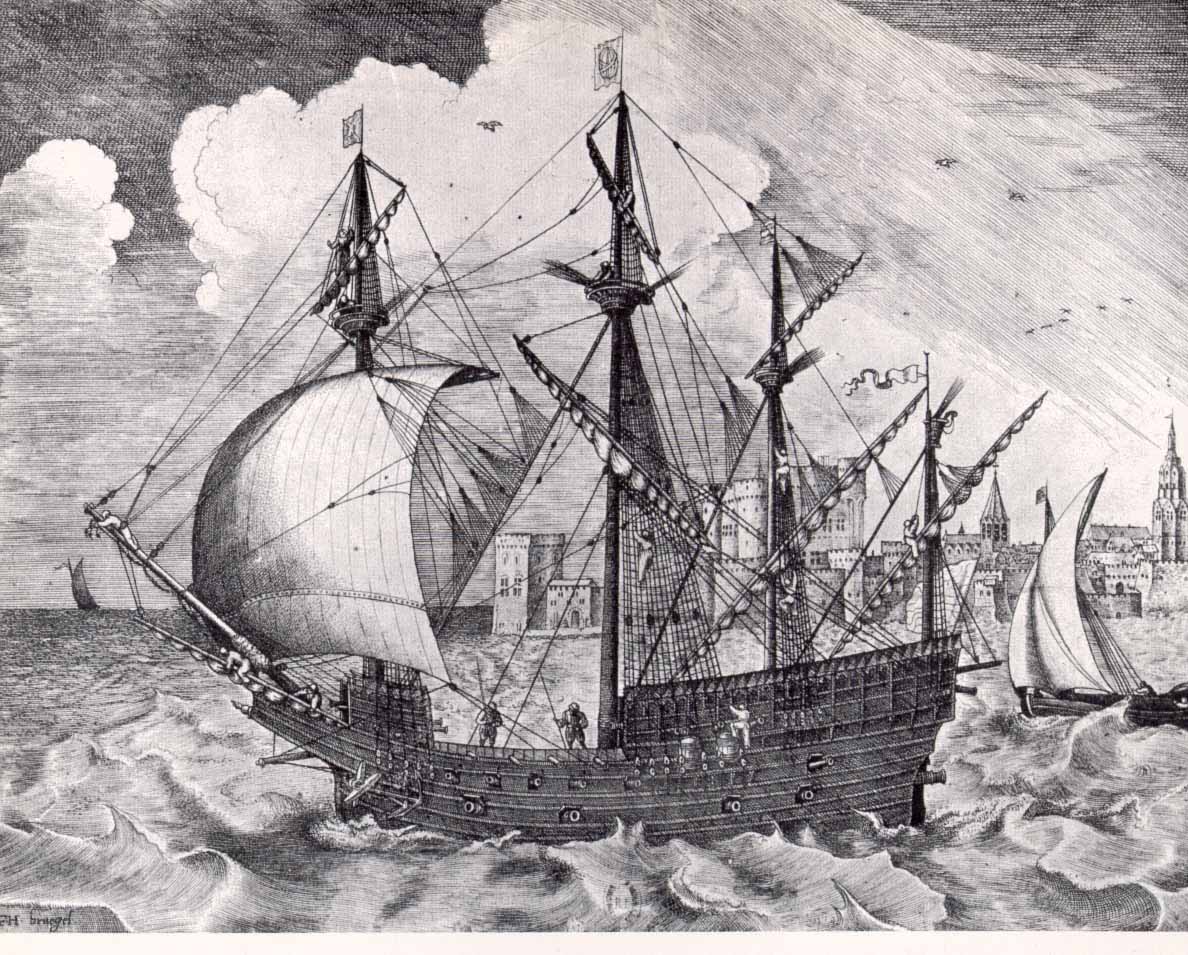
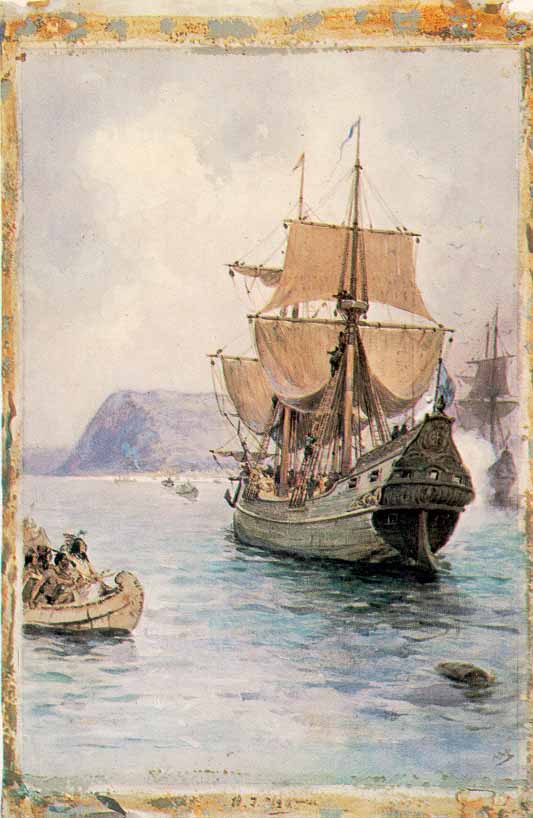
Many hypotheses have been brought forth as to how Jean Pitre arrived in Acadia. It has been speculated that he arrived with the Sir ThomasTemple Expedition on May 1, 1657.
There is no list of settlers from this expedition but it coincides with Jean Pitre's arrival in Acadia.
On the other hand, Leopold Lanctot suggests that Jean Pitre first came as a pioneer to the Dutch colonies of Fort Orange (now Albany, N.Y.) or New Amsterdam (now New York, N.Y.). When the British took over those Dutch colonies Governor Temple would have recruited Dutchmen to take them to Acadia.
Another story that was told on the origins of Jean Pitre was published in The History of St. Anthony's Parish 1803-1980 which relates to the descendants of Jean Pitre in Prince Edward Island, most of which have taken the name Peters. This account would have him in Permambuco, Brazil and escaping the Dutch wars in South America by hopping a schooner up to Acadia.
Still another story would have a named Peter (maybe Jean Pitre's father) arriving during the Scottish occupancy between 1621 and 1632. This last story is found in The Acadian Miracle by DJ Leblanc who states that Peter later changed his name to Pitre and remained in Acadia after the French retook possession in 1632.
Unfortunately all of these are just theories and speculations and we really don't know how and when Jean Pitre arrived in Acadia. For all we know, he could have arrived as a child with his parents or even been born in Acadia of parents who arrived earlier since there were not many documents kept in the early 1600's.
We know that he was in Port Royal around 1665 when he married Marie Pesseley because the following year, their first child Marie was born.
In 1671, Acadia is part of France again and the population has reached 360. In this first census taken in Acadia, we find the following:
Jean PITRE
edge tool maker, 35, wife Marie Pesseley; Children: Claude 9 months and 2 daughters, Marie age 5 & Catherine age 3; cattle 1, no ploughed land.
The first census list our ancestor with his young family. At this time, he is one of the few Acadians with no farming land and would have had to concentrate on his skills as a toolsmith to provide for his family. By 1678, his family has grown and has added 2 acres of ploughed land and one more cow to help feed them.
It is through their fifth son François that our Pitre lineage is continued. François is listed in the 1686 census as being 4 years old.
2 acres & 2 cows
4 boys: 10 1668 Claude; 5 1673 Marc; 3 1675 (son); 1 1677 Pierre
2 girls: 14 1664 Marie; 11 1667 Catherine;
Jean PITRE age 61; Marie PESELET age 45
Claude age 16; Marc age 12; Pierre age 9; Jean age 6; François age 4; girl (Marguerite) age 2; girl (Jeanne) 1 month
In 1689, war was declared between France and England. Boston's New Englanders took advantage of this by trying to invade Acadia one more time.
Admiral Phipps arrived in Port Royal in 1690 with 700 English soldiers. The fort was defended by 70 French soldiers who eventually surrendered.
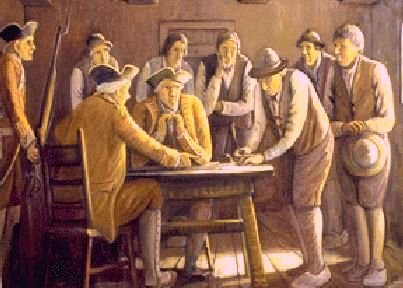 Inhabitants of Port Royal and ‘Des Mines', locked in the church and with the threat of burning down their houses, were forced to sign a Declaration of Fidelity to the Crown of England, but still refused to bear arms against their French comrades.
Even though the French settlers had given in and signed the Declaration, for twelve days afterwards the New Englanders destroyed Acadia. The Church and Presbytery were razed. Cattle was destroyed, houses pillaged and 28 of them burned to the ground. The settlers were in a disastrous situation and they moved to Jemseg on the St-Jean River.
"Signing of the Oath" by Nelson Surette
It was around that time that our first Ancestor, Jean Pitre, passes away in Port Royal. He would have been in his mid-fifties when he left his wife and nine children in mourning. Their youngest Jeanne was only 5 years old.

Because of widespread illiteracy during these earlier centuries, it was not uncommon to see the spelling of names vary according to the priest or clerk who wrote it in his own way. Therefore, original spelling of many names may vary and change from one generation to the next.

In 1654, Acadia was captured by the British. Colonel Temple became Governor of Acadia, which the British renamed Nova Scotia. During his governorship, Temple was an absentee governor who remained in Boston. His was much more of an economic arrangement than a political career and Temple only governed the immediate neighborhood of Port-Royal and a few other areas until 1670. On May 1, 1657, Sir Thomas Temple's ship arrived in Port-Royal, Acadia with a party of settlers.
| MARIE PESSELEY | JEAN PITRE | LINKS | SOURCES | MAIN | NEXT | EN FRANÇAIS |
|---|

Louis XIV ruled in France from 1643 to 1715 during a period in that country's history that was known for its opulence and political genius. The 'arts' were generously promoted by the 'Sun King' so writers, musicians and painters flourished during this era. Unfortunately, all of Louis XIV's exuberance and the endless wars, were also costly for his people, impoverished by the end of his rule.