|
|
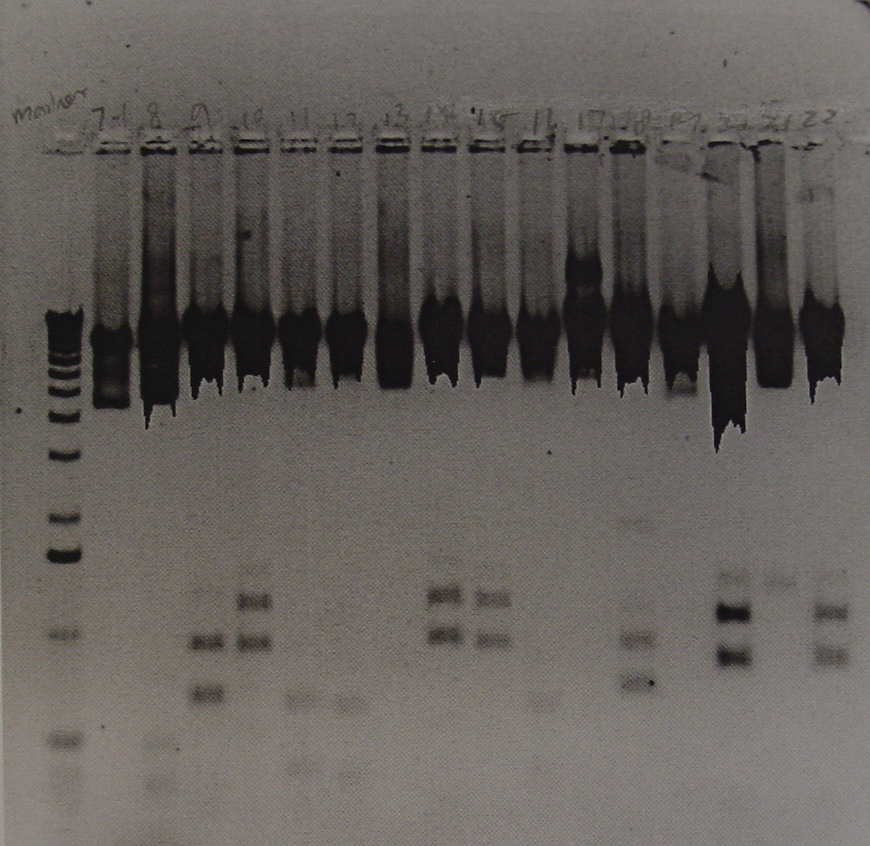
SDS gel electrophoreses allows for the identification of different interactors by observing the DNA band sizes. Out of the cDNAs that appeared to contain the same cDNA, only one or two were sequenced. The smaller the fragment, the further and faster it travels towards the negative pole. Lane identity (in order): DNA marker, 23c-1, 23c-2, 24c-1, 24c-2, 25c-1, 25c-2, empty lane, 26c-1, 26c-2, 27c-1, 27c-2, 29c-1, 29c-2, 31c-1, 31c-2, 33c-1, 33c-2, 34c-2, 34c-1, 36c-1, 36c-2, 35c-1, 35c-2, 37c-1, 37c-2, 39c-1, 39c-2, 40c-1, 40c-2, 41c-1, 41c-2, 3m-1, 3m-2, DNA marker. Xbi-2m-2, xbi-1c-1, xbi-2c-1, xbi-3c-2, xbi-4c-1, xbi-5c-1, xbi-6c-1, xbi-8c-1, xbi-9c-1, xbi-10c-1, xbi-11c-1, xbi-12c-1, xbi-14c-1, xbi-18c-1, xbi-19c-1, xbi-20c-1, xbi-22c-1 were selected for sequencing. [Colonial designations reflected the order in which they were extracted from the plate �V xbi (interactor obtained from Xb10 screen) �V 1 (order in which colony was picked) c/m (indication of library, C64 or Moroberekan) -2 (two colonies were picked from each plate and placed on liquid LB amp media (see Isolation of Plasmid DNA from Yeast in the methods section.)) (xbi-1c-2.) (To abbreviate, the xbi part will be omitted. (xbi-5c-1=5c-1.))] |
|