 |
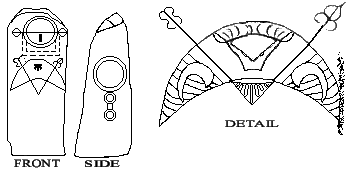
Lindores Stone. Grange of Lindores. OS No NO260 163. Greenstone 3ft 3ins Tall x 22ins wide(front face) x 18ins at cemented base level. (100cm x 55cm x 45cm) CLASS I. 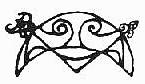 
|
|
Lindores Stone. Grange of Lindores. OS No NO260 163. Greenstone 3ft 3ins Tall x 22ins wide(front face) x 18ins at cemented base level. (100cm x 55cm x 45cm) CLASS I.
|
In ECMS (Vol 2, P344 of Pinkfoot Press Edition), the stone is
described as being rectangular, and built into a garden wall in
the village of Lindores. Apparently, the stone originally stood
on Kaims Hill at approximately NO 263 172 before being moved to
Lindores village.
It is now cemented into the floor of the morthouse at Abdie Old Kirk,
beside Grange of Lindores, on the opposite side of Lindores Loch.
They also say it is carved on the front, but now that is
freed from the wall, a mirror symbol can be seen on the side to
the right of the face-surface.
It is also only rectangular from the front, being sloped at
the back.
At some point, a sundial has been carved over the big
circle of the top symbol. The dark line on the illustration
represents the slot the gnomon occupied.
This stone is an excellent example of an ill-treated
Pictish stone, for, as well as the sundial, it has had a surveyor’s
mark gouged into it, too.
My interpretation of the “flight” of the V-rod
varies from theirs, but posssibly it was more legible a hundred
years ago.
I also saw the section of the crescent as much broader than
their representation. Perhaps fancifully, I saw it as
representing an animal head, taking the ellipses at the top for
ears.
The mirror is unusually large at 12.5” (31 cms app.)
and the handle is 12” (30cms app) long. It is also unusual
in that it is one of the rare examples of a mirror without a comb.
The handle is strongly reminiscent of a double-disc turned
through 90 degrees
The Kirk is obviously very ancient, showing several phases of
building and expansion. It is on a classic round hillock burial
site.
Also in the morthouse is a stone effigy of a person in a
long cloak with a cowl, about 5’ 9” tall (185cm ) and a
slab incised with a cross which has a head made up of eight fleur-de-lies
arranged in a circle. (If memory serves me well, a morthouse was
a sort of resting-place for bodies waiting to be buried.)
If you do decide to visit this site, I strongly suggest you park
at the “new” Abdie and Dunbog Church carpark, and walk
down the lane. There is no room to turn at the bottom without
invading the privacy of the people who live down there. It is
really just a driveway to the House beyond the church.
[The HMSO Book "PICTS" (ISBN 0 11 493491 6) Page 10 shows the shape of the stone as excavated, with fuller details of the sundial carvings]
 |
||
 |
 |
 |