 |
Saint Martin's
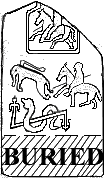
Stone Balluderon (By Dundee)OS No NO375-376 Sandstone 4ft tall x 2ft 3ins wide x 7ins approx thick. (116cm x 70cm x 18cm.)
|
|
Saint Martin's
Stone Balluderon (By Dundee)OS No NO375-376 Sandstone 4ft tall x 2ft 3ins wide x 7ins approx thick. (116cm x 70cm x 18cm.)
|
A small, insignificant stone with a stub of a cross on it, standing in a field, with a little simple iron fence around it, often hidden by crops, it is a strange inspiration for anything, far less a website on Pictish stones.
Artistically nothing, it represents far more than you could ever suspect.
Many years ago, I looked at it, and was frankly unimpressed. Not as artistic as Glamis, or as impressive as Sueno's Stone, not even as interesting as the Aberlemno roadside stones.
Eventually, through medieval studies, I became aware of the ebb and flow of history, and that places that are important now were once nothing, and that often the old centres of power have become backwaters, if they still exist at all.
So. I wondered who Martin was.
He had been important enough to have a sizeable district named after him after all.
There was a Saint Martin's Church in the locality (more details later) and several other Pictish stones or fragments were found, some of which were recorded but have disappeared since. How far back does Saint Martin's Church go?
Okay. Who was Martin?
Saint Martin.
The Martin of Strathmartine was probably Saint Martin of Tours, in France.
He lived c316 - 397, and he was an officer in the Roman army, but his heart was apparently never in the profession his parents had chosen for him. They were devout pagans, but he had become interested in Christianity. According to the legend, he came across a near-naked beggar, freezing at the roadside, so he cut his military cloak in half, and gave half of it to the beggar. Later, Martin had a dream in which God gave him a part of His cloak, and Martin converted completely to Christianity.
Martin became a monk, but the people of Tours finally persuaded him to become their Bishop, and when he died, his church became a place of pilgrimage. The word "chapel" is said to derive from "capella", the Latin for "military cloak".
He was patron of churches in Canterbury, and Whithorn Abbey under Ninian, his friend. It is rumoured that Saint Ninian brought a relic of Martin to Whithorn, when he dedicated the Abbey to the memory of his friend, but this is disputed.
Saint Ninian was renowned as the Apostle of Pictland, so churches dedicated to Saint Martin should not be unexpected, even though he never set foot in Britain. There are over 4,000 churches in France alone, and almost 200 in Britain dedicated to Martin. In the Middle Ages, his cult spread all over Europe, and he was one of the best-known saints. His influence was immense.
The Tale of Saint Martin.
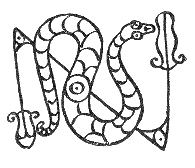
There is a story that Martin killed a serpent that was terrorizing the district around Ninewells, beside Dundee.
According to the tale, a woodcutter/shepherd/farmer had nine beautiful daughters, one of whom goes to the well for water, and does not return. He sends the next daughter, who likewise does not return. Eventually, he is forced to go look for them, and finds the serpent with bloodstained jaws. Then he/Martin attacks the dragon. Martin chases the monster the two miles or so across country up to the foot of the Sidlaws, where he slays the dragon, hence Baldragon, a local farm. The locals are so grateful they name the district Strathmartine, in his honour.
This story is a quite fanciful confusion, worthy of a modern Manga cartoonist.The version recorded in Warden Volume 4 (Angus or Forfarshire), published in the 1880s, has the Dragon at Pitempton Farm, where the Nine Maidens' Well is, although it was covered over in 1875, because the then proprietor was fed up of people coming to see it, and trampling his crops. Some things never change! This is not the Ninewells where Ninewells Hospital now is.
Anyway, Martin is in love with one of the devoured damsels, (here, the farmer's sisters) and he sets off in pursuit of the serpent.
Warden gives us the rhyme said to commemorate the event:-
Tempted at Pitempton,
Draigled at Baldragon,
Stricken at Strathmartin,
And killed at Martin's Stone.
The locals shouted "Strick, Martin! Strick!" and apparently the parish was called Strickmartin, locally, although this more likely a peculiarity of Doric pronunciation than anything else.The Bal in Baldragon is possibly the word baile in modern Gaelic which means "township", so Baldragon could mean the Dragon Town. A town in those days would be a dozen or so houses close by one another, probably one extended family. So the stone might represent the conversion of Mister Dragon to Christianity, hence the cross with his sign, the Serpent, endorsing the new religion. (The area has several older standing stones in it)
[NB the word "Dragon" comes to us through Latin from the word "DRAKO" in Greek, so it could have been in currency by the 6th Century AD, in Northern Britain.]Ninewells might be Ninian's Wells, in which case, there might be a connexion between the wells and Strathmartine.
On the other hand, there is a possibility that Ninewells is named for a Saint Donald of Ogilvie, by Forfar. He lived in the early 8th Century, and after his wife's death, he and his 9 daughters took to the holy life, before moving to Abernethy on the Fife side of the Tay, down from Perth.
They were known as the Nine Maidens, and other natural formations in the area are named after them.
Pitempton allegedly comes from the Scots Gaelic Pit teamp an - " a small church or place of worship in a hollow" and there was at one time a chapel in in the parish of Strathmartin dedicated to the Nine Maidens.
Is there just a simple confusion betwen Ninian and Nine Maidens, or were Saint Donald and his daughters devotees of the Ninian cult?
 |
||
 |
 |
 |