|
|||||||||||||||||










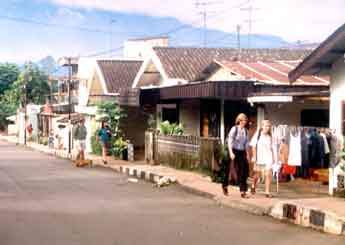
THE CITYSalatiga is situated in the Central Java (Jawa Tengah) about 40 km to the south of Semarang, which is the provincial capital and chief port. One-hour drive to the south of Salatiga lies Solo and two hours away is the tourist centre of Yogyakarta. Salatiga is situated 600 metres above sea-level in the foothills of Mount Merbabu, and the mountain's cone shaped mass dominates the town. Salatiga's population stands at over 140, 000 people, at least 90% of whom are ethnic Javanese. There is a small minority of Chinese and a sprinkling of people from other ethnic groups. Javanese language is most often heard in the streets and markets but almost everyone speaks Indonesian to varying degrees. Salatiga's economy, like that of most small towns in Java, is firmly based on agriculture. The town lies in a fertile region and is a market centre dealing in rice, fruit, vegetables, cattle, rubber, tobacco, coffee, cacao and other products.
Along the main street there are several restaurants offering Chinese and Indonesian food. In the evening delicacies, such as satay and martabak (a kind of savoury crepe) are sold at the roadside. There are many warung (eating stalls) in the markets, on footpaths and down side-streets. There are also a number of supermarkets and department stores on Jl. Sudirman. Salatiga has several cinemas which usually change their feature films each night. The films shown vary greatly, from typical Hollywood formula action/romance to martial arts films from Indonesia and Hongkong to locally produced comedies and dramas, to Hindi love stories imported from Bombay. There is also a large municipal swimming pool and tennis courts in town. The town's main mosque is on Jl K.H. Wahid Hasyim, not far from the Satya Wacana campus. There are two Catholic churches and several Protestant churches. The town Post and Telecommunications Office is about a five minute walk from the student hostel and there is a Post Office as well as several banks on campus. Salatiga also has internet, computer and photocopy facilities. Public transport within the town of Salatiga is handled by a fleet of mini pickups called angkota, each carrying about a dozen passengers. There are also becak (trishaws) and dokar (horse-drawn carriages). Intercity buses pull in at the bus terminal near the city limits on the road to Semarang. There are fast and regular bus and mini-bus services to the neighbouring towns of Semarang, Solo and Ambarawa. Several companies provide fast overnight bus connections to the more distant destinations of Jakarta, Bandung and Surabaya. THE UNIVERSITYSATYA WACANA CHRISTIAN UNIVERSITY was founded in 1956 by eight Indonesian churches as a Christian teacher training college. In 1959 it became Satya Wacana Christian University. Although it is a private university Satya Wacana has developed in line with Indonesian government policy on tertiary education. The University's broad theological orientation is Protestant. There are seven faculties: Law, Economics, Theology, Agricultural Science, Biology, Electrical Engineering, and Education. There are two post graduate schools: School of Development Studies and School of Religion and Society. The Faculty of Education consists of five departments of which Languages is one. The Department of Languages concentrates on the teaching of English, but also handles courses in Indonesian. Most of the language teaching staff on the Salatiga Program are drawn from this department. In the early years of the University's development it attracted many students from Christian regions in the outer islands of Indonesia where tertiary education institutions were scarce. The best graduates from those years were appointed to the teaching staff and today's staff at Satya Wacana consists of a diverse cross-section of Indonesia's ethnic groups. With the development of tertiary education in the outer islands in the sixties and seventies, the proportion of students from these areas fell. Today most of the students are from Java, but Satya Wacana still boasts a very colourful and diverse minority of students from regions as distant as North Sumatra in the west and Irian Jaya in the east.
|