|
Wartime
bomb damage forced the closure of the main bath hall, which remained
unglazed for several years and was not reopened until I947. Other
reinstatement of war damage was executed in the early I950’s. In
I985 the foyer ceiling was decorated with three murals, executed
by David Bratby, with the history and function of the baths as their
theme. In the first four years of operation the baths attracted
an average of almost 273,000 users each year, in addition to those
attending dances and other events in the hall during the winter
season. Post-war usage was somewhat less; between 1954 and I959
they were used by an average of 225,700 bathers each year. The numbers
of dances also declined, reflecting a change in the type of demand
for events in the East India HaIl. A wider range of sports facilities
was provided; in I956 cricket nets were installed and in the I960’s
five-a-side football, indoor bowls and basketball were introduced.
The baths ceased to provide for these activities in I980 when the
seasonal conversion of the large pool into a hall was ended, as
alternative indoor sports facilities had become available in other
buildings.
|
||||
|
Usage of the baths continued to decline. Between I966 and I970. there was an annual average of 209,324 bathers using all sections, but during the period I980-4 the comparable figure was 106,43I. The numbers using the slipper baths also fell, to the extent that those on the second floor, which were in poor repair, were removed. and the space vacated was converted into a music studio, which was completed in I984. The remainder of the warm baths section was closed in I985 and in the following year the large pool was closed for structural repairs to the roof. It was not reopened and, because of the costs of the necessary repairs to the building, the entire baths services were terminated in I988. By then it was apparent that the earlier unfavourable opinions of the building had changed markedly, at least in specialist architectural circles, with Piers Gough describing it as `a stunning building with its Hollywood style interior and beautiful vaulted ceiling'. The building subsequently was adapted as an industrial training centre, with financial support from the London Docklands Development Corporation. |
||||
|
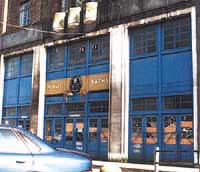
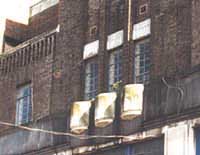
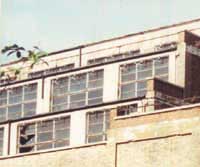
The building now shows quite serious signs of neglect and disuse. Many of the windows to the sides and rear are smashed. Weeds grow from the brickwork, vents are clumsily blocked with chemical filler and the interior through the smashed and grimy windows of the main doors seems |
|
|||
|
full of debris, probably left over from the building training scheme. The overall effect is of a proud and stately building being allowed to falter and fall to ruin. |
||||
|
|
|
|||
| For
some time there have been two distinct camps with diametrically opposed
views as to what should be the fate of this building. On the one hand
are those who believe that the site should be cleared and redeveloped.
On the others are those who feel the site is of massive architectural
importance and should be utilised as a leisure centre once more. Our
belief is that both factions are partly right, but that there is a
far more exciting option available that will preserve an important
local landmark, breathe fresh life into it and the surrounding area
and and create a whole new chapter from the ashes of the old.
|
||||