
|
Poplar Baths: A Brief History and Overview The implementation of the Baths and Wash-Houses Acts of I846-7 in Poplar began in I850, when the necessary requisition from the ratepayers was followed by the election of commissioners. |
||||
|
They appointed Price Pritchard Baly as their architect and examined his bath and wash-house buildings in St Martin's-in-the-Fields Goulston Square, Whitechapel, and Marshall Street, Westminster. Acquisition
of a site was delayed slightly until the commissioners, initially
appointed by the Trustees
|
 |
|||
|
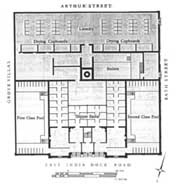
acting under the I8I3 Improvement Act, were elected by the members of the vestry as required by the Acts of I846-7. The site was at the north-eastern corner of Black Boy Field, 40 yards square, set slightly back from, and at an angle to, East India Dock Road. It was bought from James Griffiths for £1,279 3s 4d. Baly's plans had been completed by the time that the site was secured. Robert & Edward Curtis of Stratford were awarded the building contract on their tender of £6,452. The boilers, pipes, drying furnaces and apparatus were supplied by Samuel & William Standing of Whitechapel. The building was opened on I7th July I852, having cost £10,395. Baly's design used the whole of the site.On the East India Dock Road frontage was a two-storey central block of five bays, flanked by single storey ranges, with a symmetrical facade. The building was described as `of Italian character' and was thought to be `quite an ornament to the neighbourhood'. Its bathing facilities were divided into two classes, with separate entrances, the first-class occupying the eastern side of the building. In each of the side ranges there was a plunge bath 42ft long and 26ft wide, with the dressing boxes placed at the ends. The slipper baths section, behind the entrance hall and staircase, contained 6 baths for women in each division, 12 in the men's first-class section and 24 in the second-class. The steam and shower bath areas were behind the slipper baths and the laundry was placed at the rear of the building, occupying its entire frontage on Arthur Street. The laundry contained 48 separate wooden washing tubs, drying equipment and ironing rooms. The uncovered water tank, which was erected over the boiler house, had a capacity of 24,000 gallons. From the boiler house, the chimney-stack, which was encased in a tower, rose through the centre of the building. |
||||