|
The
fabric of the new building was completed early in I933, but, because
of various delays in its fitting and furnishing, it was not opened
until 20th January I934.The cost of the building, machinery and
furnishings was £124,421 and a further £5,542 had been expended
on enlarging the site.The contractors were A E Symes of Stratford
East.
|
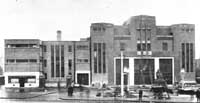
The architect’s asymmetrical design can be seen in construction belying the notion that the smaller section of the building was added later. |
|||
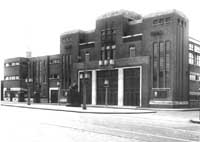
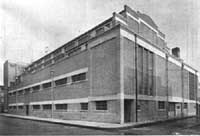
| The steel frame of the structure is clad in concrete, the exterior being faced with grey bricks | ||||
|
The decision to erect a symmetncal facade frontlng only the main bath hall unbalanced the street frontage, so that the remainder of the building appears to be a later addition; when in fact the whole was a single design. The large bath hall has a stepped roof with clerestory lights carried by seven elliptical arched ribs which were supported by horizontal beams spanning the length of the hall and held by tie beams at each end. |
The new bathhouse completed January 1934 caused much notice and remark for its monumental design |
|||
|
The architect was praised for the up-to-date internal designs and the decorations, while the exterior was described as `restrainedly modern'. The local reaction to the building's appearance was much more critical, however, and it was dubbed `Poplar gaol'. The two swimming pools were the predominant features of the new building. The larger one was I00ft long and 391/2ft wide, with 23 men's and 21 women's changing cubicles respectively on its eastern and western sides, and a further I4 `collapsible' ones under the platform at the southern end. The smaller one, which until I966 was known as the second-class pool, was 641/2ft by 25ft, with 3I changing cubicles. On the first and second floors were 86 slipper baths; 44 of them for men and 42 for women, divided equally between the first and second class divisions. |
||||
|
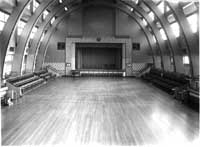
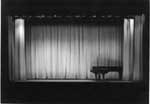
The dancehall and stage |
||||
|
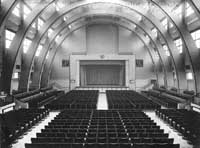
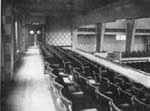
The theatre auditorium seating 1400, seen from the stage, was one of the largest and most impressive in London |
||||
| The basement contained a vapour suite, which included a plunge bath, a lounge with a buffet and a waiting room. Power was generated by two Lancashire boilers, each 28ft long with a diameter of 71/2ft; and the boiler room also contained the six filter chambers. The cold water tank had a capacity of 35,000 gallons and was placed on the flat roof of the slipper bath ranges. | ||||
|
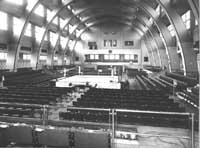
Designated
the East India Hall, the larger pool was floored over and used for
other purposes during the winter months, when the smaller one remained
in use. The hall was designed for conversion as a theatre with a
seating capacity of I,400, dance hall, cinema, exhibition room and
sports hall, especially for boxing and wrestling programmes. In
1935 a foam bach suite was installed in a part of the area occupied
by the vapour suite.
|
Mulitfunctionality was the intent. The main auditorium is here seen as a boxing arena |
|||
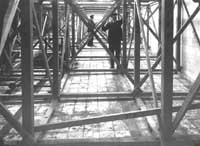 |
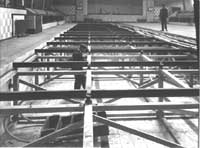
Detail of the winter hall floor conversion which still operated until 1980 |
 |
||
|
In I930 Messrs Windrum, auctioneers and surveyors, vacated the office accommodation at No.172, in the north-eastern corner of the building. The opportunity was taken to expand the foam baths into the basement area of that unit. The cost of conversion and equipment was £2,784. From I938 until I94I the office was used by the staff of the Borough's electricity undertaking, while the showrooms at Nos 208-212 East India Dock Road were being rebuilt. It was then occupied by the Transport and General workers Union and the Poplar Labour Party. |
||||
|
The Mainhall Stage set for Concert Performance |
The Gallery |
Exterior rear view of the buiding |
||