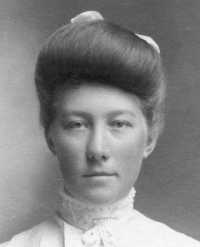
METTE EULALIA (LILY) CHRISTIANSEN
| Birth | 16 February 1885 | Ephraim, Sanpete County, Utah | ||||||
| Christened | ||||||||
| Baptism | 11 July 1893 | |||||||
| Marriage | 16 October 1907 | Manti, Sanpete County, Utah | Raymond Larson | |||||
| Endowment | 16 October 1907 | |||||||
| Sealed to Parents | BIC | |||||||
| Death | 20 March 1977 | Provo, Utah County, Utah | ||||||
| Buried |
| Children | Parents | ||||||||
| 2. Erma Larson | |||||||||
| 3. Raymond Parley Larson | 01 October 1909 | Mayfield, Sanpete Co., Utah | -- Parley Christiansen | ||||||
| 4. Walter Christian Larson | 31 March 1912 | Mayfield, Sanpete Co., Utah | Mette Christiansen -- | | | |||||
| 5. Maurice David Larson | 20 June 1916 | Mayfield, Sanpete Co., Utah | -- Dorthea Jensen Scow |
HISTORY OF METTIE EULALIA CHRISTIANSEN (LILY) LARSON
(Dictated by Raymond and Lily Larson - Recorded by Lily Jean Lott Autumn, 1963 - Edited by Floyd L. Larson )
I was born in Ephraim on February 16, 1885. My parents were Parley Christiansen and Dorthea Christena Jensen Scow.
When I was about three and a half, Dad went on a mission, I believe to the Northwestern States. He was gone two years and when he came home I didn't recognize him. I said that wasn't my father, because he had grown a long beard. So I stayed outside until it got so dark I didn't dare to stay any longer.
I remember when my brother, Aaron, was born July 13, 1889. They took Dora and me up to Aunt Mary Stevenson's to stay. Father came up to get us on a horse. We had a neighbor, Stenie Williams and she had a daughter named Delie and she had seen Aaron before we got home and it made Dora so mad she wouldn't even go in and look at him.
We got diphtheria. Dora had it first. Father stayed in the front of the house and took care of her and Mother and Aaron and I stayed in the back. They didn't think nursing babies would get it. When they thought Dora was well, they cleaned, fumigated, washed quilts, burned things, etc., but anyway I got the diphtheria and so then Dad took care of me. Dora was about seven years old when she had it and Mother said she had it so bad she couldn't get up without help. My tonsils were so swollen they said there was a hole only about the size of a pin head that I had to breathe through. They said when the marshal came to put up the quarantine flag, I swore at him and told him I would cut his head off with an axe. One day when I was better I was sitting on a chair by the window eating rice when the doctor came and said I was better and the quarantine could be lifted. I was so thrilled I jumped and ran all over the room.
Dad was called to be bishop of Mayfield Ward and we moved there in wagons in May of 1890. When we got to the outskirts of Mayfield they told us we were to Mayfield and I cried and said, "Well, if we are there why don't we stop?" Our first home was south across the street from what we used to call the Relief Society Hall.
Our second home was east across the street from Lars C. Larson's home. My sister, Merlin, and brother, Woodruff, were born in that house. I liked to play by myself. The next home was on the corner east of our second home. We had a little adobe room out north of the log house we used for a bedroom. When Elray was born Aunt Lizzie Whitlock came out to visit. Mother was in bed and Dora was taking over. Dora used to walk in her sleep and in the morning Aunt Lizzie's two children couldn't find their clothes. We finally found them on the mantle place over the fireplace. Dora had walked in her sleep and taken them and put them away. Elray weighed twelve pounds when he was born and looked like he was a month old.
Dad had our next home built. It was adobe. There was a kitchen, living room, closet and pantry downstairs and a hallway that went up to two bedrooms that were upstairs. There was a porch on the front of it. Junius was born in this home.
We went to public school. The school house I went to first was in a building they called the furniture store.
I used to tend babies when I was starting in my teens. From then on until I was married I worked. I tended babies for Beanie Olson Whitlock and she always used to promise us silk dresses, but we never got it. The highest wage I ever got in Mayfield was $1.75 a week. I used to do washings for fifty cents.
I was about 14 when I started teaching classes in the Primary and Sunday School. When I was 17 I got a job as janitor of the schoolhouse. We burned wood and coal in the stoves. There were four rooms. Uncle Woodruff helped me. I either paid him ten cents a day or ten cents a week, and we used to take the ashes out and bring the coal and kindling in and get it all ready to start in the morning. I got $8.00 a month the first year and the second year they raised it to $10, and the third year I believe I got $12 a month. We swept it with straw brooms. When it stormed we would carry the dirt out by the coal buckets full. They didn't oil the floors or anything then. We rang the bell at 8:30 every morning.
I worked for Aunt Manie (Mary Larson Olson) while I was taking care of the schoolhouse when Lucile was born. I slept there, and Uncle Hy was working over on the order (the land formerly occupied by the United Order) so I had to get up early and fix his breakfast. One evening I went up home for a while and when I came back I lit the lamp. It made the kitchen light. Manie had asked me to make a cup of tea for her. Uncle Hy was sleeping on the floor in the bedroom and he woke up and saw this bright light and he thought the house was on fire. They didn't wear nightshirts in those days, so he had on his garments and a shirt and he came running out in the kitchen and about scared me to death. Aunt Manie yelled, "Hy, Hy, what are you doing? Come back here!"
I worked for my sister, Dora, when Hazel and Adele were born. They lived in a little log house with one room and a lean-to until they built their new home. I used to help her house-clean. The ceiling was of factory (unbleached muslin cloth). We whitewashed the walls and the ceiling with lime when we housecleaned. The house was covered with dirt and it would come down on the factory. So we would cut a hole in places and let the dirt down on the floor before we whitewashed. We had rag home-made carpets with straw under it. They would weave it a yard wide and then we would sew enough of it together to fit the room. When we would take the carpet out to clean and take the straw up, there would be two or three inches of dust under the straw we had to sweep up. This was in the early 1900's.
When Adele was born, Aunt Dora got gathered breasts. One of the remedies they used was hot cow manure heated up and put in a bag and then laid on her breast.
I house cleaned for Laura Voorhees and Miltilda Whitlock. I also stayed with her when one of her babies was born. I did the washing on a wash board. I carried the water from the ditch and put it in a great big kettle outside and built a fire under it to heat it. I would get so wet from the washing on the board, my dresses would freeze as stiff as a board. When I got ready to leave she asked me what she owed me and I said $1.75 a week and she said, "Oh, have you raised your wages?" I said, "Well, if it wasn't worth it, you don't have to pay me anything."
Her husband had a farm out north of Mayfield and he wouldn't get home until 9:00 in the evening or later so sometimes I had to milk the cow. Sometimes one and sometimes two, and chop wood. I would get home about 11:00 at night and of course I had to be up there early in the morning to get their breakfast and get them off to school and the farm. She would read to me while I was ironing. When she came to a word she couldn't pronounce she would say, "axehandle".
I worked for Mrs. Frank Christiansen when two of her oldest babies were born. Someone told me that he had said I nearly starved them to death. I didn't cook enough for them to eat, so when he came to get me when their third child was born, I told him no and I told him why.
I was eighteen or nineteen years old when I went to Salt Lake to work. I worked for Mrs. Smith. She had a boarding house. They didn't stay there, but they would come there to eat. I had to be on my feet so much, it would feel like there was cold water running down my legs. It got so I felt like it was just too much work, I couldn't take it. Finally I told her I believed I would have to quit. I worked for her for a month or so. When I had my suitcase packed ready to go, she discovered some of her jewelry was gone. So she said if I would do anything as disgraceful as to leave her, it was hard telling what I would do and maybe I had taken her jewelry. So I put my suitcase down and said, "There's my suitcase. Open it and see." She tossed her head in the air and said, "No--you're too willing."
Some time after this, my father came up to Salt Lake on business. We were walking along West Temple where Mrs. Smith lived. Father wanted to know where that Mrs. Smith lived and when we got to her home I told him and he started to go in. I said, "Oh, heavens! Don't go in there!" He just kept going and rang the bell and she came to the door. I don't know what she thought when she saw me there with him. He told her he just thought he would come and talk to her. He told her he didn't think it was very nice of her to accuse me of stealing because I wasn't that kind of a girl.
My friend Eva knew that Mrs. Hills needed a girl. Mrs. Julia Hills was married to Bishop Burton's grandson, Herbert B. Hills. He had been electrocuted in a mine just a year before this. Their home was at 836 South West Temple. She had two boys. I did all the work there--washing, ironing, cleaning, and cooking. I ate with them in the dining room. We always had the table set real nice with linen napkins.
We spent the summer out to her father's home. He had a large dairy farm. The summer when we were there the oldest of her two sisters, Stella, got married to Burt Cutler, the son of Governor Cutler. I helped fix the refreshments and helped serve them. They had oatmeal cookies, tomatoes fixed with mayonnaise on the inside, sandwiches and cake. I also helped houseclean the house they live in in Salt Lake City.
Mrs. Hills had a big fireplace in her living room and in the evenings she liked to tell me about her courtship days and their marriage and how happy they were. I used to comb my hair up and bob it in back and she used to tell me I should have a picture taken of the back of my hair with my shoulders bare, she thought it was so pretty. She also used to wish she had eyebrows like mine.
She used to have real bad headaches, I guess they were migraine. One time she had an attack of appendicitis and she asked me if she had to have an operation and if she died if I wouldn't be baptized for her. We would talk about the gospel and I would try to explain how I understood it and she said she wished she could believe that things were the way I believed they were.
I read in the paper that she died when she was 65 years old. She had built a new home up on 13th East and I learned through her son's wife that she had joined the Relief Society and the Daughters of the Utah Pioneers and was active in them and that she had been to the temple and had been baptized and sealed to her husband which made me very happy.
Ray Larson and I had corresponded for five years before we were married, from the time he went to Nevada, and I had gone with him off and on from the time I was fifteen. Ray had written while I was at Mrs. Hills and asked me if I would consider getting married in the fall, and I wrote back and said that I would.
On the strength of that I bought things for my trousseau. My father had given me a trunk and I put everything in it. I spent the rest of the summer making things for my trousseau and making quilts in preparation for my marriage.
Ray came home from Nevada about the fist of October and we were married in the Manti Temple on the 16th of October, 1907. I was counselor in the MIA, so the members had a surprise party for me and gave me a nice white bedspread. We had a reception at my father's home the night we were married. They decorated the house with fall flowers. We had the immediate relatives and the bishopric for dinner.
The young people kept us up until 4:00 the next morning. Ray had bought a gallon of wine and Uncle Aaron and John Larson got pretty high. I baked all the cakes for my wedding. Aunt Zina thought that was wonderful. Of course Ray's mother couldn't be there because she was an invalid, but we went down and saw her. I had a white silk wedding dress. Aunt Manie and Aunt Annie made it for me.
A week later we headed for our new home in Nevada. We went down to the depot in a buckboard and when we got to Salt Lake we boarded the train about 11:00 p.m. We had a Pullman. When we got to Nevada we went to Hans Anderson Streep's place which was a mile south of where I was going to live. There were several of Ray's friends there. Will Bounty, Ray's partner, became ill and they took him up to our home and he thought he had an attack of appendicitis and he threatened to kill himself. So finally they gave him a pistol and told him to go ahead but I guess he was to big of a coward because he didn't do it.
The men finally came back and Ray took me up home. I didn't know whether I dared to go or not, but I went. Will recovered from the appendicitis attack and when his wife came home we lived together for a few months. Then we decided we would live in one part of the house and they could in the other. There were four rooms and a shanty--long house--we had one bedroom and the living room and they had one bedroom and the kitchen.
In June I came in to Utah because I was expecting our fist baby. The night I got into Salt Lake I stayed at the Whitehouse Hotel. The next morning I went down to the depot to get a ticket to go home to Mayfield and when I got there, the train was just pulling out so I wondered what in the world I should do until the next morning.
I decided to go up to Mrs. Hills where I had worked and they were very happy to see me. That day she took me to see her sister, Stella, and her home, and she had a sister who was married to Sam King (a brother of Senator William King.) We went by streetcar.
This was 1908 and there were very few cars in Salt Lake. I felt terrible because I was so big. It was just a month before Erma was born, but she didn't seem to mind that. I stayed with her that night and the next morning I got up early and took the streetcar down to the depot and succeeded in getting on the train on time. They had changed the departure time. That is how I came to miss it the first morning. I was pretty nervous and I didn't see daylight until I got to Provo and I don't remember who met me at the train station at Gunnison.
Ray and Lindy came in the early part of July and Erma was born on the 21st of July. She weighed 7-1/4 pounds. They went back to Nevada in August. I stayed in Mayfield until about the 4th or 5th of October. Of course I thought I would be all alone up in Salt Lake to get on the train to Nevada, but Ray had written in to his folks that he was going to be there, but they shouldn't tell me. But his mother thought I ought to know so I wouldn't be worried so she told me but said that I should act surprised when I got there. Ray's father went to conference that day too, so I had plenty of help. Then we went up and stayed with Will Bounty's sister. She had a rooming house. I had a gray skirt and of course it touched the ground and it was muddy and wet six inches up from the bottom.
We went back out to Nevada. The next summer (1909) Aunt Linda came in to get Bert. I was pregnant again. The Indian children liked to take care of Erma. She liked to play in the water. One day I missed her and went out to look for her and she was sitting under a pipe that brought the water to our house, letting the water run down on her with all her clothes on. When she wanted to go to sleep, she would go and get the harmonica for Ray to play to put her to sleep. She liked them to take her horseback riding. The first connected sentence she ever said was, "Please pass the pickles."
Albert had to come in to Utah the middle of September and we decided that I should come in with him. When Aunt Lindy found out that I was coming in she was kind of put out and she said that I wouldn't have that baby for two months. I started to have pains about 12:00 on the 30th of September and Ray hadn't come in. He was still out in Nevada. He stayed out to take care of selling the sheep and he didn't get in until five days after Raymond was born. There weren't any men around and we decided we would wait as long as we could to call the doctor and when we did call the doctor about 7:00 in the morning he had gone duck hunting. We thought it was too late to get a doctor from Manti or Salina, so we got Lars C. Larson to go over and get Sister Carlson. Raymond was born about 9:00, and Aunt Senie said we would have to get a letter off to Aunt Lindy because she would surely be surprised I had the baby already.
Raymond weighed nine pounds. You can imagine how they all felt when they saw that his feet were crooked and they didn't know what to do, whether they should tell me or not, but they finally decided they should tell me. I guess I went all to pieces in the evening and they sent for Dr. Hagen. He came up and told me that his feet could be fixed and that he would walk as good as anybody. Anyone who would see him now would never know that he had had crooked feet.
The first braces they made for him were made out of tin. We would put cotton around and wrap his feet around and try to straighten them. Then he was a few months old we went to Mt. Pleasant to Dr. Winters. He put casts on his feet and legs up to his knees. In the spring of 1913 we took him to Salt Lake and had him operated on. Ray went with and stayed with him. I stayed in Ephraim while they were gone and had my teeth fixed. Raymond wore casts for nine weeks and then we had braces made for him and he wore them for a year or so.
Ray come home about the 9th of October. We stayed at Mother's that winter because Elray and June were still in public school and Mother and Father went in to Ephraim to be with the boys who were going to college. In April we moved over to our home on the farm. We lived there thirty years.
Walter was born the 31st of March in 1912.
Father was having a lot of kidney and bladder trouble and finally the doctor suggested that he go to Salt Lake and be operated on. He said since Mother and Father would be up there he thought it would be a good time for me to go and see what they thought about my stomach since I was having so much trouble.
In the meantime Ray had gotten a pain in his side so he went up and he was examined and the doctor decided his appendix was infected. They said it might be all right, but it might come on any time and he would have to be operated on, so he decided he just as well have his appendix removed.
Before they did that they operated on my father for prostate trouble, so I went to Dr. Hosmer and Murphey for an examination. After they examined me he said he wouldn't touch me without X-ray pictures, so I spent the day in the offices. They gave me a bismuth meal and they would take a picture every hour or so. I had sixteen X-ray pictures taken and of course I had this ulcer, so they decided I needed an operation and so they decided that since mine would be quite a serious operation they would take Ray's appendix first. When they saw he got along all right from his operation they decided to operate on me.
The ulcer was in the outlet to the stomach and they didn't know until they cut me open what this other was, but they found the one lining in the bowel had broken loose and formed a sac and that was what was giving me so much distress. My stomach was distended clear down into my pelvis. The way I understood it, they cut the ulcer and the bowel off and sewed it up and went further down on my stomach and made an outlet and sewed the bowel to that. The one bowel had gotten so large that they just folded it over like a sleeve that was too big and sewed that up and I had chronic appendicitis so they took it out at the same time.
They didn't think they could do it all in one operation, but they said I stood it so well they went ahead and did all of it. That was one of the first operations of that kind that they had performed in Utah. There was a man and a woman operated on that same time for the same thing and they both died. The staff called me "The Wonder" because I got along so well. They said they had never seen anyone with such a regular pulse.
Uncle Aaron watched the operation. I was taped all over my body. When I finally saw the scar I asked him how they could do all that and make such a little incision. After a while he told me they had taken everything out of me and laid it on top of me while they worked.
They wheeled Ray in to see me the first day. In about eight days he went and stayed with Cassin Olson and then he went home and brought Erma up to have her tonsils out again. She had them out once in Mt. Pleasant. When the three weeks were up, Father was ready to go home and since I had gotten along so well, they decided I could go and Dr. Hagen could look after me.
When I was five months pregnant I almost lost Maurice. I had to go to bed then for quite a long time. Lars C. Larson passed away and I couldn't go top the funeral. I was staying with Mother.
Life went on as usual and June 20, 1916 Maurice was born--about a year after I was operated on. The doctor kept me in bed three weeks and Aunt Merlin was my nurse. Maurice only weighed about five pounds and when she went to put a diaper on him, she said she couldn't find anything to put it on. The other children had all had whooping cough and Maurice was born with kind of a croupy cough and whenever we would take him out any place, people would look and wonder why we didn't keep him home and take care of him.
One time we were up to Merril and Bardella Whitlock's to a little party and when we went out to go home, we had already gotten in the buggy to go home and they called and wanted to know if we didn't want to take our baby home with us.
Grandma Lena Larson died in March on the next year (1917). She suffered from arthritis and hadn't been able to walk for 14 years. Aunt Senie and Linda and Mable were the ones who took care of her.
The children grew up and went to school in Mayfield and when they got old enough they went to Manti to high school. Erma went to Provo to the Brigham Young University and Walter and Raymond went to Utah State Agricultural College. In later years, Walter and Raymond got their Master's Degrees. When Erma got enough credits so she could teach, she taught school in Mayfield one year and then went to Cowley, Wyoming and then next year she taught in Smithfield, Utah and was married in September 18 of that year.
When Raymond got enough credits to teach, he taught in Morgan County (Milton) in the public school. At the present time he is principal of Morgan High School. He has been principal for several years. He is also Stake President. He married Ann Giles the 21st of May, 1930.
Walter married Beth Bowen September 1, 1936. He taught in Woodruff one year and then he taught in Morgan schools five years. Then they moved to Salt Lake in 1942. He taught at Jordan Jr. High School, and was principal of Lincoln Jr. High School for seven years. He then was principal of East High School until his sudden death on August 12, 1958.
Maurice went to USAC in Logan one winter. He married Norma Jensen on September 22, 1939. They lived in Gunnison for a couple of years and he worked on different jobs. Later they moved to California and he worked on the city busses in Los Angeles. He had had some trouble with his stomach and it perforated one night while he was on the job and they took him to the General Hospital where he was operated on. There wasn't a doctor there and he had to be operated on right then, so it was an intern that operated on him. He came home until he recuperated. They went back to California and worked for Lockheed Airplane Co., and then he came home an went up to Hill Field and got a job. They lived in Farmington. Then he came to Salt Lake and started lathing and that is the work he did until he died. He even put the lathe on the hospital room he died in. He died the 19th of February, 1962.
Due to the depression of the 1930's we decided to let our farm go to the Federal Land Bank. Mother was living with us at that time and she needed someone to take care of her, so we moved to Gunnison and lived in her home. Ray worked at the turkey plant and fed turkeys for Ira Overfelt and worked at the C. C. Camp. I got a job in the hospital as night nurse for $1.00 a day. Dr. Rees owned the hospital and Merle Jensen was the nurse and the housekeeper, so I went over and helped her quite a bit. There were nine babies delivered while I was there. I took care of patients after they had been operated on, too. I worried about it too much and that is one reason I quit. I worked 13 hours at night and got $1.00 a night.
After I quit the hospital, I worked for Mrs. Overfelt. They went on a trip for two or three weeks and I stayed at their home and took care of her mother, Mrs. Carlyle and Marilyn, her daughter. When Vern Michelson's had one of their babies, Dr. Hagen was the doctor and I was the nurse. I went up there twice a day, morning and night and I washed the baby's clothes. I should have had $12.00 and they paid me $5.00, so they still owe me $7.00.
I was counselor to Katherine Christiansen Willardsen in the MIA, and I was counselor to Nellie G. Lyman in the Primary. I was asked to be President of the Relief Society in August of 1928 and I chose Emma Vest Christiansen as one counselor and Kate Skow as second counselor. I was president for eleven years.
During this time we had to take care of the Red Cross material that was sent out by the government to help take care of people who were in need. I was in charge of distributing that. One summer we found that several children were in need of having their tonsils removed and because of hard times people didn't seem to be able to take care of it so we made arrangements with Dr. Rees and Dr. Hagen to do that work. We would go to private homes and set up beds and arrange an operating table in the kitchen. They did this work for $15.00 per person and we donated $2.50 from the Relief Society funds and the others would pay $12.50. If they couldn't pay it we loaned it to them until they could pay us back. The Relief Society sisters took care of the patients. Sometimes they would operate on nine a day.
Other work we did was to sit up with people when they were sick and we also prepared several bodies for burial. This was before they started taking them to the mortuaries. The sisters sewed all the burial clothes at that time. I was asked to speak at several funerals of members who passed away in those years. At Christmas time we always visited the shut-ins and took them a Christmas treat.
When the chapel was being built we asked the sisters to bring a donation each meeting day and we raised quite a large sum which we turned over to the building committee. We also gathered "Sunday eggs" and donated them toward the chapel. We also paid for the taking care of the sacrament for years.
During the early days of the Relief Society one of the things the ladies were asked to do was to gather wheat and store it. So every fall we would get a man to furnish us with a wagon and horses and go around and gather wheat.
They had built a Relief Society granary and sometimes we would loan wheat out to the farmers and then they would pay us back a little extra when they brought it back after the harvest. Just before I resigned, we were asked by the church authorities to send in the money we had collected for the grain. It amounted to quite a sum. It was probably the largest sum for the size of our organization that was had in the church. It was over $3,000. When the church was dedicated we felt it was a credit to the members of the ward of Mayfield. I worked for three different bishops while I was president of the Relief Society.
I resigned in the fall of 1939 and they had a social for the retiring officers and gave each one of the presidency a nice bedspread.
I took care of Mildred Jensen when one of her babies was born. Dr. Hagen was the doctor. Some complications arose and Dr. Hagen said that was the worst case he had had in taking care of 3,000 babies. The baby was born all right and Mildred got along all right, but one day while I was taking care of her I was worried so I went to Dr. Hagen's office and told him if he didn't think I was capable of taking care of her I wanted him to say so. He said, "You're doing all right, old lady. If you're going to take care of sick people and be a nurse, you'll have to take the bad cases along with the good." I've helped four different doctors deliver 25 babies, some of them in my own family. They're all grown up now. Some have gone on missions, some are married and raising families of their own and they still recognize me now as the nurse that took care of them when they were born.
Mother was with us all this time. Ray got a job at the pipe company at Provo and we decided to move to Springville. Mother was still with us so we took her up there with us and we rented her home in Gunnison. We rented a home in Springville and stayed there about five years. While we were in Springville I went to Morgan when Ann lost a baby and stayed with her five months. Mother passed away the 13th of April 1946. We took her to Mayfield and held the funeral there. She was buried in the Mayfield cemetery by the side of her husband. He had died the 21st of May, 1930.
When Ray was 65 he retired so we went to Salt Lake and stayed about a year. While we were there Ray worked at the LDS hospital. Later, Ray received an offer to be custodian of the Gunnison chapel, so we decided to move back to Gunnison. He kept this job until he was 77. After he had been there for a while they divided the ward and he had to take care of both wards.
Our home burned down the 10th of August, 1962, so with the insurance we had we bought a trailer home and set it up on Milton and Erma's lot. We sold our lot to the hospital for a parking lot.
We enjoy our association with the church and neighbors and friends and our families. We visit occasionally with our children that are out of town. At the present time we are visiting Lily Jean and her family in Toppenish, Washington.
06/23/99