Daniel and Hannah Gorletski
A New Life in London
Arriving in London
Either alone, or along with Hannah and Abraham (now seven) and Hyman (now three), Daniel arrived by boat Tilbury Docks in the East End of London in early 1891.
They would have been met by 'crimps' men who met the incoming boats to find new arrivals whom they could decoy into squalid boarding houses. Theses men also sought women desperate to make money whom they could ply into service as prostitutes. The later problem was so severe it was eventually met by the formation of the "Jewish Association for the Protection of Girls and Women" in 1895. This group members met the boats and, if needed, gave the single women shelter in a hostel in Tenter Street North.
Many of those who came had no desire to come to England, wanting only to go to America.
Knowing this, men with horse drawn carriages would offer to take them directly to America, to New York, for a price of course. Instead they would take them to places like Manchester, telling them as they got out of the carriage that now they were in America!
By one means or another many of the immigrants were quickly conned out of their money, if they ever had any.If they had no relatives or friends to go to the only safe haven for a Jew was the Poor Jews Temporary Shelter. The shelter's rules stated that the first thing anyone wanting to stay there had to do was to have a bath, and to have their clothes disinfected. A Jew could stay there for only two weeks, and then, somehow, they had to find another place to live.
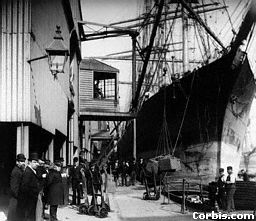
Boats in London Docks c1890
"Of the passengers some were young women wearing shawls on their heads and clad in soiled, faded and torn refinery. Some were men, young or middle-aged, but so enfeebled and spiritless that one might have fixed their age at nearer 70 than 30. A few were old women, bent emaciated and almost lifeless."
An article in the East London Reporter on the passengers disembarking in 1891 at Irongate Stairs..
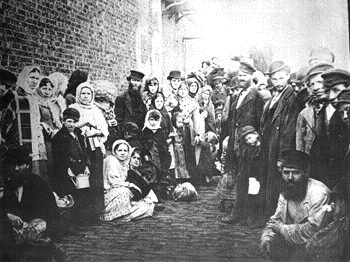
Russain refugees, photographed in the port of Liverpool in May 1882
Perhaps Daniel and his family knew someone who had already 'come over' for they did find a place to live, at 9 Jewson's Court in Sandy's Row.
Insert here the bit from the natualisatoin papers where it says where they lived.
THEIR LIFE IN LONDON
Jewsons Court, Sandy' Row
Daniel and Hannah and their children lived in Jewsons Court in Sandys Row for five years.With Whitechapel High St at one end, Sandys Row merges into Artillery Lane at the other. In fact what is now the Sandys Row Synagogue was formerly the Artillery Lane Chapel.
This photograph shows Artillery Lane at around the time Daniel. Hannah, Abraham and Hyman arrived there.
Jewsons court no longer appears on London maps, but by looking at the turn of the century taxation maps for London we can see that the closest existing location is now called Strype St.
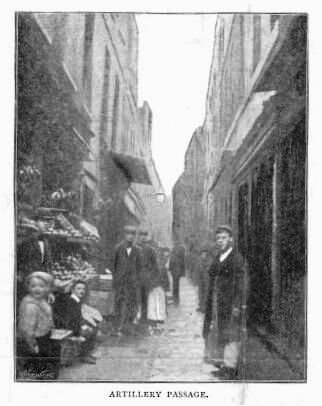
Artillery Passage ca1891
They are not listed as living there in the 1891 census which was taken on the 10th of April. Either they arrived later that month, or, like some other immigrants, they do not appear because they either did not understand or avoided the census
We do know from the census that when they arrived at 9 Jewson Court it was already home to five families. Of the eighteen people living there eight were adults, all of them born in Russia or Poland. Their listed occupations give some idea of the kind of community it was . There was: a tailor, a tailoress, a hawker, a furrier, a greengrocer, and a glazier. Of the ten children living there, all but two were born in London.
It seems from this article published in 1889 that Sandys Row was the 'humble' end of Middlesex street:
'For Petticoat Lane isn't Petticoat Lane at all, but Middlesex Street, and, this afternoon, as the dusk comes, it is very quiet, and has actually most responsible-looking offices and warehouses all along the right-hand side of its clean and regular width�But long may Sandy's Row remain for the benefit of the disappointed pilgrim to Petticoat Lane. Why the other end of Middlesex Street is called Sandys Row we cannot imagine, unless the sprouting respectability of the former disdains association with the humble grime of the latter. For where Middlesex Street dwindles into Sandys Row, the pavement is narrow and often encroached upon by the stock of the shops, and the intrepid explorer slips and staggers on the foul, greasy slime which carpets the irregular cobble-stones of the roadway'.
Arthur G. Morrison in "The Palace Journal" (April 24, 1889)
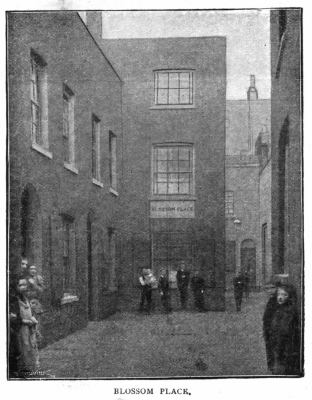
Blossom Place, circa 1890
To say the East End they lived in was crowded is an understament. It was not uncommon for a health officer to find cases such as a room ten foot square being the bedroom for six adult women (two slept under the bed).
The Rev. W. N. Davies, rector of Spitalfields, took a census of some of the alleys in his parish. He reported that :
In one alley there are 10 houses--51 rooms, nearly all about 8 feet by 9 feet--and 254 people. In six instances only do 2 people occupy one room; and in others the number varied from 3 to 9. In another court with 6 houses and 22 rooms were 84 people--again, 6, 7, 8, and 9 being the number living in one room, in several instances. In one house with 8 rooms are 45 people--one room containing 9 persons, one 8, two 7, and another 6-
Jack London 'The People of the Abyss' 1903
At the turn of the century the average population density in London was 54 people per acre. In Christ Church, the area where Daniel and Leah and their children lived in their first years in London, it was 286. In Bell Lane (when they lived there from 1896 on), it was 600.
The census returns for the small area in which they lived which included parts of Bell Lane, Raven Row and Artillary Row, Sandys Row, Fishers Row and Frying Pan Alley show nine hundred and four people living there. Interestingly there were more women than men - 512 females, and 392 men.
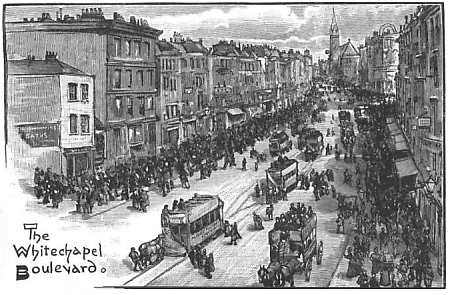
The Whitechapel Boulevard1894
Coxen Square, Bell Lane
In May 1896 the family moved to 6 Coxen Square in Bell Lane (Spitalfields).
Daniel was now thirty three, Hannah was thirty and their oldest child, Abraham was twelve. Hyman was eight. It was in that year that their first daughter- Bessie was born. Two more children were to follow , their youngest son Louis in 1898 and their youngest daughter Millie in 1907; (which means Hannah had her last child when she was 41 and Daniel was 42.)
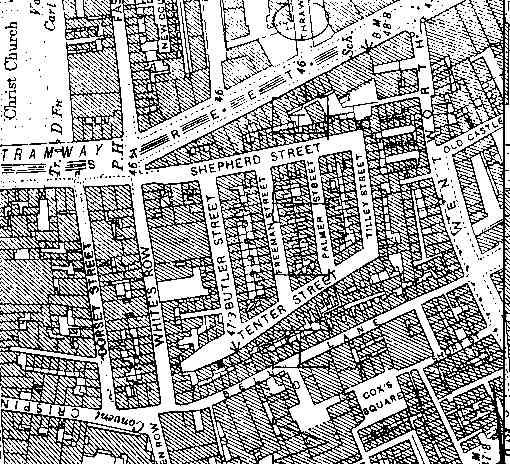
COX'S SQUARE
Cox'es (Coxen) square is near the bottom. Click to see full size.
By the time their grand children were old enough to remember visiting them they were living at Apartment 2, Wentworth buildings, 43 Wentworth St.
The original buildings have been demolished. though Toby and Sylvia have a photograph of it. Leon recalls these apartments as "the poorest of the poor, really" There were stone stairs leading to the two room apartment. At the end of the corridor there was a communal toilet. None of the apartments had baths, everyone using the communal baths. One room of the apartment was the kitchen, where they had their gas cooker, the other room was the bedroom and living room. On the landing was the scullery. Leon describes it as being scrupulously clean, and very cosy and pleasant. The beds had big thick feather filled duvets on them, and the grandchildren could lay between them, one beneath them and one above, which they describe as luxury.
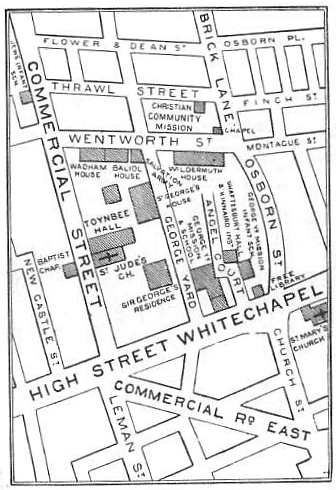
WENTWORTH ST
Click to see full size.
Still working on this section!:
Hannah's Death
Hannah lived in the Wentworth buildings until she died in May 1934, aged sixty-eight.
(IMAGE OF, LINK TO HER DEATH CERTIFICATE?)
Daniel's moves to Nottingham
During the Blitz Daniel moved to Nottingham joining Bessie there. He ermained there until he died , in her house at 1023 Goldsmith St on the 19th of April 1943, aged 80.
(IMAGE OF LINK TO HER DEATH CERTIFICATE)
His grave is at Wilford Hill Cemetery in Nottingham, grave Number 36.
Click here for more about their leaving poland and arriving in London, their working life and the Jewish community, cultural life and children's education in London. Click here to return to the index.