Daniel and Hannah Gorletski
Leaving Poland, and the Journey to London
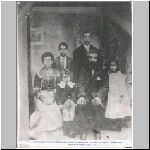
Hannah, Hyman, Louis and Betsy Photo cira 1904. Click to see full size
As far as we know only two photos of Daniel exist. This is one. The other photo is held by Doris, and in that he look less somber.
Why They Left Poland
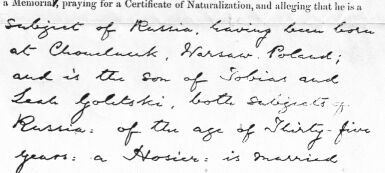
In 1835 Poland collapsed and Daniel and Hannah home town, Chmielnik, became part of the area created by Russia called the Pale of Settlements. This is why Daniel's natualisation papers describe his parents, Tobias and Leah, as 'Subjects of Russia.':
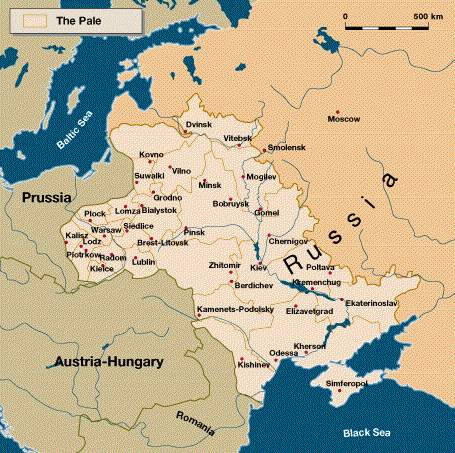
The Pale extended from the Baltic sea to the Black Seam, covered 386,100 square miles. By 1897 according to a census 4,899,300 Jews lived there, making up 11.6 percent of the population.
While the Pale was called a 'Russian Protectorate' it did anything but protect the Jews.
In fact the Pale was a place where Russian Jews were confined, barred from practicing their professions and trades, and where they came to live in increasingly harsh conditions
.In March 1881 Tsar Alexander II was assassinated, and in the months that followed there were anti-Jewish riots and soon bloody pogroms . Before the year was over more than two hundred Jewish communities were subjected to murder, arson, pillage and rape. It would only get worse in coming years, and would carry on for more than a decade. Thousands were murdered, and thousands fled in fear for their lives In the period 1881 to 1882 alone 225,000 Jewish families fled Russia.
On Peseach in 1891 there was a sudden announcement of the expulsion of the Jews from Moscow and from other towns and villages outside the Pale.
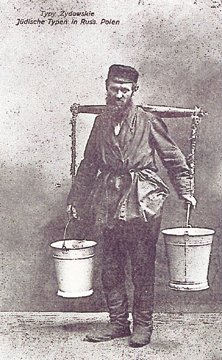
A water carrier. Most cities in the Pale had no other form of water distribution than by water carrier. According to the 1898 census there were still 5,378 water carriers in the Pale.
Many of these people (over 400,000) poured into the Pale. The economy suffered severely, and more and more people lived in poverty. There were also rumours that the Russian Tsar would re-introduce conscription of males into the army, and conscription meant serving in the army for twenty five years
Not surprising the numbers of Jews emmigrating that year more than doubled, and amongst those who left were Daniel and Hannah Gorlicki and their two young boys.
The Journey To London
There had been pogroms before of course, but now there was the railway, and it meant people could get out. If they had the fare they could take the trainfrom the Pale to Hamburg. Some of those who could not afford to take the train walked there, a walk that took from ten to sixteen days. From there they could get to England by boat, with four steamer leaving Hamburg each week, all bound for London.
On the boats the steerage conditions were appalling.
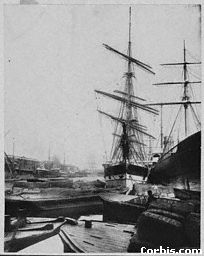
London Docks 1893
The ship themsleves resembled cattle boats with passengers herded together, sleeping on fondon.ouled rags or blankets in small spaces between decks. Everyone had to bring their own food and bedding.
Albert Gerlis says he believes Daniel came over first, Hannah and the children remaining in Chmielnik and then coming over when Daniel had set things up. This was a frequent practice amongst the immigrants, as the eye witness account on the left describes.
(In Commercial Street �) �the shipping agents and bankers are taking money for remittance to relatives abroad who are to leave the Russian Pale and come to the city paved with gold, or booking passages to America and the Colonies for the immigrants who are "moving on." From. "Off the track in London" by George R. Sims.1911
Click here for more about their new life in London, their working life, and the Jewish community, cultural life and children's education.Click here to return to the index.