Daniel and Hannah Gorletski
Community, Cultural Life and Education in London
THE JEWISH COMMUNITY
They arrived to what was already a large Jewish community.
In March 1890 the Jewish Chronicle quoted Samuel Montagu as saying there were 58,000 Jews in East London, with 30.000 of them in Whitechapel; ten years later it would be three times as large. This was in an area of around two square miles.
With this concentration of Jews the name for Frying Pan Alley was very appropriate: with so many people frying fish there were times when whole streets in the East End were half hidden from view in the smoke from cooking oil.
Leon describes Daniel as a very religious man, a man who went to synagogue twice a day.
When I visited the site of Jewsons Court I was surprised to see the Sandys Row Synagogue was still there, pansies growing in the window box telling me that someone still cared for it. A sign listed then times of services and I waited until the afternoon service, when a small group of men gathered I wondered then if Daniel might have gone to services there, and showed them copies of his naturalisation papers. Of course, no one knew of him, but I wondered if in the synagogue records there still lay some mention of him. I have since found out that this synagougue served mostly the immigrant Dutch Jews.
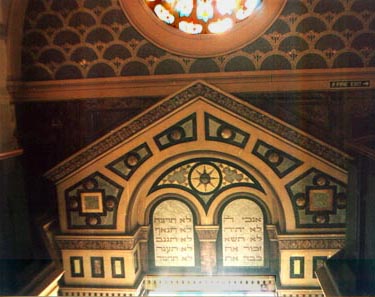
Interior of the East London Synagogue
In fact at the turn of the century the East End had close on fourty synagogues and shtibls, (a shtibl is a room in a private house where services are held) Many of the shtibls were formed by people from particular locations or pofessions (landsleit). Some names of the 21 members of the Federation of Minor Synagougues formed in 1887 : Bikkur Cholim Sons of Lodz, Sandy's Row, Polish, Love and Kindness, United Brethren of Konia.
THE CHILDREN'S EDUCATION
The family lived one block away from the Jewish Free School in Bell Lane, a school which had at one time 4,300 pupils and 70 teachers, and was reputed to be the largest in the world. Today the area is desolate, the buildings boarded up, the school demolished.
Perhaps Abraham and Hyman, and later Louis Millie and Bessie attended the school .DOES ANY ONE IN THE FAMILY KNOW ANYTHING?
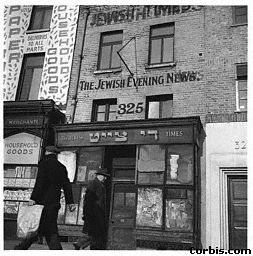
The Jewish Times Yiddish Newspaper (closed 1952)
CULTURAL LIFE
Like many in the East End Daniel and Hannah spoke little English, a sign of the times is that on of the merchants who appears in his naturalisation papers as a character reference signs his name with a 'X'.But East End Jews didn't need that much English, they made their own world, in their own language. There were pamphlets and books in Yiddish being published, and there were Yiddish dailies and weeklies.
A year after they arrived The Pavilion Theatre, the home of Yiddish theatre was opened.
Louis Behr, when 84 years old, described the scene at the Palace on a Saturday night in a interview with David Mazower:
"When Shabbas was out, that was the treat - you queued up the stairs in Vallance Road, the gallery entrance. And it was fabulous waiting, you would have an hour sometimes hour and a half wait, but it was worth it, to listen to the people queuing up. These housewives, they were the real characteristic Yiddish mommas; the whole week they slaved, there wasn't no washing machines, no refrigerators , no television, but that was their day out of it. Once a week they went, and they'd come along with packets of gefilte fish, fried fish, beigels and food - they should be nourished waiting".
And there were cheaper entertainments too...this account was published the year they arrived in the East End:
' ...the monotony of Brick Lane is quickly transformed by the bright lights and gaiety of the Whitechapel Road - 'the greatest public pleasure-ground of the East End accessible to all'.
Large music halls with broad lobbies and high stories and galleries are located there, and small hidden penny gaffs, in which there is little to see on account of the tobacco smoke and little to hear on account of the noise. ....
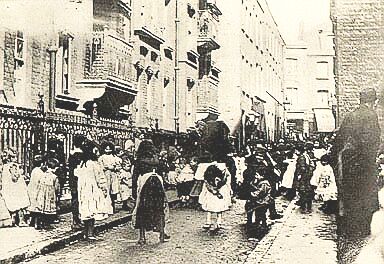
An Organ Grinder in the East End 1902
There is the medicine man with his wizard oil which cures all ills - no matter how taken, internally or externally - as well as the shooting stand, whose waving kerosene oil flames make the gaslights unnecessary. There we meet the powerful man and the mermaid, the cabinet of wax figures and the famous dog with the lion's claws - his forefeet have been split; all that is to be seen for a penny.'
J.H. Mackay The anarchists (Boston 1891)
Click here for more about their leaving poland and arriving in London, their working life. Click here to return to the index.