 Thus, phenylalanine, one eats it.
 And after does it become?
After, in the liver of the patients, phenylalanine is transformed by oxidation into tyrosin , thanks to a specific enzyme: The phenylalanine-hydroxylase which itself needs a cofactor, the t�trahydrobiopt�rine (BH4) .
It is like if in our liver, one had a small tiny workman: the enzyme, whose specific work is to cut phenylalanine of pieces. He has need for one assitant: The cofactor
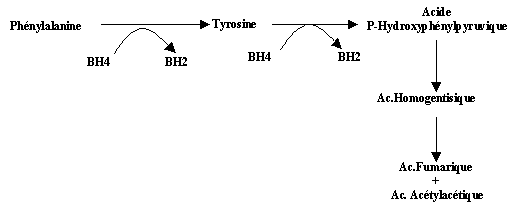
Then by transamination: one obtains acid p-hydroxyphenylpyruvic
By a continuation of transformation one leads to the formation of acetic acid hydroquinone (or ac homogentisic ).
At the end of the metabolism, one obtains fumaric acid and acetic acid ac�tyl .
All these products are used by the organization, or are eliminated by the kidneys if one does not need any.
What occurs then for the ph�nylc�tonurie?
Eh well, of the anomalies can occur in the normal metabolism of the phenylalanine whose
consequences are: appearance of serious illnesses such as: The
ph�nylc�tonurie .
Transfers producing the disease were described in gene coding the enzyme: phenylalanine-hydroxylase .
The absence of phenylalanine-hydroxylase in the liver of the patients,
involves the blocking of the transformation of tyrosin phenylalanine.
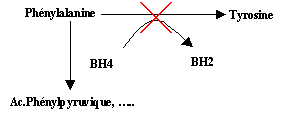
So the ph�nylanalanine is not degraded and accumulates in the blood and fabrics of the
patient, whereas a part is transformed into acid phenylpyruvic and
different catabolites:
This accumulation in the blood and the brain of phenylalanine and these derivatives is toxic for the nervous cells and involve a progressive destruction
of the brain.

