 Ph�nylc�tonurie???
It is complicated
Ph�nylc�tonurie???
It is complicated What is it this disease?
The ph�nylc�tonurie is a hereditary genetic disease transmitted by the
two parents (carrying healthy) to their child.
It comes from a disorder of the transformation of tyrosin phenylalanine . This transformation is under the control of the enzyme phenylalanine-hydroxylase
which itself needs a cofactor, the t�trahydrobiopt�rine (BH4) .
It is what this nonsense...??
Let us start with the beginning:
Our feeding is composed of 3 principal elements:
- Proteins
- The lipids (greases)
- Glucides or carbohydrates (sugars)
The proteins are in the majority of food, but particularly in great quantity in: meat , the fish , eggs , dairy
products and in certain cereals and leguminous plants such as rice,
lenses, pea, beans... etc.
A protein consists of a whole of amino acids of different types and in
different proportions, which gives an aspect and a different taste to each food.
There are many types of amino acids.
We thus eat food proteins, of origin animal or vegetable, which will be
digested , i.e. the connections which join together the amino acids to form proteins
will be broken, and the amino acids thus released will pass on the level intestine in blood circulation .
They will be used by the various bodies, for the construction tissue, the growth, or
degraded (destroyed) according to processes' various and specific to each amino acid.
L-Phenylalanine is an essential amino acid not only for the man, but
also for any alive being including the bacteria.
Like all the other acid-amino ones, it is brought by the feeding, and will be
degraded by the liver of the patients.
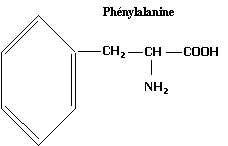 |
Phenylalanine |
There is another amino acid near to phenylalanine: |
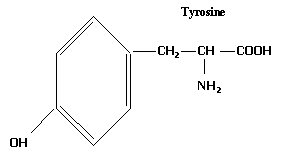 |
These two amino acids are known as ketogenetic .
Phenylalanine is essential, nonreplaceable , because our organization
cannot manufacture it, which is not the case of the tyrosin which it is essential, but
replaceable. Indeed one can obtain it thanks to phenylalanine by oxidation.
Practically all the food contains proteins and thus of phenylalanine.

