|
||||
The Story of the Ramakian
Hanuman The Evil King Totsaka Sita King Rama
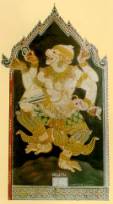
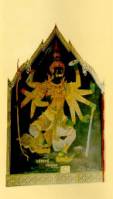
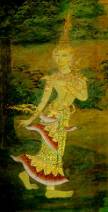
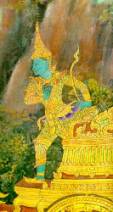
The
Ramakian is an epic poem taken from Sanskrit legend. It consists of 14
divisions, with 212 paragraphs! It is the story of Phra Rama, the rightful King of Ayuttaya, and Totsakan,
the island of Longka's evil King. This evil King abducted King Rama's beautiful
wife, Sita, and took her to Longka. Rama enlisted the help Chompupan the monkey
chief, Hanuman, a magical monkey and the monkey troops to bring word of rescue
to Sita. King Rama gave Hanuman a ring, and a piece of the Queen’s cloth as
proof that they are indeed from him.
The monkeys and their troops endured
many trials on their way to Longka, such as freeing the beautiful Busta Malee,
healing the magical bird Sampatee, fighting the powerful giant Phi Sua and
outwitting a sage. Finally, Hanuman alone reached the gardens of Longka where
Sita was kept. When he found Sita, he saw her weeping because of Totsakan, so
he turned himself into a tiny monkey so that he could spy on the evil
King. Tokosakan wanted to make Sita his
wife, but, she refused him, proving her love to Rama. However, she was so
distraught that she tried to hang herself, and Hanuman the magical monkey swung
down from a tree and stopped her. He showed her the ring and piece of cloth,
and begged her to wait for Rama, who was on his way to save her.
When King Rama and his troops
finally reached the tip of the subcontinent, they took five days to build a
bridge of stones across the sea to Longka. They crossed over to fight King
Totsakan’s army. Totsakan called forth his giant brother, and Hanuman used his
magic to grow big enough to fight this giant. However, after Hanuman won, he
found all of the men dead, including Rama. He then had to fly to a mountain to
fetch a special herb to bring Rama back to life. Rama was healed and he took an
arrow, pointed it at Totsakan and said a prayer to the sun. Totsaka saw that
goodness would always defeat evil, and just then the arrow pierced his heart.
The gates opened and Sita was finally reunited with Rama.
The Traditional Dramatic Forms of Thailand
Performing arts in Thailand take on one of six
major dramatic forms, as follows:
Khon
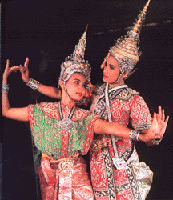
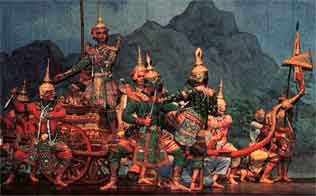
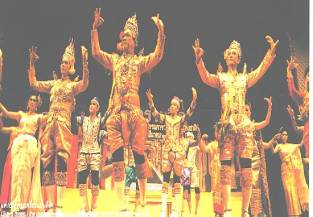
Khon is a formal, masked dance drama that was originally performed for the Royal Court of Thailand. Scenes from the Ramakian are used as the basis for the dance. There are five divisions of Khon performance.
Lakhon
Lakhon is similar to Khon, but it is a non-formal type of dance drama that also uses scenes from the Ramakian. Thai folk tales are also used for storyline, but masks are not worn. Lakhon is divided into four types.
Likhe
Likhe is a colourful misture of Thai comedy,
melodrama, folk music and dance. It is usually performed by traveling troupes
of performers and has outrageous costumes.
Manohra
Manohra is dance drama from Sounthern Thailand and
it is mainly based on scenes from the Ramakian.
Hun Luang or Lakorn Lek
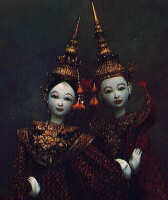
Lakhon Lek or “Little Theatre” is puppetry that was
reserved for the Royal Courts. The Hun Luang or “Royal Puppets” are made of koi
paper and ornate cloth and are very beautiful. Stories for performance were
taken from the Ramakian.
Nang Talung
Nang is Shadow Puppetry and it is very popular,
especially in Southern Thailand. The puppets are made of leather and the
characters are from the Ramakian. There are four types of Nang.
|
Khon There are 5 types of Khon performance; Klang
Paleng, Nung Rao, Rong Nai, Na Chor and Chak, and all of them are based on
the Ramakian. They differ in that some are performed inside, some in the
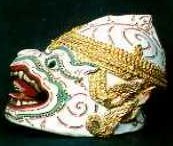
open-air, and some have different types of stages and scenery. Scenes from the Ramakian are performed in the
Khon masked dance. Khon performances have five types of masks, humans,
celestial, animal, monkey, and demon, but all of the performers are male.
Recently, women have been allowed to perform. There is much singing and
dancing in a Khon performance, however, the singing must be done offstage by
a chorus because the actors cannot sing with their masks on! The singers are
provided with music played by an elaborate orchestra called a “piphat”. Traditionally, Khon dramas were performed at the
Royal Court for special occasions, such as births, and weddings, but today,
they are staged for the public.
Lakhon
Dancers Likhe Likhe is a folk theatre that contains several
elements, such as lively dance, colourful costumes, mime, folk music, social
satire and slapstick comedy. It is performed at local festivals, and uses a
lot of improvisation, jokes and double meanings to get the audience involved
in a light-hearted way. Likhe is therefore very casual and “folk” oriented.
It usually begins with an introduction called the “awk khaek”, wherein an
actor narrates a summary of the story: a prince travels in search of the
woman of his dreams and a friend to help him in his duels always accompanies
him. This same basic plot is always followed,
and it is based upon the Ramakian. However, the characters are exaggerated
and specific references to the local area where it is performed are made.
Hun Luang Puppets and
Lakorn Lek Theatre Lakorn Lek theatre was performed in the Royal
Court of Thailand, usually at funerals. The storylines were based upon the
Ramakian along with some other Thai epics that are lesser known. The Hun Luang puppets are very beautiful and
rare and they are placed on display in museums. They are marionettes that are
about one meter high, with approximately eleven strings to manipulate them.
The heads are made either from wood painted with gold details, for important
characters, or from paper, for less important characters. The puppets’
costumes are very elaborate and beaded and are based upon the costumes of the
Khon dancers. The movement they use is very slow and rhythmical, and it is
very difficult to manipulate them. In fact, it took several people to move
and narrate them, and these days, no one knows how to do this properly.
Therefore, Lakorn Lek is no longer performed. |
Khon Masks and Mural Lakhon Lakhon is quite similar to Khon, in that it
involves singing and dancing. However, it is a less formal type of
presentation and the performers do not wear masks. There are three major
divisions of Lakhon; Lakhon Chatri, Lakhon Nok and Lakhon Nai. . Lakhon Chatri
is performed at Thai shrines and it can often be seen in Bangkok, the capital
city. . Lakhon Nok is performed by men and it is filled with humour,
bawdiness and lively music and movement. Likhe drama is derived from Nok.
Lakhon Nai, by contrast, is graceful and romantic, and it is performed only
by women.
Manohra Manohra is the Southern Thai equivalent to
Likhe, and it is the oldest surviving form of Thai dance drama. The
performers use contemporary, rhymed words and comments. The regular
performers even compete at local festivals to see who can rhyme the most.
Like Likhe, “Nora” as it is called, also uses the plot structure of the
Ramakian. A local Prince sets off to rescue the woman he loves, a beautiful
woman-bird princess. As she is a bird, Nora is often called the “Women’s Bird
Dance”.
Nang Talung Nang Talung,, or Shadow Puppetry, is very popular in Thailand. Shadow
puppets are performed at night, behind a screen lit by candles. It usually
falls into two basic categories, Nang Yai and Nang. Nang Yai puppets are
usually two meters high, depict a whole scene and the puppeteer has to dance
along with the puppet behind the screen. This is the formal version of shadow
puppetry. By contrast, nang are usually smaller, depict specific characters,
have moveable joints and the puppeteer sits down behind the screen to
manipulate them. Often, one puppeteer can perform the entire show. Nang is
much more casual, and like Likhe, depicts folk tales that are comedic and
lively. Political situations are also topics for nang storylines. A folk
music orchestra usually plays along with the puppets. |
Resources and References - Spirituality through Drama, Dance and
Music in Thailand
Websites
General
http://www.siam.net/thailand-travel-guide/theater_dance.html
http://www.seasite.niu.edu/Thai/literature/ramakian/khonmasksofthailand/khonkhon.htm#The%20Khon%20Masks
http://www.chiangmaihandicrafts.com/thaiculture/ThaiandLocalCulture/TheatreandDance.htm
http://www.thaifolk.com/Doc/perform2_e.htm
music &
dance
http://welcome-to.chiangmai-chiangrai.com/thaidance.htm
http://www.siamclassicaldances.com/index.html
http://www.travelthailand.com/hokstory/dance.htm
http://www.bangkok-photos.com/pages/frameme.php?page=framemein.php?page=049_ThaiDance.htm
puppets &
theatre
http://www.thaimyway.com/article/Puppet/puppet.htmlhttp://www2.accu.or.jp/paap/data/A_THA2.xml?mode=detail1
http://www.nationmultimedia.com/thelink/index_oct9.html
Thailand Conclusion, Activities and Exit Questions
Conclusion
As you can see, Thailand has a wide variety of performing arts, and they all incorporate dance, music and colourful costumes. For centuries, and still today, almost all of the storylines used for these dramatic forms are based upon the Ramakian, the ancient, religious East Indian story. Why would an Indian story be so popular with people in Thailand? Well, during a period in history when Indian Kings and politics were popular in South East Asia, the Thais adopted the story. These Indian Kings equated themselves with the gods, and the Thai Kings wanted to use this as their model because it was noble. The tradition continues today, and the Tahi King is revered among his people.
Activities and Follow-Up Questions
1. Can you see any similarities between Thai
dramatic forms, and those that you saw in any of the other countries?
2. What is unique about Thai performing arts?
3. How can you adapt the characters of
the Ramakian to place them in a modern time and setting?
4. Using these characters, write a
modern day version of the Ramakian.
5. Create your own shadow puppets, by
cutting out paper characters, colouring them and attaching them to wooden
sticks. Use a sheet with a flashlight behind it and perform the story you wrote
in question 4.