|
||||
Japanese Music
Early
forms of Japanese music involved the drums and flute, which were used in kagura
shrine dances. Gagaku, or court music,
came from Korea and China, and was played in Japanese courts from the 6th
century on. A gagaku ensemble consists
of 16 musicians on percussion, string and reed instruments. The free-reed mouth organ, or sho, the cyndrical oboe (hichiriki), the biwa lute and the koto zither are
the most distinctive instruments of the ensemble.
During the 6th
century, additional instruments were also being used as part of Buddhist rites
and chants. Bells, gongs, wooden
clappers, plaques, percussion tubes and rattles emerged as elements of Japanese
music; many of these instruments were also used in kabuki plays. By the 17th century, the shamisen
(three-stringed lute) became popular.
It provided rhythm for kabuki and bunraku theatre.
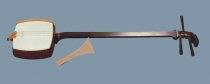
shamisen
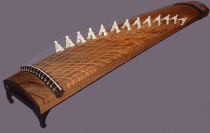
koto
The koto, which began as a member of the
gagaku ensemble also became an important solo instrument in the 17th
century as it became a part of the Ikuta and Yamada schools in the 17th
and 18th century; their solo and chamber music are considered to be
Japanese ‘classical’ music.
The taiko nailed drum has
also become a popular individual instrument in contemporary times. Concerts provide entertainment at festivals
and special events. The shakuhachi (end-blown flute) is another important
solo instrument. It was originally
developed under Zen priests with performance schools in the 16th to
19th centuries.

shakuhachi
Folk
music is another important form of Japanese music. Each region in Japan has its own folksongs, or minyo.
Such songs focus on the day to day activities of traditional life.
Japanese Theatre
|
|||||||
Noh
One of the three main
classical theatres of Japan is noh.
Dating back to the 14th century, Noh is the oldest form of
Japanese theatre, which continues to be performed in present day. Noh is performed in ancient language and
the actors use very ritualized movements.
There are approximately 260 noh plays. Noh
is a dramatic presentation, which combines poetry, dance and drama. The themes of the plays are usually
Buddhist. The primary message of Noh
theatre is that the world is one of illusion, and therefore, no one should
become too attached. The
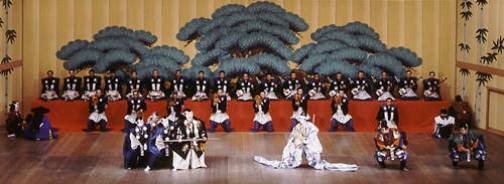
setting for a noh play is an unadorned wooden stage, except for a painted
pine tree on the back wall. The
musicians play at the rear of the stage, followed by six to eight chanters
sitting at the right of the stage. Up
to three actors perform in noh. The waki, one supporting actor, who is
usually a priest, provides the audience with an explanation of how he has
come to the theatre. The shite, primary actor, enters next,
beautifully costumed and wearing a mask.
He relays his tale to the priest, and asks to be set free from his
karma. Usually, the protagonist is plagued
by a desire to re-enter the material world.
The purpose of noh is not to entertain, but to help the audience
reconcile the acceptance of life and death. The presentation
typically contains three plays, including two kyogen plays, which are
performed in between them for comic relief.
In contrast to noh, kyogen plays are not philosophical in nature, and
they usually depict everyday people with human weaknesses. The language used is plain, with simple
costumes and lively movements.
Bunraku Puppet Theatre
The
third form of classical Japanese theatre is bunraku. Bunraku is a sophisticated puppet theatre
that was originally intended for adult audiences in the 16th
century. Bunraku
puppets are one-half to full life-size.
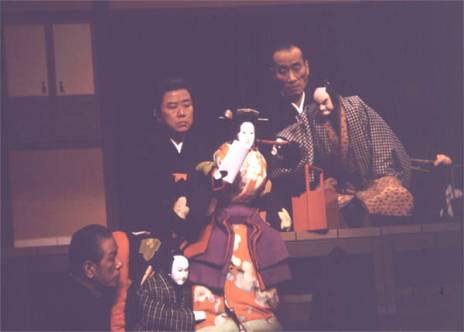
Each character is manipulated by three puppeteers who are in view of
the audience. The main puppeteer’s
face is visible to the audience and he controls the eyelids, eyeballs,
eyebrows, mouth and right arm of the puppets. The other two puppeteers appear in dark hoods; one is
responsible for moving the left arm and the other operates the legs. The puppets represent character types
rather than individuals. A
chanter, tayu, sits to the
right of the stage and acts as the voices of all of the puppets. A shamisen player provides music for the
performance. The combination of
puppets, chanter and music make bunraku a captivating dramatic experience. Bunraku was created
after kabuki, and the two forms of theatre have enjoyed popularity throughout
history. Like kabuki plays, bunraku
themes reflected Buddhist and Confucian morals. The conflict between social duties and personal desires (giri-ninjo)
was often explored through these plays. |
|
| 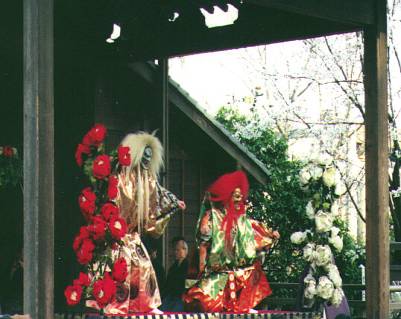 Kabuki
theatre was intended to entertain the audience. A kabuki play begins with the sound of wooden clappers. A stage curtain opens to reveal plays that
are very dramatic, with special effects.
The plays consist of a combination of dramatic dialogue, dance and music
by flutes, drums and chanting. The
type of music, which is performed, depends on the play. The actors’ costumes are also reflective
of the type of play being performed: historical or a dramatization of an
event. Themes of kabuki plays reflect
Buddhist and Confucian thought and include the idea of justice, piety and the
conflict between love and duty. Only
men perform in kabuki theatre. In the
developing years, women were banned from performing. Prostitution became an important business
of the women kabuki troupes, and men assumed the women’s roles. Kabuki
began in the early 17th century.
It became very popular by the end of the late 17th century
due to playwrights and actors who depicted heroes with superhuman
powers. Most of the kabuki
performances today still use traditional plays and costumes. The average performance lasts for five
hours, including intermissions.
|
||||
Japanese Dance
Traditional Japanese
dance is very diverse. The oldest form
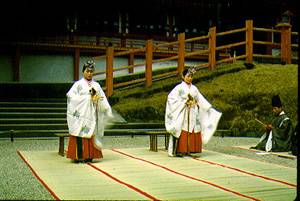
of traditional dance is kagura, or dance of the gods. Shamans
originally performed this dance, and it influenced all the Shinto dances seen
in shrines today to appease the deities.
kagura
Japanese
culture has been influenced by other Asian cultures. In the 6th century, gigaku, masked dance-drama, came to Japan from
Korea. The two-person shishimai dance
seen in gigaku led to the development of the lion dances seen in Japan
today. In the 7th and 8th
centuries, Korean and Chinese music influenced Japanese art forms; bugaku,
or court dance and gagaku, (court music) are two examples.
The dancers of bugaku wear ornate costumes and are accompanied by
gagaku. Bugaku was also performed in
temples and shrines with Buddhist ceremonial dances.
Sarugaku is an acrobatic performance, which was
used as the dance component of the court sumo festival (794-1185). Sarugaku and dengaku were originally
performed as fertility rituals, but they also played a role in the development
of noh drama.
Folk
and festival dances were typically accompanied by hayashi music (drums and
flutes).
The
development of kabuki and bunraku theatre also involved the development of
different forms of dance. Shosagoto
dances became the primary form of kabuki dance.
Glossary
bugaku – court dance
gagaku – court music
gigaku-masked dance drama
giri-ninjo - the conflict between
social duties and personal desires explored through bunraku puppet plays
hayashi – music of drums and
flutes played at festival dances
hichiriki - cyndrical oboe
kagura – dance of the gods
kyogen
plays performed in between noh plays for comic relief
minyo -japanese folk songs
sarugaku – acrobatic performance
shamisen
– three-stringed lute
shite,
primary actor in noh
sho – free-reed mouth organ
shosagoto - the primary dances of
kabuki dance
tayu
-a chanter in bunraku puppet
waki,
one supporting actor in noh who is usually a priest
Resources and References
- Japanese Spirituality through Drama, Dance and Music
Websites
www.artsci.wustl.edu/~rlneblet/noh
www.columbia.edu/cu/web/services/preservation/bunraku/bun281.htm
www.jinjapan.org.access.kabuki
home.san.rr.com/koto/instru.htm
http://jin.jcic.or.jp/museum/perform.html
aris.ss.uci.edu/rgarfias/gagaku/gagaku.html
Japanese Exit Questions
1. Choose one style of classical Japanese Theatre and design a costume that you would think would be in keeping with the theme of the play.2. Which of the Japanese instruments would you be most interested in learning more about? Are there any similarities between the traditional Japanese instruments and modern-day musical instruments?3. Japanese Dance forms are tied to tradition, folklore and meaning. Create your own dance that interprets a traditional story that you know.4. Japanese art forms have been influenced by other Asian cultures. Do you notice any similarities between Japanese performing arts and the art forms of other countries?5. List three things that impressed you most about Japanese performing arts. Explain.