|
|
||||
In India, religion is a way of life. It is an
integral part of the entire Indian tradition. For the majority of Indians,
religion permeates every aspect of life, from common-place daily chores to
education and politics. Secular India is home to Hinduism, Islam, Christianity,
Buddhism, Jainism, Sikhism and other innumerable religious traditions. Hinduism
is the dominant faith, practised by over 80% of the population. Besides Hindus,
Muslims are the most prominent religious group and are an integral part of Indian
society. In fact India has the second largest population of Muslims in the
world after Indonesia.
Common practices have crept into most religious
faiths in India and many of the festivals that mark each year with music, dance
and feasting are shared by all communities. Each has its own pilgrimage sites,
heroes, legends and even culinary specialties, mingling in a unique diversity
that is the very pulse of society.
Various devotional poets, religious mendicants,
renowned men and women of spirituality, and local holy men and women wear no
religious tags, and their teachings and lives continue to be an example to the
common realm of humanity. From the 9th century to the 16th
century, from the Deccan to the north, and from Bengal in the east to
modern-day Gujarat and Maharashtra in the West, India was swept by the fervor
of bhakti, or devotion. The songs, lyrics, and religious compositions of the
bhakti poets — Nammalvar, Jnaneshvar,
Kabir, Tulsidas, Surdas, Tukaram,
Vidyapati, Chandidasa, Mirabai,
among others — are still sung to popular and classical music alike, and
scarcely any kind of literature resonates more with Indians than do their
compositions.
For more information on the different religions,
check out the following website
http://www.indtravel.com/welcome/religion.html
Indian Music
|
|
|
Music has always occupied a central place in the
imagination of Indians. The range of musical phenomenon in India, and indeed
the rest of South Asia, extends from simple melodies, commonly encountered
among hill tribes, to what is one of the most well- developed
"systems" of classical music in the world As in dance, the nine emotions are basic to the
Indian music. The 'raga' the basic musical mode is rendering the seven
musical notes. 'Tala' binds the music altogether. With the help of tala and
shrutis the musician can create numerous variations in feelings. Basically there are two dominant styles of music in India; the South Indian Carnatic music and the North Indian Hindustani music. Through the styles are distinct, many features and underlying philosophy are the same.
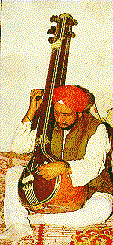
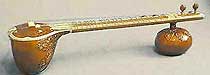
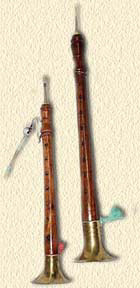
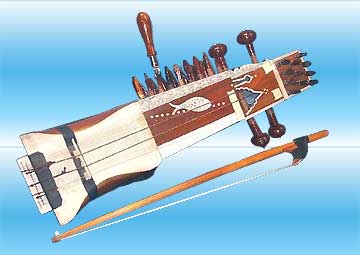
Instrumental Music In North Indian or Hindustani
music, the major stringed instrument is usually either the sitar, a long-necked fretted lute, or the sarod, a
plucked lute without frets, and with a considerably shorter neck than the sitar.
Other major stringed instruments include the sarangi, a short-necked bowed
lute, and the surbahar, which is much like the sitar except larger. Wind
instruments include the shehnai, which has no keys, and the bansuri, a bamboo
flute, blown from the side, and with six or seven holes. In a concert,
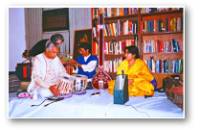
rhythmic accompaniment is provided by tabla, a pair of small drums played
with the fingers, and the drone is provided by the tanpura. In
South Indian or Carnatic music, the veena, a long- necked and fretted plucked
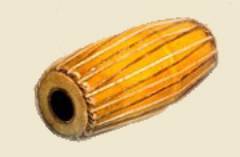
lute with seven strings is most commonly heard. Other
commonly used instruments used are: Violin , mridangam [a double-conical, two-headed
drum], Sarangi, Shehnai, Tabla In the West, the most well-known of all the instruments is undoubtedly the sitar, having been made famous by Ravi Shankar.
|
Vocal Music In South Indian Music, the composed pieces are mainly set for the
voice and have lyrics. From the mid 1700’s to the 1800’s,
3 composers dominated vocal composition: Tyagaraja, Muthuswami Dikshitar, and
Syama Sastri. Their compositions are called krti. In North Classical Music, the
most common from of singing is called Kyhal, a word which means
“imagination”. Another popular from of singing in North Classical music is
the thumri, which derives its text from devotional literature, like Radha and
Krishna. In Nortj Classical Music,
instrumental as well as vocal, the musicians are described as being
affiliated with gharanas (literally,
houses) or particular styles of music.
|


In India, dance and music pervade
all aspects of life and bring colour, joy and gaiety to a number of festivals
and ceremonies. In fact, dance and music are tied inextricably to festivity of
any kind.
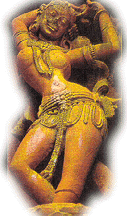
Dance in India has seeped into several other
realms like poetry, sculpture, architecture, literature, music and theatre. The
earliest evidence of dance comes from the beautiful statuette of a dancing
girl, dated around 6000 B.C. Bharata's Natya Shastra.)
is the earliest available treatise on dramaturgy. It is said that Brahma, the
Creator, created Natya, taking literature from the Rig Veda, song from the Sama
Veda, abhinaya or expression from the Yajur Veda and rasa or aesthetic experience from the Atharvana Veda.

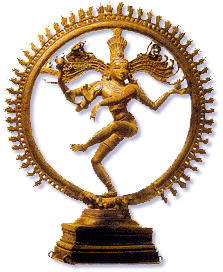
One of the most enduring symbols of India is the
figure of Nataraja
- Shiva, the King of Dancers . Shiva's cossmic dance is believed to encompass
creation, preservation, and destruction and this idea has been embedded in
Hindu thought and ritual since the dawn of civilisation. Also known as the
Ananda Tandava, this dance is a metaphor for the belief that life is
essentially a dynamic balancing of good and bad, where opposites are
interdependent. The dance of Shiva is the dance of life.
Indian dance is a blend of nritta - the rhythmic elements, nritya
- the combination of rhythm with expression and natya - the dramatic element. Nritta
is the rhythmic movement of the body in dance, pure dance. It does not express
any emotion. Nritya is usually
expressed through the eyes, hands and facial movements. Nritya combined with nritta
makes up the usual dance programmes. Nritya comprises abhinaya, depicting rasa (sentiment) and bhava (mood).To appreciate natya or dance drama, one has to
understand and appreciate Indian legends. Most Indian dances take their themes
from India's
rich mythology and folk legends. Hindu gods and goddesses like Vishnu and
Lakshmi, Rama and Sita, Krishna and Radha are all depicted in classical Indian
dances. Each dance form also draws inspiration from stories depicting the life,
ethics and beliefs of the Indian people.
All the Indian classical dance styles viz. Bharata
Natyam, Kuchipudi, Kathak, Odissi, Mohiniattam, Kathakali, Manipuri, etc., are
derived from the Natyashastra. Some of these dance styles have evolved from
folk dances and are intimately connected with the art of story telling. Most of
these stories are drawn from our epics like the Ramayana and Mahabharata, tales
from collections like the Panchatantra, Hitopadesha, Katha Sarit Sagara, etc.,
also from the subject matter of these dance styles. In fact the Kathak and
Kathakali from U.P. and Kerala respectively, derive their names from the term
Katha which in Sanskrit means a story. As the story is told in the form of
dance, these dance styles can actually be called dance-dramas, the only
difference is the absence of dialogue.
Resources and References – Indian Spirituality through
Drama, Dance and Music
http://courses.nus.edu.sg/course/ellpatke/Miscellany/music.htm
http://www.sscnet.ucla.edu/southasia/Culture/Music/instr.html
http://www.meadev.nic.in/earthquake/culture/addresses.htm
http://www.geocities.com/ResearchTriangle/Lab/9898/sudheer_contributions/finearts.html
http://www.carnatic.com/
http://www.buckinghammusic.com/tabla/tabla.html
http://www.zero-g.co.uk/index.cfm?Articleid=110
1. Choose one emotion or rasas and create several hand gestures that
express that emotion.
2. Give an example of each emotion from your own personal experience.
3. How are dance and storytelling related?
4. Describe the importance of religion in the everyday life of the
people of India.
5. Do you find any similarities between the dramatic forms of India
and the other countries you have visited?